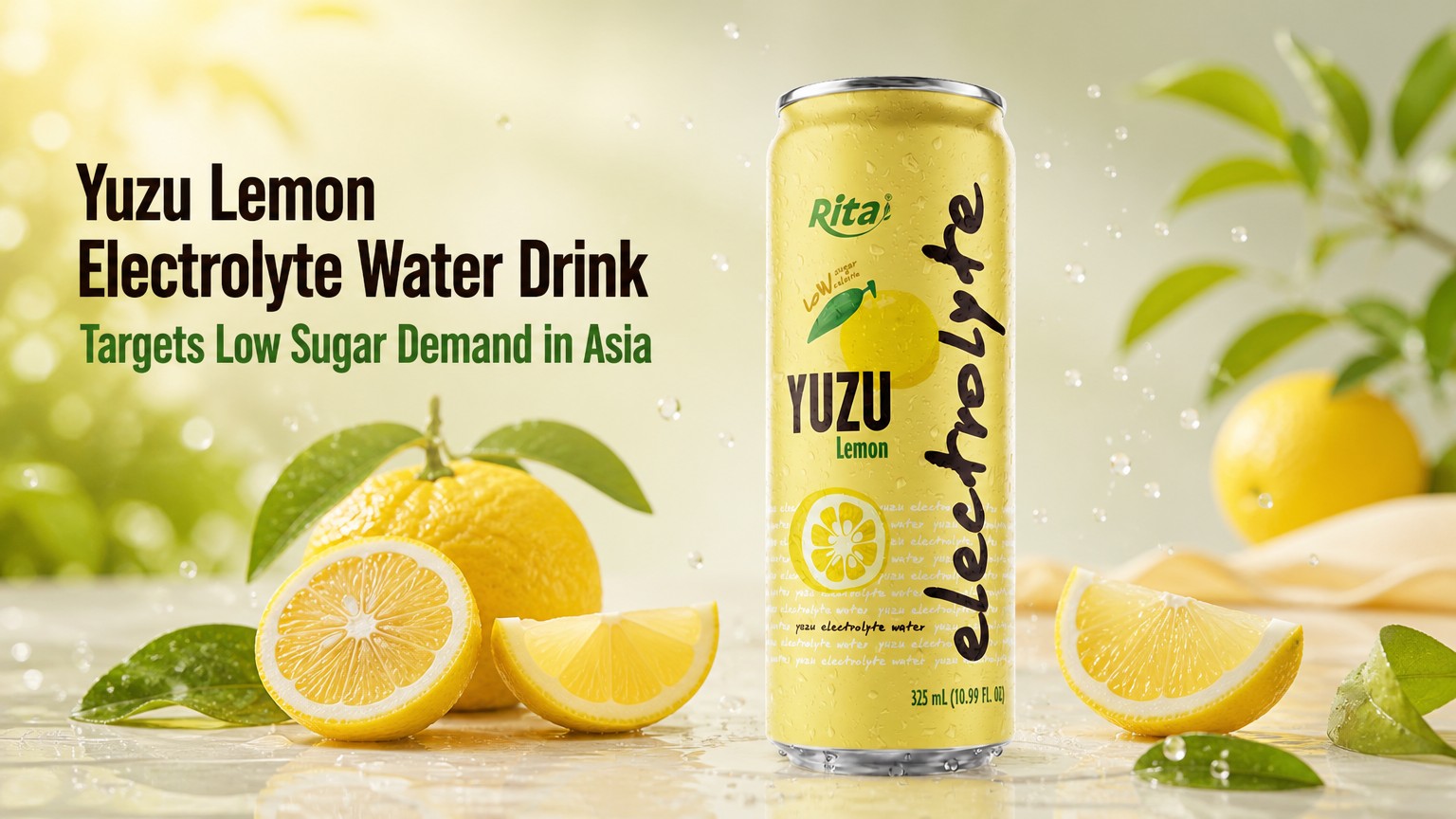
The Yuzu Lemon Electrolyte Water Drink enters the Asian beverage market at a moment when low-sugar formulation, portable packaging and category-blurring positioning are converging into a single brief for distributors. RITA Food and Drink Co., Ltd, a Vietnamese manufacturer exporting to more than 200 countries and territories, presents the 325ml Yuzu Lemon Electrolyte Water Drink as an innovation-led answer for buyers who want a refreshing everyday occasion without the sugar load of conventional sodas or the heavy sweetness of traditional sports drinks. This report examines the product itself, the reformulation wave driving demand for it, and the sourcing and private label infrastructure supporting rollout across Southeast Asia, East Asia and South Asia.
Key Takeaways
- Low-sugar reformulation is fast becoming a default requirement across Asian beverage portfolios, reinforced by sugar tax debates in Europe and excise measures already in force across the region.
- The Yuzu Lemon Electrolyte Water Drink pairs yuzu tartness with lemon in a 325ml aluminum can, formulated at roughly 26 kcal and under 5g of sugar per 100ml.
- Electrolyte and mineral formats are migrating from the sports aisle into mainstream convenience and grocery channels.
- RITA’s OEM and ODM capability, international certifications and monthly container volumes give distributors a scalable route to private label versions of the format.
- Citrus inputs for the lemon component draw on Vietnam’s established delta and highland growing belts, while the yuzu character relies on imported flavour inputs.
Low Sugar Mandates Are Reshaping Beverage Portfolios Across Asia
Sugar policy has moved from debate to draft legislation, and beverage developers are responding before the rules land.
Germany’s government has signalled support for a sugar tax plan, adding fresh momentum to a European debate that Asian executives follow closely, because excise frameworks have a habit of travelling. Once a tiered sugar levy is proven administratively in a large market, trade associations elsewhere begin modelling the same structure for local treasuries. Across Asia, sweetened beverage excise mechanisms are already familiar territory, and formulators now treat reduced sugar as a baseline specification rather than a premium feature that commands a shelf premium on its own.
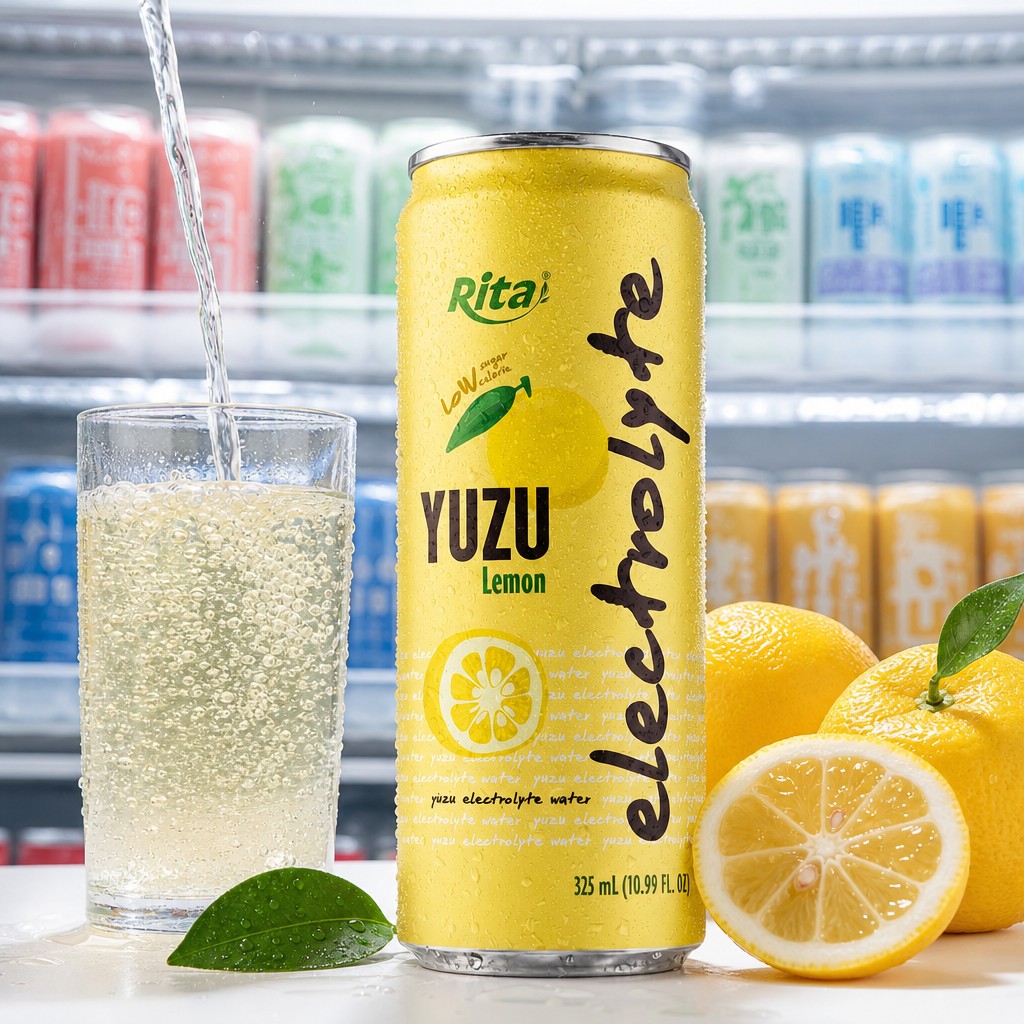 ” alt=”Low sugar hydration beverage trend shaping Asian drink portfolios”>
That shift matters commercially. Regional retailers have begun applying front-of-pack sugar indicators, shelf guidance and range reviews of their own, and buyers increasingly ask for a reduced-sugar option alongside the standard variant in any tender. A product built around a sub-5g sugar figure per 100ml therefore arrives pre-qualified for conversations that would otherwise require reformulation work before listing, shortening the path from sampling to first shipment.
Reformulation as a competitive default
The strategic question is no longer whether to reduce sugar, but how much flavour complexity can be retained while doing it. Sour and citrus-led profiles have proven resilient at lower sugar concentrations, because acidity carries much of the perception work that sweetness would normally perform. That is one practical reason yuzu and lemon pairings are appearing in more regional portfolios, from canned water ranges to tea-based extensions.
Electrolyte formats move beyond the sports aisle
Mineral and electrolyte beverages are being repositioned as everyday refreshment rather than performance-only products. The result is a shelf where a lightly flavoured electrolyte water sits comfortably beside sparkling water, flavoured water, tea and juice categories, and where buyers judge the drink on taste, format and label clarity first.
- Convenience and forecourt channels prioritise cans under 350ml for single-serve, on-the-go purchase.
- Modern trade buyers request at least one low-sugar option per hydration shelf block.
- Travel, hospitality and workplace catering are adding lightly flavoured mineral drinks to standard beverage lists.
- Private label demand is strongest where brand owners want citrus-forward profiles without high sweetness.
Inside the 325ml Yuzu Lemon Electrolyte Water Drink Can
The product is designed to read as a bright, contemporary can before it is ever tasted.
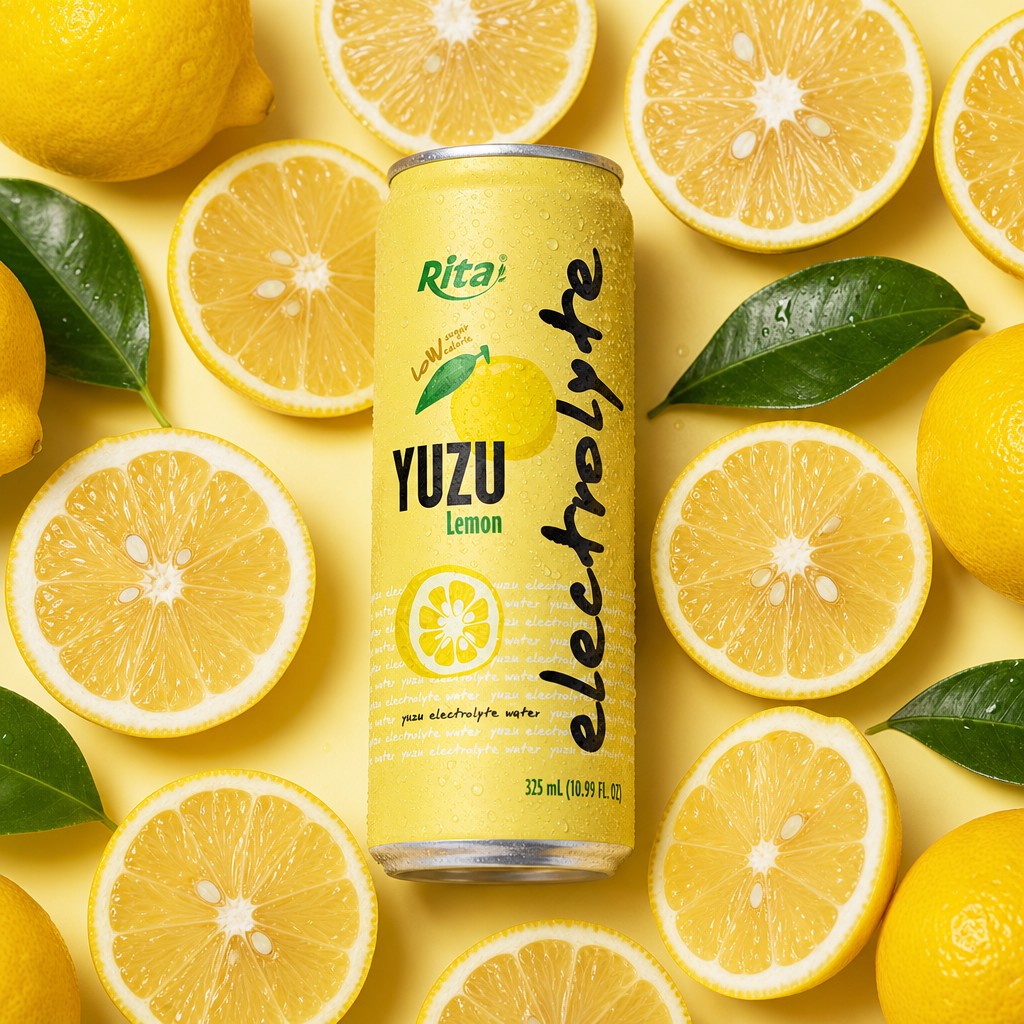 ” alt=”Yuzu Lemon Electrolyte Water Drink 325ml aluminum can product shot”>
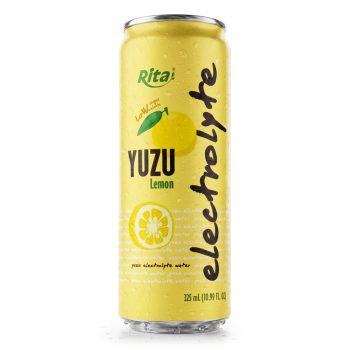
Presented in a tall 325ml aluminum can of 10.99 fl oz with a silver rim and a sunny-yellow body, the pack carries whole-fruit and leaf illustrations, a lemon slice icon and repeating background lettering that identifies the drink as yuzu electrolyte water. Condensation graphics reinforce a chilled, on-the-go consumption cue, while a green low sugar calorie statement sits close to the fruit artwork. The combination is deliberate: the can reads clearly from a cooler door, photographs cleanly for marketplace listings, and communicates its central claim within a couple of seconds of shelf contact.
On specification, the drink sits at approximately 26 kcal per 100ml with less than 5g of sugar per 100ml, and it is produced without artificial colours or preservatives. Those figures place it well below the sugar profile of standard carbonated soft drinks and beneath several mainstream sports beverages, a positioning that the full Yuzu Lemon Electrolyte Water Drink listing sets out in detail for buyers preparing tender documentation.
| Attribute | Specification |
|---|---|
| Format | 325ml aluminum can (10.99 fl oz) |
| Energy | Approximately 26 kcal per 100ml |
| Sugar | Less than 5g per 100ml |
| Flavour profile | Yuzu and lemon, citrus-led and low sweetness |
| Colours and preservatives | No artificial colours or preservatives |
| Added minerals | Electrolyte mineral blend |
| Consumption occasions | Daily refreshment, travel, warm-weather and active routines |
Flavour architecture where yuzu meets lemon
Yuzu contributes a fragrant, high-toned tartness that is less blunt than lime, while lemon supplies a familiar, clean finish that keeps the profile accessible to shoppers who have never bought a yuzu product before. The pairing is intentional: it allows a brand owner to market something new while still reassuring a mainstream buyer. For portfolio context, the format sits naturally alongside the broader soft drinks catalogue that Vietnamese manufacturers supply to regional importers.
The electrolyte mineral component is subtle by design, present enough to define the category on the label, but not so pronounced that the drink reads as a specialised rehydration solution. It is a beverage first, framed for ordinary drinking occasions rather than narrowly defined scenarios, which is what widens its addressable audience.
Packaging format and shelf presence
Aluminium was chosen for reasons that extend well beyond aesthetics. Cans chill quickly, move efficiently through tropical distribution chains, and are widely accepted by modern trade buyers from Jakarta to Tokyo. For private label partners the same body becomes a canvas, since formulation, label artwork and outer case configuration can all be adjusted to suit a market’s shelf rules and language requirements.
From Our Orchards — Citrus Sourcing Across Vietnam’s Delta Belt
Raw material traceability has become a standard question in beverage tenders, and citrus inputs are no exception.
The lemon component of the blend draws on citrus supply from Vietnam’s established growing regions, where fruit quality and consistency have been developed over decades of export-oriented agriculture. An overview of the Mekong Delta as a high-quality raw ingredients area illustrates the scale of the sourcing base that underpins citrus and tropical fruit inputs for the country’s beverage manufacturers.
The yuzu character itself relies on imported flavour inputs, a common approach for a fruit that grows primarily in East Asia, and one that gives Vietnamese producers flexibility to build a consistent citrus profile regardless of local harvest conditions or seasonal pricing.
OEM and Private Label Infrastructure for Asian Distributors
RITA positions the drink as a platform for brand owners, not only as a finished SKU.
Established in 2004, the company operates more than 50 automated production lines and ships over 1,200 containers per month, supplying brands in more than 180 countries with juice, coconut, functional, tea and canned beverage formats. That scale matters to distributors evaluating a low sugar hydration beverage for private label launch, because repeat orders, mixed-flavour containers and seasonal variants all depend on production capacity rather than marketing intent.
Development work runs in parallel with commercial planning. Research and development teams can adjust sweetness level, acidity, mineral blend and fruit ratio, then match the result to a target price band and pack format, whether that is an aluminum can, a PET bottle or an aseptic carton. For buyers building a range rather than a single item, that flexibility is often the deciding factor between suppliers.
Certifications that open shelves in Southeast Asia and beyond
Certification coverage is where export conversations usually become concrete, since importers in different markets ask for different proofs of compliance.
- BRC and FSSC 22000 for food safety management systems recognised by major retail groups.
- Halal Jakim and Halal HCA-GCC, which are decisive for distribution in Malaysia and the Gulf.
- Kosher, ISO, GMP, HACCP and SMETA covering broader customer and audit requirements.
- Export coverage reaching more than 200 countries and territories worldwide.
Buyers who want to review the wider manufacturing scope, including co-packing arrangements and pack format options, can start with the company’s OEM service overview, which sets out how briefs move from formulation brief to shipped container. The Yuzu Lemon Electrolyte Water Drink works equally well as a reference product for that process, giving a buyer a working sample of flavour, can artwork and label structure before committing to a bespoke line.
Distribution Outlook for the Yuzu Lemon Electrolyte Water Drink in Asia
Near-term demand is being shaped as much by policy calendars as by consumer taste.
The German sugar tax discussion is the clearest recent signal that fiscal pressure on sweetened drinks will remain on the industry agenda, and several Asian governments continue to review similar instruments. Alongside that, corporate developments such as Hijos de Rivera establishing a German subsidiary, suspended strike talks at a Diageo site, and ongoing asset discussions at Uncle Nearest all point to a beverage sector in active strategic motion, where buyers look for products that are already aligned with stricter label expectations.
Where the format fits in a 2025 range plan
For importers and retail groups across Thailand, Indonesia, the Philippines, Malaysia, Vietnam and Singapore, the practical case for the product rests on three points: a recognisable citrus flavour story, a can format that suits warm-climate distribution, and a sugar figure that clears most internal reformulation thresholds. In East and South Asia, the same attributes answer the questions posed by tighter labelling rules and by retailers building dedicated reduced-sugar bays. Early movers in each market tend to secure the shelf position first, which is why several distributors are evaluating samples now rather than after the next policy announcement.
Frequently Asked Questions
What is the Yuzu Lemon Electrolyte Water Drink 325ml?
It is a canned citrus beverage produced by RITA Food and Drink Co., Ltd that combines yuzu and lemon flavour with an electrolyte mineral blend in a 325ml aluminum can, positioned for everyday refreshment occasions rather than a single specialised use.
How much sugar and energy does the drink contain?
The formulation contains less than 5g of sugar per 100ml and approximately 26 kcal per 100ml, and it is produced without artificial colours or preservatives, which is the specification buyers most often cite when comparing it with standard carbonated soft drinks.
Can the formula, artwork and pack be customised for private label?
Yes. RITA offers OEM and ODM arrangements covering formulation adjustment, flavour balance, label design and pack format selection across cans, PET, PP and glass, allowing a distributor to develop a market-specific version of the format.
Which certifications support export of the product?
Production is covered by BRC, FSSC 22000, Halal Jakim, Halal HCA-GCC, Kosher, ISO, GMP, HACCP and SMETA, giving importers documentation suitable for retail onboarding in most destination markets.
Which markets does RITA supply?
The company exports to more than 200 countries and territories, with established relationships across Southeast Asia, East Asia and South Asia, supported by more than 50 automated production lines and over 1,200 containers shipped monthly.