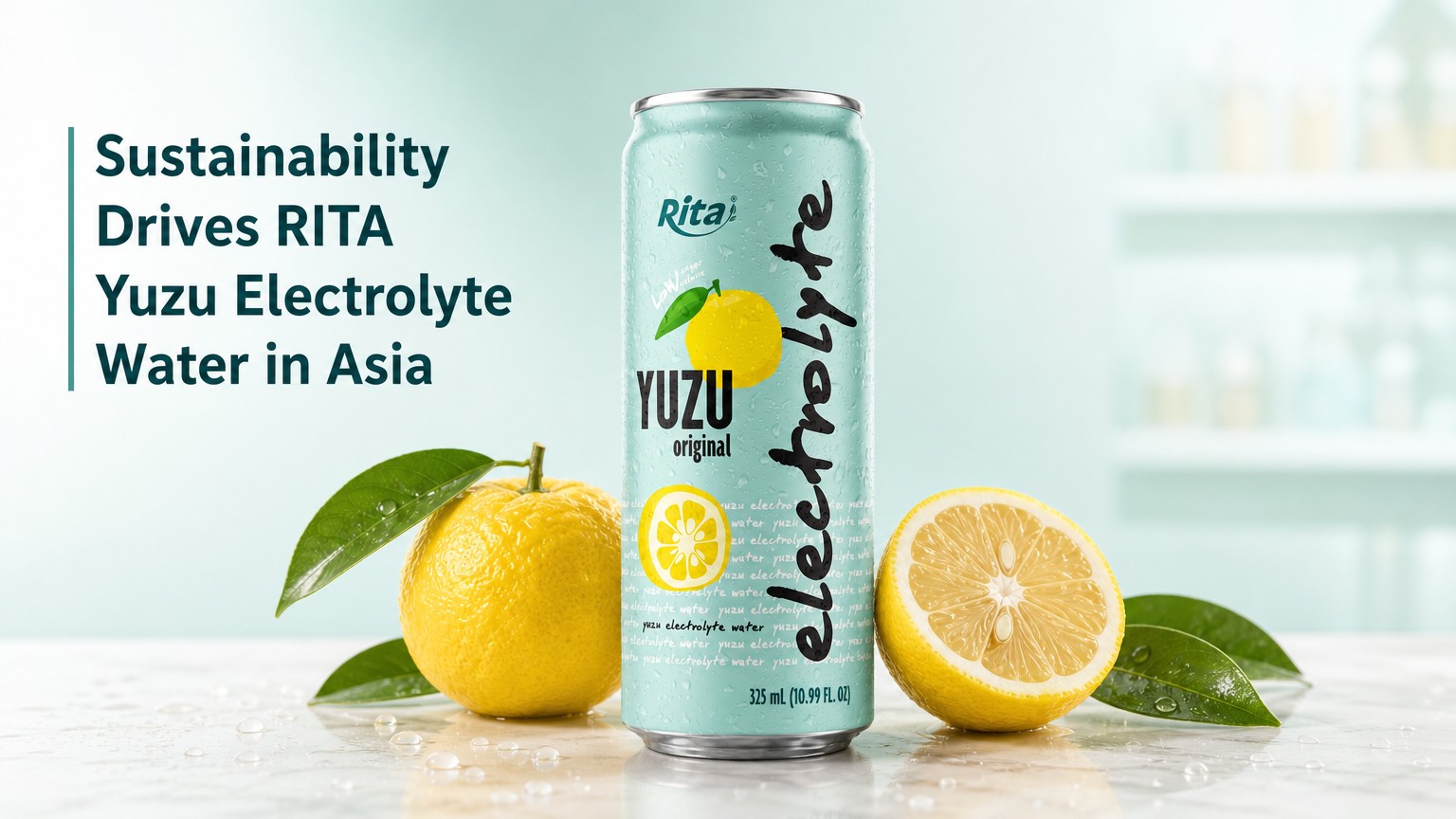
Sustainability has quietly become a procurement criterion in Asia’s beverage trade, and one of the clearest new expressions of that shift is the Yuzu Electrolyte Water Drink from Vietnamese manufacturer RITA. The 325ml low-sugar hydration beverage combines a tangy real-yuzu citrus profile with an electrolyte blend, then packages it in a slim aluminum can designed for chilled, on-the-go consumption across hot, humid markets from Bangkok to Jakarta to Manila.
What makes the product commercially interesting is not the flavour alone. It is the way a single stock-keeping unit addresses several buyer priorities at the same time: controlled sugar content, recyclable packaging, an auditable certification dossier and flexible manufacturing capacity that can absorb localisation requests without blowing out lead times.
Key Takeaways
- Sugar levies are spreading from Europe into Asia, turning low-sugar formulations into a trade-compliance asset rather than a marketing choice.
- The Yuzu Electrolyte Water Drink ships in a 325ml slim aluminum can, a substrate with established recycling streams in Japan, South Korea, Taiwan and Singapore.
- RITA runs more than 50 automated production lines and exports over 1,200 containers monthly, giving brand owners scale and schedule certainty.
- OEM and ODM services let buyers adjust formulation, sweetness and artwork for Thailand, Indonesia, the Philippines, Vietnam and other local markets.
- Productions carry BRC, FSSC 22000, Halal Jakim, Halal HCA-GCC, Kosher, ISO, GMP, HACCP and SMETA certifications.
Sugar Policy Is Turning Into a Sustainability Question
Regulators increasingly treat sugar as a fiscal and environmental issue, not only a dietary one.
In Germany, the federal government has publicly backed a sugar tax plan, adding fresh momentum to a policy conversation that has already reshaped beverage shelves in the United Kingdom, Mexico and parts of Southeast Asia. For exporters serving Europe and Asia from a single production base, one formulation now has to clear several different thresholds, and reformulation after the fact is far more expensive than designing compliance in from the start.
The commercial consequence is straightforward. Brands that move toward lower sugar early avoid costly rework later, and they can market one recipe across jurisdictions instead of maintaining parallel product lines and separate inventories. Manufacturers with in-house research and development capacity are best placed to absorb those requests without extending lead times. RITA, a Vietnamese food and beverage producer established in 2004, operates more than 50 automated production lines and ships over 1,200 containers a month into markets spanning 200+ countries and territories.
Low sugar has quietly become a routine entry requirement in export tenders.
What Buyers Now Ask For in Export Tenders
Procurement teams increasingly open tenders with a compliance checklist rather than a taste brief, and the Yuzu Electrolyte Water Drink is formulated against that structure: a low-sugar, low-calorie base, an electrolyte blend, and a label carrying no artificial flavors, colors or preservatives.
- Sugar content positioned ahead of incoming national levies
- An electrolyte blend that supports a genuine product claim rather than an aroma-level one
- A shelf-stable format compatible with ambient distribution networks
- A certification dossier spanning food safety, religious and social compliance audits
Certification is where mid-tier exporters most often fall short. RITA’s portfolio carries BRC, FSSC 22000, Halal Jakim, Halal HCA-GCC, Kosher, ISO, GMP, HACCP and SMETA, a combination that covers retail entry in Japan and South Korea, distribution through Muslim-majority markets such as Indonesia and Malaysia, and the ethical audit requirements European importers increasingly attach to purchase orders. Specification and pack details are published on the Yuzu Electrolyte Water Drink product listing.
Inside the Yuzu Electrolyte Water Drink Formulation
The recipe is deliberately narrow, and that narrowness is the commercial strategy.
RITA’s yuzu variant delivers the distinct, tangy taste of real yuzu citrus in a light body, supported by an electrolyte blend and positioned as a natural-tasting alternative both to heavily sweetened soft drinks and to flat, unflavoured water. That middle position suits consumers who want flavour without a dessert-level sugar load, and it suits retailers who need a product that sits credibly in the chilled hydration cabinet rather than in the indulgence aisle. Buyers comparing wider portfolio options can review the soft drinks manufacturing range alongside this format.
Format, Pack Size and Consumption Occasions
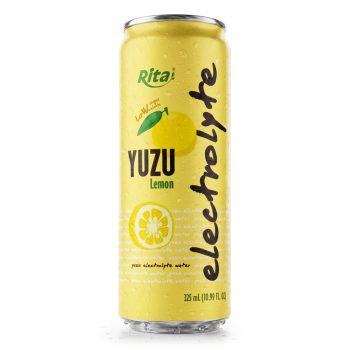
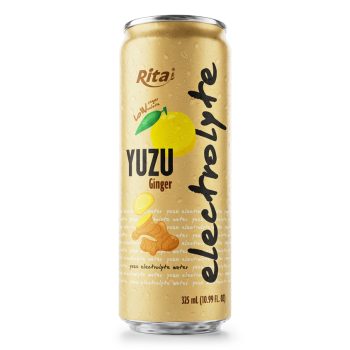
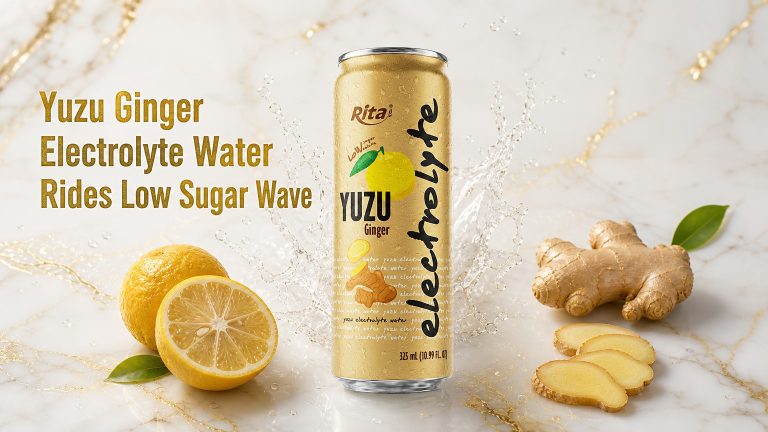
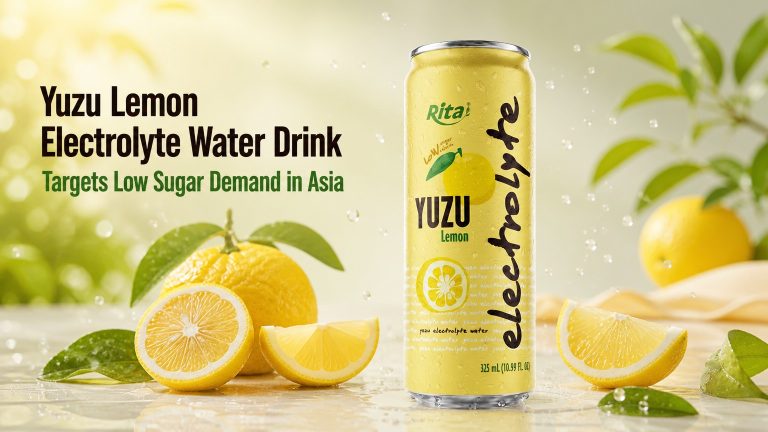
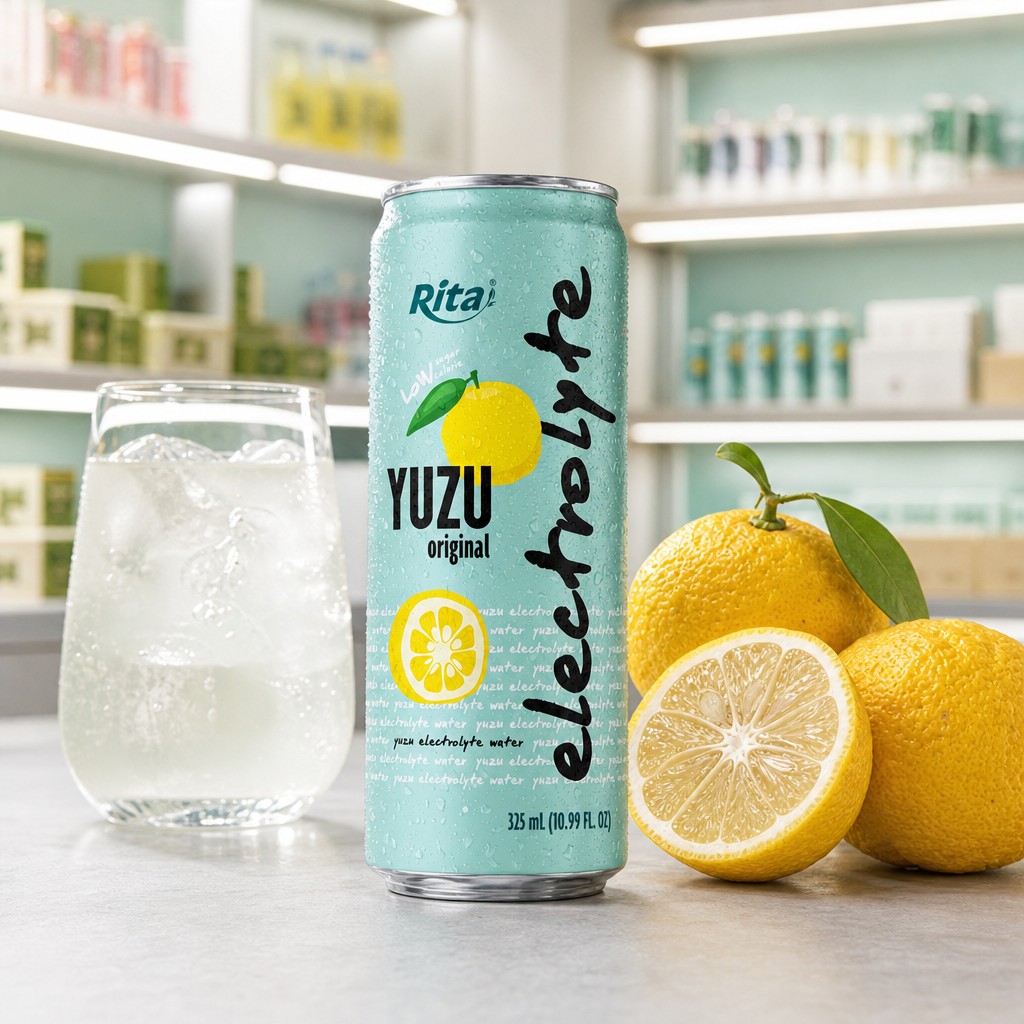
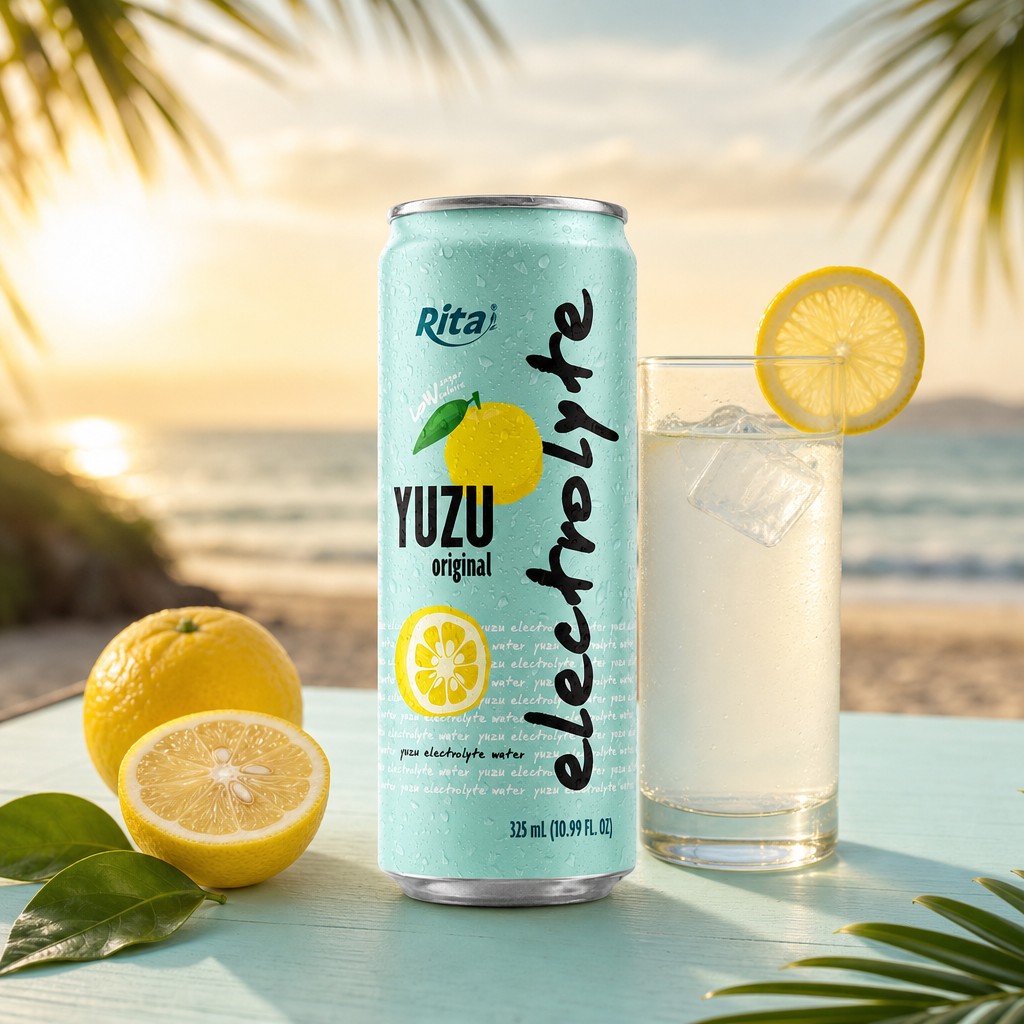
The 325ml slim aluminum can is a deliberate format choice. It fits convenience-store chilled cabinets and vending machine columns, it is sized for a single consumption occasion, and aluminium is one of the few packaging substrates with an established closed-loop recycling infrastructure across Japan, South Korea, Taiwan and Singapore. The seafoam green design, condensation imagery and fresh yuzu fruit graphics, including a whole fruit with leaf and a cut half showing the pulp, reinforce a chilled expectation before the tab is pulled.
One base recipe, many markets, and that is the logic behind the OEM model.
Because the body is clean and the sweetness level is adjustable, the same formulation can be tuned for local palates. Thai and Filipino consumers tend toward brighter acidity; Japanese and South Korean buyers often request a drier finish; Indian and Bangladeshi markets frequently prefer a sweeter profile inside the same low-sugar band. Table 1 compares the pack profile of the yuzu can with two conventional alternatives.
| Attribute | Yuzu Electrolyte Water Drink 325ml | Conventional sweetened soft drink 330ml | Flavoured water PET 500ml |
|---|---|---|---|
| Packaging substrate | Slim aluminum can | Aluminum can or PET bottle | PET bottle |
| Sugar positioning | Low sugar, low calorie | Full sugar | Low or variable |
| Added electrolyte blend | Yes | Rarely | Rarely |
| Primary consumption occasion | Chilled on-the-go hydration | Meal accompaniment | Everyday carry |
| Recycling infrastructure maturity | High in Japan, South Korea, Taiwan, Singapore | High for aluminium, moderate for PET | Moderate for PET |
Aluminum Can Recycling and Packaging Circularity in Beverage Supply Chains
Aluminum can recycling is among the most mature systems in the markets RITA exports to.
Across Japan, South Korea and Singapore, collection and remelt rates sit among the highest globally, and the metal can be recycled repeatedly without degradation of its properties. That closed loop is a concrete, auditable claim in a tender document, and it carries more weight than a general statement of environmental care. Extended producer responsibility schemes are also active or under discussion in several Asian jurisdictions, which keeps recyclability high on the agenda for both retailers and importers.
Packaging decisions also shape freight economics. Slim 325ml cans pack efficiently into export cartons and shipping containers, and aluminium’s strength-to-weight ratio tends to mean fewer damaged units on arrival than glass over long-haul tropical routes. Small gains in cube efficiency compound quickly across a monthly programme of more than 1,200 containers. Beyond cans, RITA’s packaging capability extends to glass bottles, PET and PP bottles, so buyers can match the substrate to each market’s maturity and distribution length.
For the Yuzu Electrolyte Water Drink, the label artwork carries part of the sustainable beverage packaging story too, communicating freshness and restraint on shelves where louder functional drinks compete for attention.
Where Functional Hydration Sits Across Asian Markets
Demand grows fastest where the climate and the daily commute are both demanding.
Thailand, Indonesia, the Philippines, Vietnam, India, Japan, South Korea, Taiwan and Singapore combine high ambient temperatures with long urban travel times, creating a natural consumption occasion for chilled, single-serve functional hydration drinks. Convenience store channels in Japan, South Korea and Taiwan, and modern trade formats across Southeast Asia, both allocate cold-merchandising space to products that can be consumed within minutes of purchase, a requirement that favours cans and small PET formats over large sharing bottles.
Positioning Against Adjacent Categories
Compared with sports drinks, the yuzu can offers a lighter body and a citrus-forward taste rather than heavy sweetness. Compared with flavoured water, it carries a real electrolyte blend rather than aroma alone. Compared with bottled water, it delivers flavour and a functional cue at a broadly comparable price tier in Southeast Asian convenience channels. That triangulated position is what allows a single SKU to travel into several very different markets with minimal local adaptation and minimal additional SKUs on the shelf plan.
It also gives retailers a reason to merchandise the product outside the sports nutrition fixture, in the mainstream hydration set where foot traffic is considerably higher.
RITA’s Manufacturing Platform Behind the Yuzu Electrolyte Water Drink
A strong formulation still needs a supplier able to deliver it at volume, on schedule, with the paperwork intact.
RITA Food and Drink Co., Ltd was established in 2004 and operates as an OEM beverage manufacturer based in Vietnam, serving brand owners across Asia and beyond in more than 180 countries. More than 50 automated production lines and a dedicated research and development function let the company take a brief from a buyer and return a shelf-ready product. Buyers looking for a fuller manufacturing profile can start with the company overview.
OEM and ODM flexibility is what turns a good recipe into a repeatable export programme.
For the Yuzu Electrolyte Water Drink, the OEM service model allows buyers to customise formulation, sweetness level and packaging artwork to suit local market preferences while keeping the same production process and certification scope. ODM partnerships go a step further, with RITA’s development team proposing flavour and format directions drawn from regional consumption patterns. The current 325ml low sugar hydration beverage specification works as a reference point for brands evaluating the category before committing to a private label programme.
Because the same production base handles tropical fruit juices, coconut products, functional drinks and energy drinks, quality systems, audit scope and logistics documentation are shared across the portfolio. For a brand owner onboarding a new supplier, that consolidation removes several weeks from the compliance review, usually the slowest stage of the entire process, and it reduces the RITA beverage export paperwork burden on the buyer’s own team.
Frequently Asked Questions
What is the Yuzu Electrolyte Water Drink?
It is a 325ml low-sugar, low-calorie hydration beverage produced by RITA, featuring the distinct tangy flavour of real yuzu citrus together with an electrolyte blend, packed in a slim aluminum can.
Can the formulation and packaging be customised for local markets?
Yes. Through OEM and ODM services, buyers can adjust formulation, sweetness level and packaging artwork to match preferences in Thailand, Indonesia, the Philippines, India, Japan, South Korea, Taiwan and Singapore.
Which certifications cover production of this beverage?
Production runs under BRC, FSSC 22000, Halal Jakim, Halal HCA-GCC, Kosher, ISO, GMP, HACCP and SMETA certifications, supporting retail and food service entry across multiple jurisdictions.
Why does the aluminum can matter for sustainability goals?
Aluminium has an established closed-loop recycling infrastructure in several key Asian markets, and the metal can be recycled repeatedly without loss of properties, which gives brand owners an auditable packaging claim rather than a vague one.
What is the practical starting point for a private label programme?
Brand owners typically begin with the reference formulation and pack format, then discuss container volumes, lead times, label artwork and destination-market requirements directly with RITA’s export team before confirming a production slot.