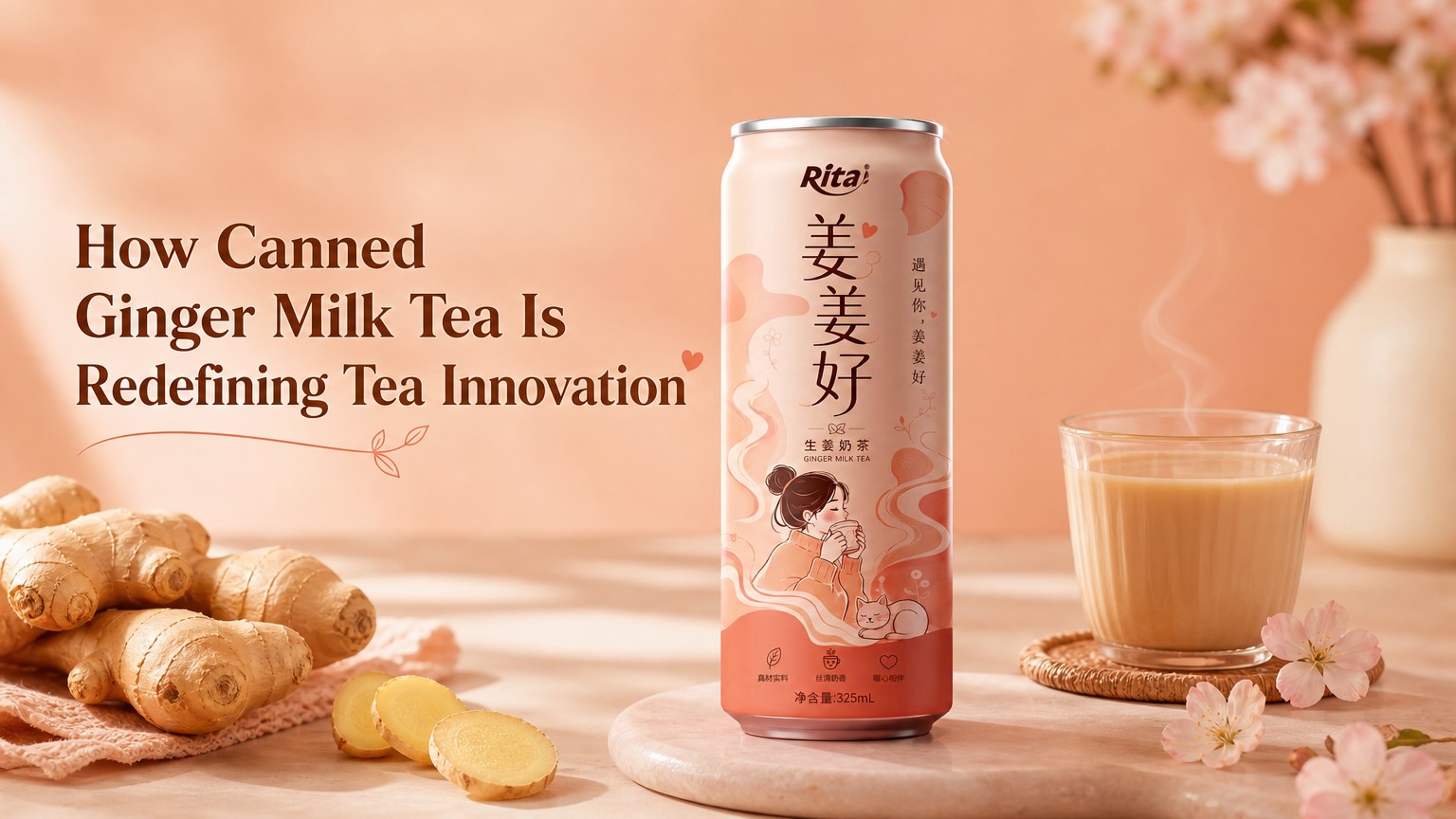
What happens when one of the world’s most familiar comfort flavors is placed inside a modern aluminum can? RITA’s ginger milk tea drink, delivered in a convenient 325ml format, is part of a broader wave of canned tea innovation aimed at consumers who want an authentic flavor experience and everyday convenience in a single serving.
Developed by RITA Food and Drink Co., Ltd., a Vietnamese OEM and ODM beverage manufacturer established in 2004, the product pairs genuine ginger with smooth milk in a formulation built around an aromatic taste profile and a creamy finish. The company operates more than 50 automated production lines and exports to over 180 countries, supplying private label and branded beverage programs across a wide portfolio that spans tropical fruit juices, coconut products, functional drinks and tea-based beverages.
What sets the innovation apart is not novelty for its own sake, but the direction the category itself is taking. Across East Asia, Southeast Asia and South Asia, canned milk tea has moved from a convenience-store afterthought to a deliberate part of the daily beverage rotation, and buyers are looking for suppliers who can match that demand with scale, consistency and certification. The 325ml canned ginger milk tea drink gives distributors and retail groups a concrete reference point for how such products are being designed today.
Key Takeaways
- RITA’s 325ml ginger milk tea drink combines real ginger and milk in a canned format built for export markets.
- The category reflects a shift toward canned tea beverages that emphasize aroma, taste authenticity and packaging that communicates warmth.
- RITA operates as a full-scale OEM/ODM manufacturer with 50+ automated lines, exporting to 180+ countries.
- International certifications including BRC, FSSC 22000, Halal Jakim, Halal HCA-GCC, Kosher, ISO, GMP, HACCP and SMETA underpin the product’s export readiness.
- Private label and custom formulation options make the product a flexible entry point for brands entering the canned milk tea segment.
Why Canned Ginger Milk Tea Is Drawing Attention in Asian Markets
Interest in canned milk tea across the Asian beverage market is no longer niche.
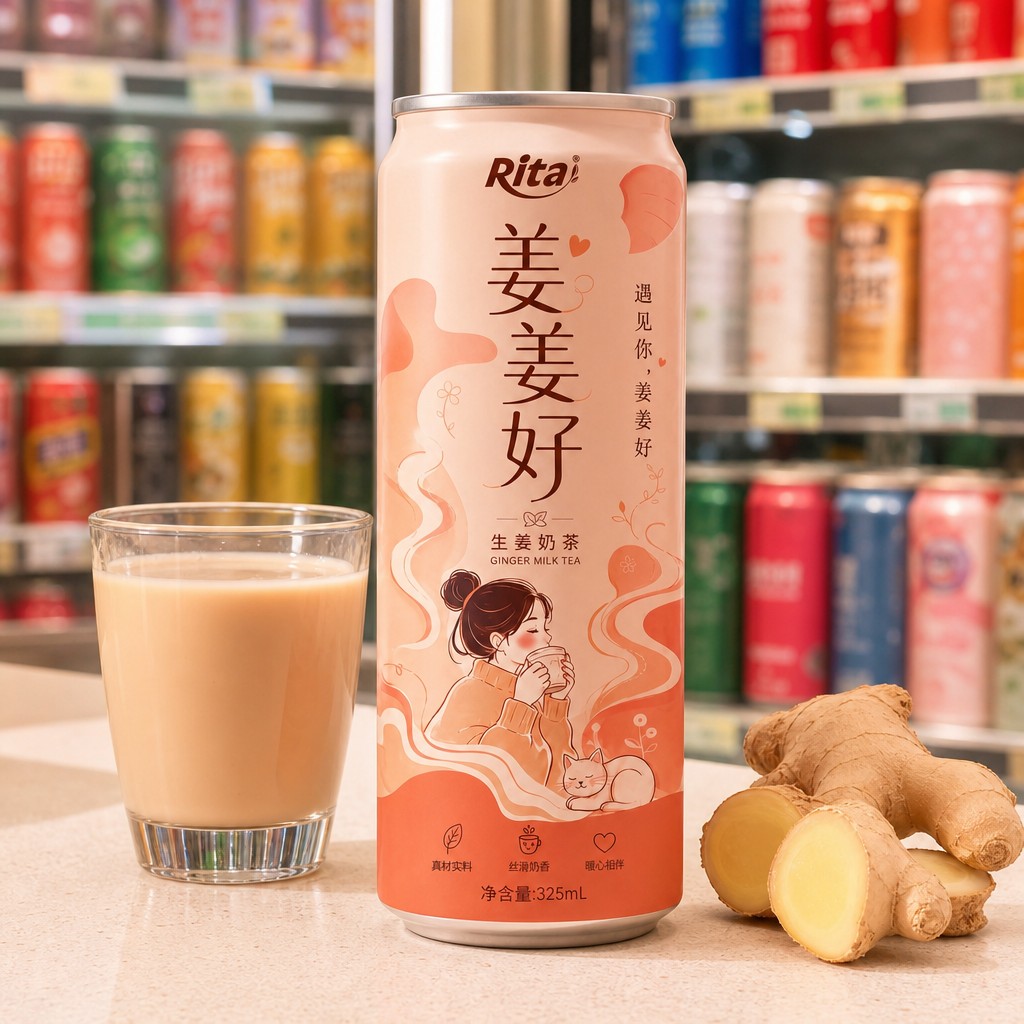
Across major consumption markets including Japan, South Korea, Taiwan, Thailand, Indonesia, the Philippines, Malaysia, Vietnam, Singapore, India, Bangladesh, Sri Lanka and Pakistan, tea-based beverages in cans have gained shelf space in convenience stores, supermarkets, foodservice outlets and e-commerce platforms. Retail buyers report that canned milk tea sits in a sweet spot: it offers the familiarity of tea and milk flavors, yet delivers the portability and extended shelf life that glass bottles struggle to match in humid, high-turnover retail environments.
For manufacturers, the commercial implication is straightforward. The format is export-friendly, the flavor architecture can be localized per market, and the aluminum can supports both ambient storage and premium shelf presentation. Products such as the 325ml ginger milk tea can illustrate how a single product concept can be repositioned for different channels, from chilled convenience displays to bulk wholesale programs.
Convenience Without Compromise
Portability is the category’s most obvious advantage, but buyers are increasingly treating it as a baseline rather than a differentiator. What distinguishes successful SKUs now is the balance between convenience and perceived quality of the drinking experience. A can that opens smoothly, chills evenly and holds a stable flavor profile over months of shelf life is evaluated differently from a product that merely ships well.
That evaluation is shaping procurement decisions. Distributors in high-volume markets increasingly specify shelf-stable formats with clear labeling, consistent fill volumes and packaging graphics that read quickly on a crowded shelf. The 325ml can format has emerged as a practical middle ground: large enough to feel like a full serving, compact enough to price accessibly in the emerging-premium tier.
Flavor Authenticity as a Differentiator
Flavor has become the category’s most contested territory. Consumers across Asian markets are familiar with milk tea from many cultural directions, and that familiarity creates both demand and expectations. Formulations built on recognizable ingredients, a clean taste curve and a genuine aroma tend to outperform heavily sweetened or heavily flavored alternatives in repeat-purchase environments.
Ginger offers a distinctive position within this landscape. Its warm, spicy aroma and layered flavor profile give the product a sensory identity that stands apart from conventional milk tea variants, while milk provides the smoothness that anchors the drinking experience. Together, they create a profile that is aromatic, creamy and approachable, and one that reads as deliberate rather than derivative. For brands considering entry into the category, that distinction matters more than it might appear on a specification sheet.
Inside the 325ml Can: Flavor Design and Packaging Language
The product’s design language signals a clear editorial direction: warmth, calm and companionship rather than energy or intensity.
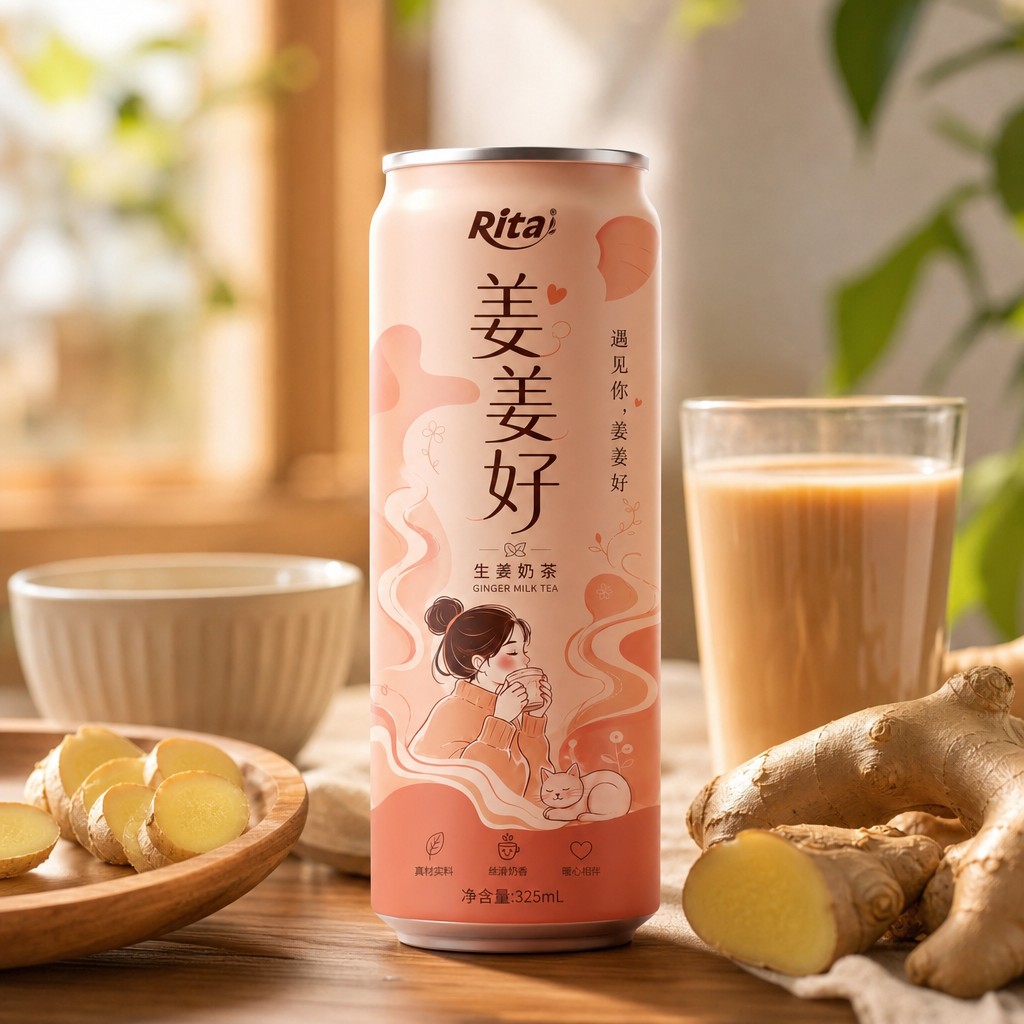
The ginger milk tea drink is presented in a 325ml aluminum can with soft peach and coral hues, accented by illustrations that evoke quiet moments and unhurried rituals. The design strategy is notable for its restraint. Instead of loud claims or aggressive functional cues, the packaging leans into mood and atmosphere, which aligns with how tea beverages are consumed and described in many of the target markets: as a pause, a small ritual, a moment of warmth rather than a performance product.
This kind of visual storytelling has become increasingly relevant for export-oriented beverage programs. In markets where shelf space is competitive and consumer attention is fragmented, packaging that communicates an experience rather than an ingredient list tends to travel well across languages and cultures. The visual language here is deliberately universal: soft gradients, steam-like curves and domestic imagery that does not require translation.
Aroma and Texture as the Selling Points
On the sensory side, the formulation is designed to deliver an authentic creamy flavor profile with a soothing aroma. The milk component provides body and smoothness, while the ginger element adds warmth and aromatic depth without overwhelming the palate. The result is a beverage that can be consumed at room temperature, chilled or lightly warmed, giving it flexibility across seasons and dayparts.
That flexibility matters commercially. A canned milk tea that performs equally well as a chilled afternoon purchase and as a warm evening option extends its addressable consumption occasions, which in turn supports broader distribution and higher-frequency stocking. RITA’s milk series portfolio reflects a similar approach, with multiple flavor directions built on the same principle of recognizable ingredients and consistent texture.
Packaging That Communicates Calm
There is a broader design trend worth noting here. Across the tea and milk beverage segment, premium positioning is increasingly expressed through softness rather than spectacle. Pastel palettes, understated typography and illustrative storytelling have become shorthand for products positioned as part of a lifestyle rather than a quick energy hit. The 325ml can design sits squarely in that trend, which is one reason the format is resonating with retail buyers evaluating next-generation SKUs.
For export buyers, packaging execution also carries practical weight. Aluminum cans support efficient palletization, robust shipping performance and a wide range of decoration options, including the detailed illustrative artwork this product uses. The format is equally suited to single-can retail listings and multi-pack programs, which adds to its versatility in regional distribution networks.
Manufacturing Capability Behind the Innovation
Innovation at scale depends on infrastructure, and this is where the beverage industry’s most meaningful competitive advantages are built.
RITA Food and Drink Co., Ltd. has operated as a beverage manufacturer and exporter since 2004, with a production base in Vietnam and export relationships spanning 200+ countries and territories. The company runs more than 50 automated production lines and ships over 1,200 containers per month, a scale that allows it to support both large branded programs and smaller private label initiatives without compromising specification accuracy.
For buyers evaluating the 325ml canned ginger milk tea drink, that scale translates into practical reassurance: repeatable flavor, reliable fill tolerances, consistent packaging quality and production capacity that can respond to promotional cycles and regional demand spikes. The company’s OEM service capability is built around exactly this kind of repeatable execution.
Certification-Backed Production
Export readiness in the beverage sector is largely defined by documentation and certification. RITA’s production programs are backed by BRC, FSSC 22000, Halal Jakim, Halal HCA-GCC, Kosher, ISO, GMP, HACCP and SMETA, a combination that supports access to a broad range of markets, including those with strict religious and quality compliance requirements.
That certification matrix is not incidental. Halal Jakim and Halal HCA-GCC approvals open distribution channels across Southeast Asia and the Gulf region, while BRC and FSSC 22000 are routinely required by international retail groups and foodservice distributors. For brands building an Asian-market portfolio, the ability to source from a single manufacturer with this documentation set reduces compliance risk and shortens onboarding timelines across multiple territories.
Private Label and Customization
One of the most significant shifts in Asian beverage sourcing is the move toward flexible private label programs. Brands, distributors and foodservice groups are increasingly asking manufacturers to do more than fill cans to a standard specification: they want flavor adaptation, packaging customization, formulation support and export documentation handled under one roof.
RITA’s advanced R&D and private label solutions are structured around that expectation. Formulation can be adjusted to local flavor preferences, packaging artwork can be reworked for different retail formats, and production can be sequenced to align with launch calendars and seasonal demand. For the tea segment specifically, this flexibility is what allows a product like the ginger milk tea can to be positioned differently in, say, a chilled convenience display versus a premium supermarket shelf.
Sourcing Strategy: Where the Flavor Comes From
Flavor credibility in a beverage program ultimately traces back to ingredient sourcing, and this is where manufacturers in Vietnam have built a meaningful competitive edge. The Mekong Delta has established itself as a high-quality raw ingredient region for RITA’s beverage programs, supplying a wide range of fruits and botanicals that feed the company’s juice, coconut, tea and functional beverage lines. [Vườn nguyên liệu Đồng bằng sông Cửu Long của RITA] illustrates the company’s sourcing model in practice, and the regional advantage extends naturally to ginger and other aromatic ingredients used in tea-based formulations.
The sourcing approach is grounded in proximity, traceability and supply consistency. Vietnam’s agricultural base, combined with Vietnam’s position as an export-oriented manufacturing hub, gives manufacturers like RITA a practical advantage: raw materials can be procured locally, quality-graded on arrival and moved into production with minimal lead time, which supports both freshness consistency and cost stability across large-volume export programs. For buyers, that translates into formulation flexibility and the confidence that seasonal variation will be managed rather than passed downstream.
Watch the Mekong Delta sourcing journey: https://www.youtube.com/watch?v=jiBixXjeG8A
Commercial Pathways and Market Entry
For distributors, retail groups and brand owners evaluating entry into the canned milk tea segment, the practical question is less about whether the category will grow and more about which format and supplier combination offers the most reliable path to shelf.
The ginger milk tea drink offers several entry advantages. The format is already established across Asian retail channels, the flavor direction is distinctive enough to support differentiation without requiring heavy education, and the packaging communicates a premium mood at an accessible price point. For brands building an initial portfolio, pairing a tea SKU with complementary offerings from the same manufacturer is a common and efficient approach. RITA’s tea, honey and fruit beverage range provides a natural extension set for programs that want to anchor around tea-based beverages.
Comparing Canned Tea Formats
| Format | Primary Appeal | Retail Fit | Export Profile |
|---|---|---|---|
| Canned milk tea | Creamy, aromatic taste; ritual positioning | Chilled cabinets, supermarkets, e-commerce | Strong ambient shelf life, efficient logistics |
| Canned coffee | Energy and familiarity | High-traffic convenience channels | Well-established global export category |
| Canned fruit tea | Light, refreshing flavor profiles | Seasonal promotions, family retail | Depends on fruit sourcing and seasonal supply |
| Canned energy drinks | Performance positioning | On-the-go and impulse channels | Regulatory scrutiny varies by market |
The comparison highlights where the canned milk tea segment fits most comfortably: it occupies a middle ground between indulgence and refreshment, which makes it less dependent on seasonal cycles than fruit tea and less category-saturated than coffee or energy formats. For suppliers, that positioning supports more consistent demand planning and more stable order volumes across the calendar year.
What Buyers Should Ask
Procurement teams entering this category typically weigh several factors in parallel. Minimum order quantities, production lead times, certification coverage by target market, packaging customization options and the manufacturer’s track record in private label delivery all influence the final sourcing decision. A supplier that can demonstrate automated capacity, multi-market certification and proven export execution reduces the number of variables a buyer has to manage.
RITA’s portfolio and production footprint position it as a reference manufacturer for programs of this kind. The company’s combination of scale, certification breadth and formulation flexibility makes it a practical partner for brands looking to move quickly from concept to shelf in competitive Asian markets, where speed of execution is often as important as the recipe itself.
Frequently Asked Questions
What is RITA’s 325ml ginger milk tea drink?
It is a canned milk tea beverage produced by RITA Food and Drink Co., Ltd. in Vietnam, combining genuine ginger with smooth milk in a 325ml aluminum can. The formulation is designed to deliver an aromatic, creamy taste profile and is produced without artificial flavors, colors or preservatives.
Which markets is the product intended for?
The product is developed for Asian beverage markets including Japan, South Korea, Taiwan, Thailand, Indonesia, the Philippines, Malaysia, Vietnam, Singapore, India, Bangladesh, Sri Lanka and Pakistan. Its packaging format and shelf-stable profile make it suitable for convenience retail, supermarkets, foodservice and e-commerce channels.
Can the product be produced under a private label?
Yes. RITA operates as an OEM and ODM manufacturer with advanced R&D and private label solutions, allowing buyers to customize formulation, packaging artwork, volume specifications and export documentation for different regional programs.
Which certifications support the product’s export readiness?
Production is backed by BRC, FSSC 22000, Halal Jakim, Halal HCA-GCC, Kosher, ISO, GMP, HACCP and SMETA, supporting access to a wide range of retail and distribution markets with strict quality and compliance requirements.
What packaging format is used?
The beverage is packed in a 325ml aluminum can featuring soft peach and coral design tones with illustrative motifs that emphasize warmth and calm. The can format supports efficient shipping, extended shelf life and a wide range of retail display options.