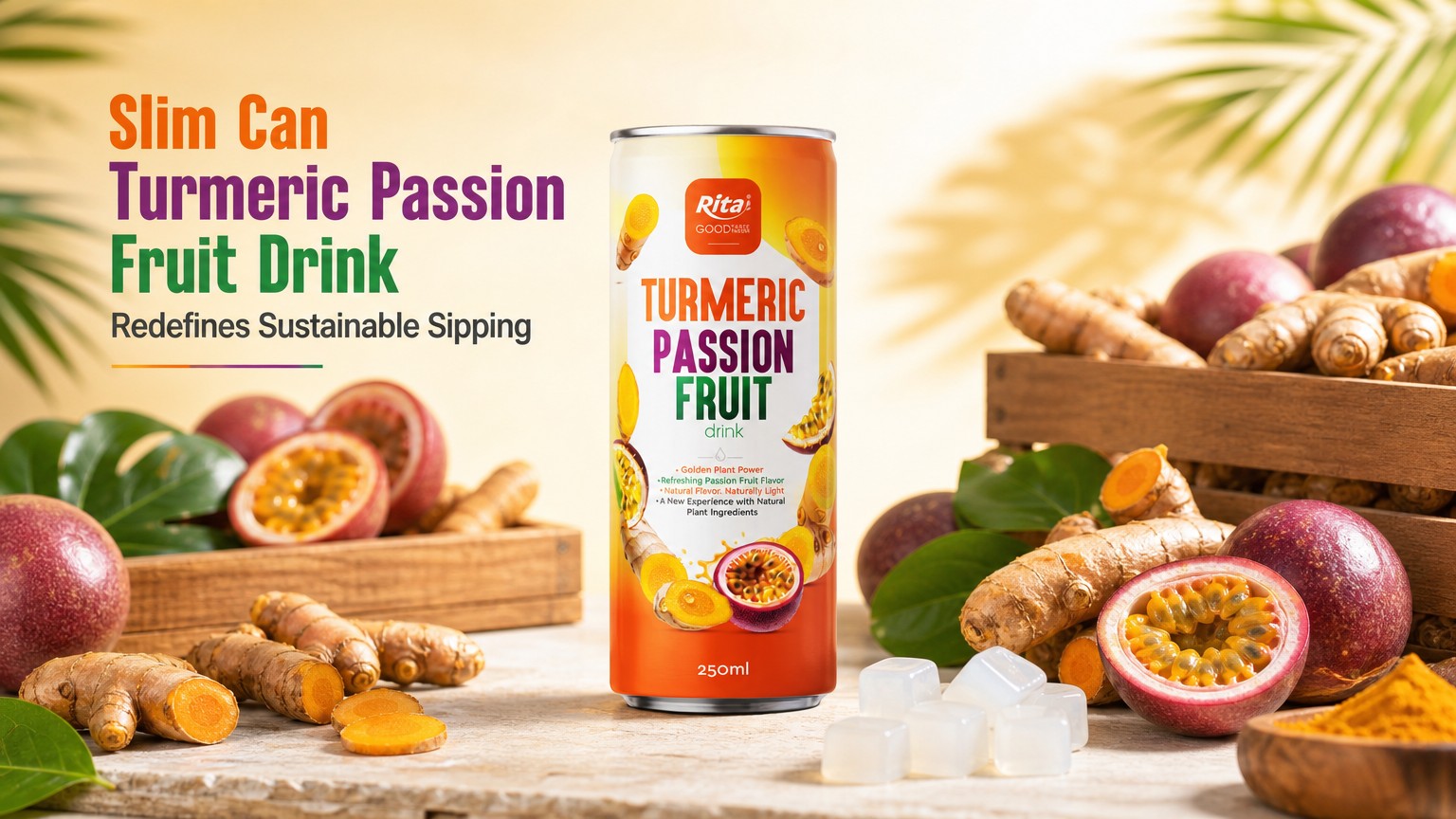
The turmeric passion fruit drink is attracting fresh interest from beverage buyers who want an unfamiliar flavor story paired with packaging and sourcing decisions they can defend to modern shoppers. RITA Food and Drink Co., Ltd, a Vietnamese OEM/ODM manufacturer established in 2004, has shaped its 250ml Turmeric Passion Fruit Drink Slim Can around that demand, combining a clean-label recipe with a recyclable metal format and short, documented supply lines. The product reflects three forces now moving in parallel across the sector: simpler ingredient lists, packaging accountability, and made-to-order production.
Key Takeaways
- The 250ml slim aluminum format answers packaging concerns while staying comfortable in hands and cup holders.
- The recipe blends turmeric extract with 10% real passion fruit juice, monk fruit sweetness and nata de coco texture at 48 kcal per can.
- Ingredients trace back to Vietnamese growing regions, including passion fruit gardens in the Central Highlands.
- RITA’s OEM/ODM model matches output to confirmed orders across export programs reaching 200+ countries and territories.
- Certifications spanning BRC, FSSC 22000, Halal, Kosher, ISO, GMP, HACCP and SMETA open doors in regulated retail channels.
Sustainability Reshapes Shelf Decisions Across Asian Beverage Markets
Across Asia, category managers now score beverages on packaging and provenance before they weigh price alone.
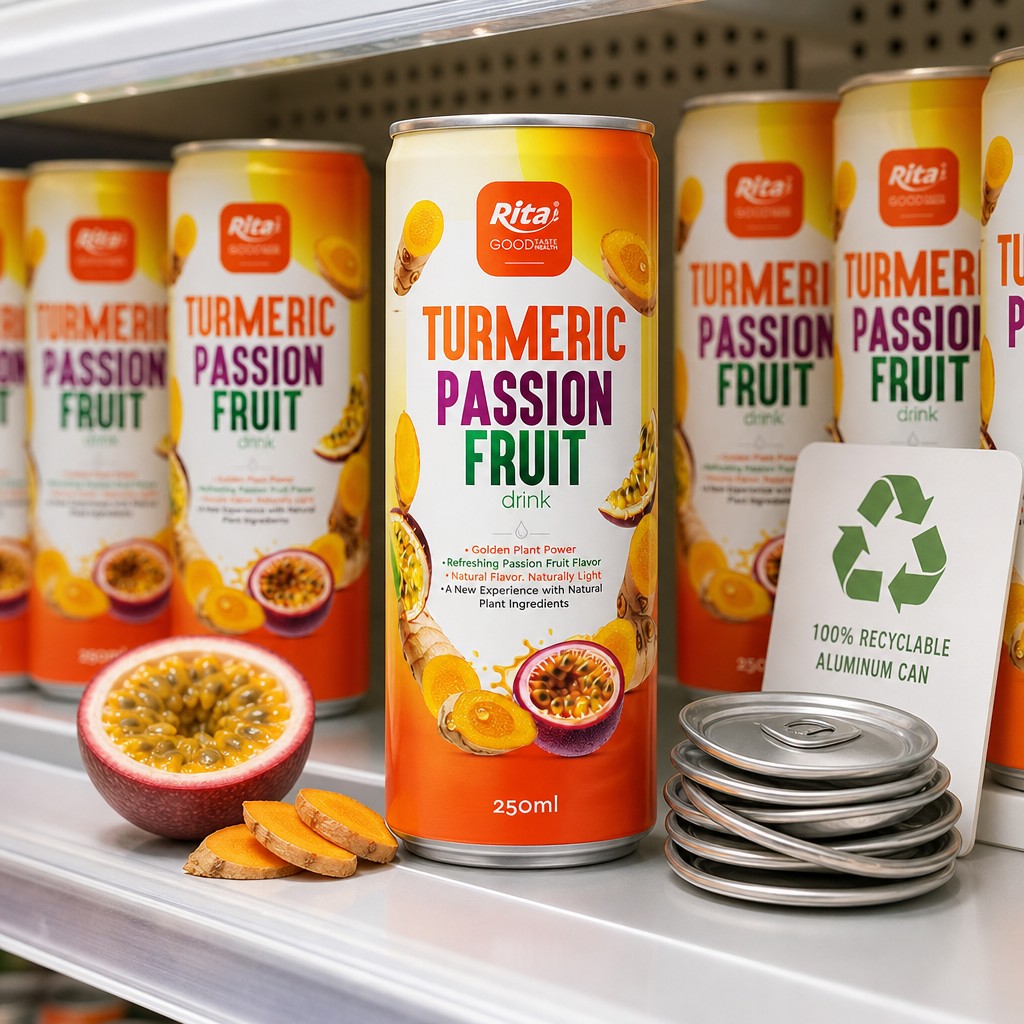
From convenience chains in Southeast Asia to premium grocery formats in East Asia and modern trade in South Asia, buying committees are adding recyclability, ingredient transparency and supply documentation to their standard evaluation sheets. A drink that ships in a slim aluminum can with a 24-month shelf life answers several of those questions inside a single SKU, because metal ranks among the most widely recycled packaging substrates and long ambient stability eases the load on refrigerated logistics.
Why the Slim Can Format Fits the Brief
The slim can is a small object carrying a large share of the beverage packaging sustainability argument.
Its narrow profile sits comfortably in the hand and in vehicle cup holders, which matters for the on-the-go consumption patterns that dominate impulse channels. The footprint also translates into denser pallet configurations, so distributors move more units per shipment and trim the transport cost attached to each individual can.
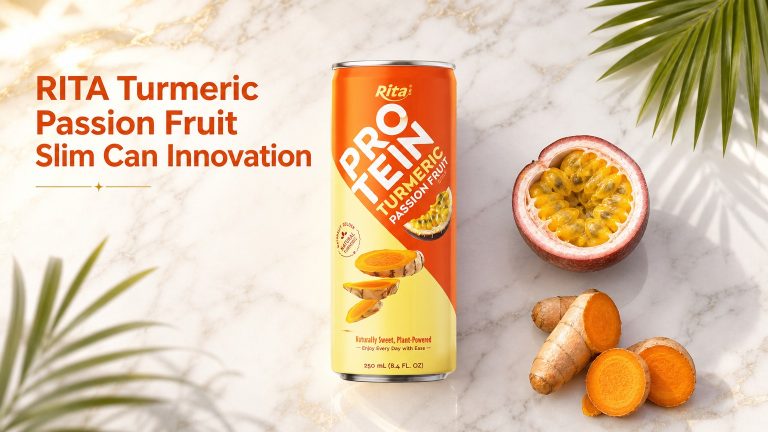
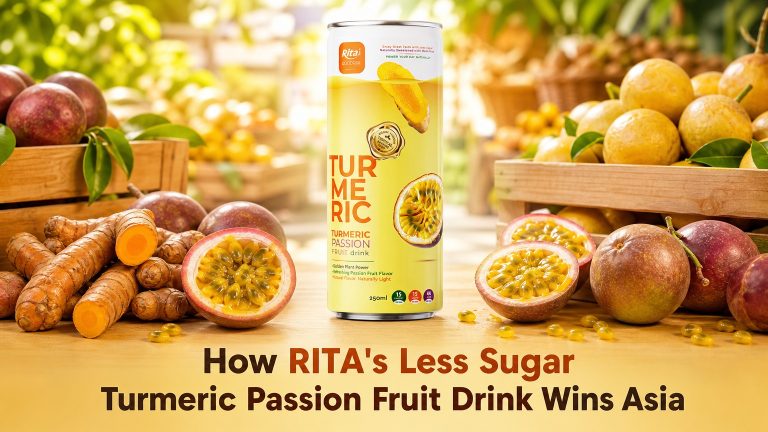
Aluminum’s recovery infrastructure is comparatively mature in many export destinations, letting the container re-enter a material stream rather than a waste stream after use. For retailers publishing packaging scorecards, that characteristic is easier to verify than a claim printed on a label, and it gives the turmeric passion fruit drink a defensible position at shelf. The same format carries vivid label artwork, with sliced turmeric root and passion fruit illustrations in orange, purple and green, without the visual distortion curved bottle surfaces can introduce.
Product Profile: Inside the 250ml Turmeric Passion Fruit Drink Slim Can
Golden turmeric extract meets 10% real passion fruit juice in a single 250ml serve.
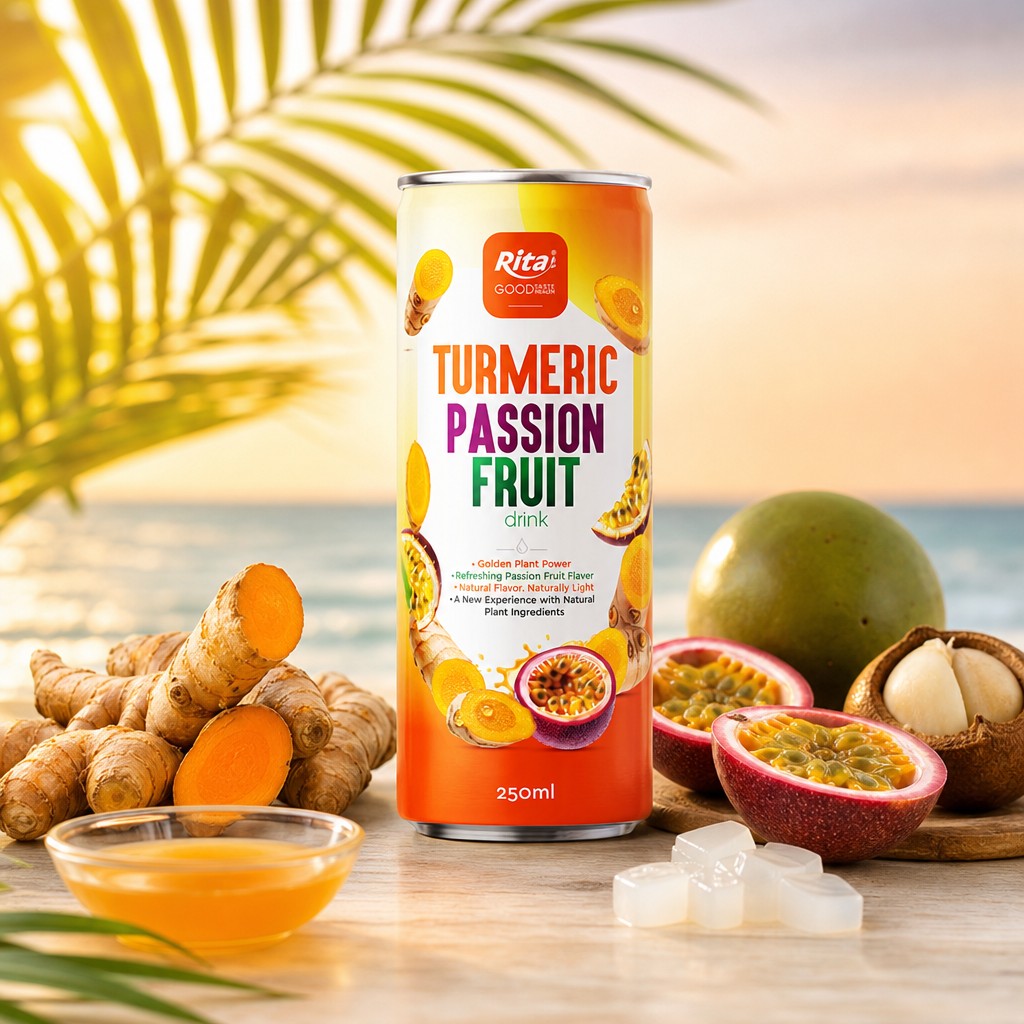
Monk fruit supplies the base of natural sweetness, while sucralose and acesulfame potassium keep the sugar profile low, and nata de coco pieces add a chewy texture that extends the experience beyond a straight liquid. The recipe carries no artificial flavors, colors or preservatives, relying instead on authentic fruit juice and a short list of recognizable inputs. At 48 kcal per can, the drink sits at the lighter end of the canned range that shoppers now compare side by side.
Flavor Architecture of the Turmeric Passion Fruit Drink
Two contrasting tropical notes, one warm and one bright, define the drink’s taste signature.
The earthy, slightly peppery character of turmeric sits against the sharp tang of passion fruit, producing a profile that reads as exotic rather than sweet-first. That balance suits markets where consumers have long encountered herb-and-fruit combinations in local beverage traditions, and it separates the product from conventional single-fruit juices competing for the same fixture. Buyers running comparative tastings can review the full 250ml Turmeric Passion Fruit Drink Slim Can specification before requesting samples.
Label Design Built for Shelf Impact
Bold typography and vivid fruit illustration handle the first selling job at the shopper’s eye level.
The label features drawings of sliced turmeric root and halved passion fruit, accented with juice splashes and scattered seeds, while orange, purple and green lettering keeps the product name legible from a distance. Bullet points on the can, referencing refreshing passion fruit flavor and a naturally light positioning, communicate the proposition in the few seconds a shopper spends in front of the fixture. The artwork translates cleanly across private label beverage variants, so a distributor can adapt the design without rebuilding the layout from scratch.
| Attribute | Detail |
|---|---|
| Net volume | 250 ml |
| Packaging | Slim aluminum can |
| Passion fruit juice content | 10% |
| Energy per can | 48 kcal |
| Sweetness sources | Monk fruit, sucralose, acesulfame potassium |
| Texture element | Nata de coco |
| Shelf life | 24 months |
| Additives | No artificial flavors, colors or preservatives |
The specification table shows how compact the formulation is, a point that matters when a retailer asks what separates this drink from a standard canned juice on the adjacent shelf. It also positions the product naturally within a broader soft drinks lineup rather than as a one-off novelty.
From Sunlit Gardens to the Can: Sourcing the Recipe
Traceability starts in the field, and the passion fruit in this drink has a documented origin.
RITA maintains direct relationships with growing areas in Vietnam, and the team records orchard conditions before fruit enters the recipe pipeline. The passion fruit component draws from gardens in the Central Highlands, where the passion fruit gardens of Vietnam’s Central Highlands are checked for ripeness and juice yield ahead of each harvest window.
Turmeric follows the same discipline, with root crops drawn from established raw-material areas including the Mekong Delta raw ingredient zone that supplies much of the company’s botanical and fruit input. Consistent sizing and pigment levels in the root determine the color and warmth of the finished drink, so incoming material is graded before it reaches blending.
Field documentation matters commercially as well as operationally. Buyers in regulated channels increasingly request origin records alongside certification files, and a named growing region shortens the due-diligence conversation during onboarding.
Footage from the sourcing visits is available for review at https://www.youtube.com/watch?v=HjYZTn8BZL4
Manufacturing Scale, Certifications and Private-Label Flexibility
Behind that single can sits a large export operation built for volume and full documentation.
RITA Food and Drink Co., Ltd runs more than 50 automated production lines and ships over 1,200 containers per month to buyers in 200+ countries and territories, a scale that holds lead times even when a private-label program ramps quickly. As an OEM ODM beverage supplier, the company places the turmeric passion fruit drink listing alongside a wider catalog covering tropical fruit juice products and canned formats built for long ambient distribution.
OEM and ODM Controls That Trim Overproduction
Made-to-order production remains the quiet sustainability lever that most beverage programs tend to overlook.
Because every run is tied to a confirmed purchase order, ingredients and packaging are committed only when demand exists, which limits the unsold stock that eventually becomes waste. For a private label beverage manufacturer entering the category, that structure also reduces the risk of committing to a recipe a local market rejects after the first shipment.
- BRC and FSSC 22000 food safety management systems
- Halal Jakim and Halal HCA-GCC approvals for Muslim-majority markets
- Kosher certification for additional retail channels
- ISO, GMP and HACCP process controls
- SMETA ethical audit coverage for brand compliance teams
The same certification file supports sampling rounds and label revisions: buyers reviewing the full OEM beverage specification can adjust sweetness level, turmeric intensity, can artwork and case configuration before production. Packaging flexibility extends across aluminum cans, glass bottles, PET and PP, so the same recipe can be repositioned for a different channel without reformulating.
Market Signals Pointing to the Next Wave
Recent moves across the beverage trade suggest the next growth pockets are forming around lighter, more flexible formats.
Boston Beer’s Jim Koch has highlighted the spirits-ade category as a hot spot for growth, a reminder that consumers keep rewarding drinks that sit between established categories rather than inside them. The turmeric and passion fruit combination belongs to that same blurring instinct, borrowing from culinary tradition while presenting itself as a straightforward refreshment.
Celsius leadership has struck a bullish tone on the US energy market and pointed to further retail expansion, while Keurig Dr Pepper heads to trial in an anti-trust case that could reshape distribution conversations. Quarter Proof’s founders are backing a mid-strength spirit called Demi on the premise that a clear gap exists between full-strength and zero-proof options. Each signal points the same way: shoppers want more choice at more points along the intensity scale, and a low sugar fruit drink at 48 kcal lands naturally in that widening middle ground.
Trade policy adds another layer to sourcing decisions. India’s investigation into bulk Scotch has prompted a trade group to argue that the probe undermines a UK-India trade agreement, a reminder that beverage flows can shift quickly when tariffs and regulations move. Importers building regional portfolios therefore favor suppliers whose documentation travels well across jurisdictions.
Against that backdrop, a Vietnamese beverage exporter with established certification coverage and monthly container volumes offers a simpler planning horizon than a patchwork of smaller suppliers. The turmeric passion fruit drink compresses several of those considerations into one SKU, and the product page collects formulation details, packaging options and ordering information for teams evaluating their next launch. Development teams can also align sweetness and turmeric intensity to local preference before sampling rounds begin.
Frequently Asked Questions
What ingredients define the turmeric passion fruit drink?
The turmeric passion fruit drink combines golden turmeric extract with 10% real passion fruit juice, sweetened with monk fruit alongside sucralose and acesulfame potassium, and finished with nata de coco pieces for texture. It contains no artificial flavors, colors or preservatives and comes in at 48 kcal per 250ml can.
Why does the product use a 250ml slim can?
The 250ml slim can beverage format keeps the serve portable, fits standard cup holders and allows denser pallet loading for exporters. Aluminum also benefits from established recovery infrastructure in many destination markets.
Can RITA adjust the recipe and label for private-label programs?
Yes. OEM and ODM services cover sweetness level, turmeric intensity, label artwork and case configuration, and packaging can be produced in aluminum cans, glass bottles, PET or PP depending on the channel strategy.
Which certifications support export of this beverage?
The manufacturing base holds BRC, FSSC 22000, Halal Jakim, Halal HCA-GCC, Kosher, ISO, GMP, HACCP and SMETA coverage, giving importers a consolidated documentation file for retailer onboarding.
How does sourcing support a sustainability positioning?
Ingredients are traced to named Vietnamese growing regions, including Central Highlands passion fruit gardens and Mekong Delta raw material areas, while made-to-order production ties ingredient and can purchases to confirmed demand rather than speculative stock.