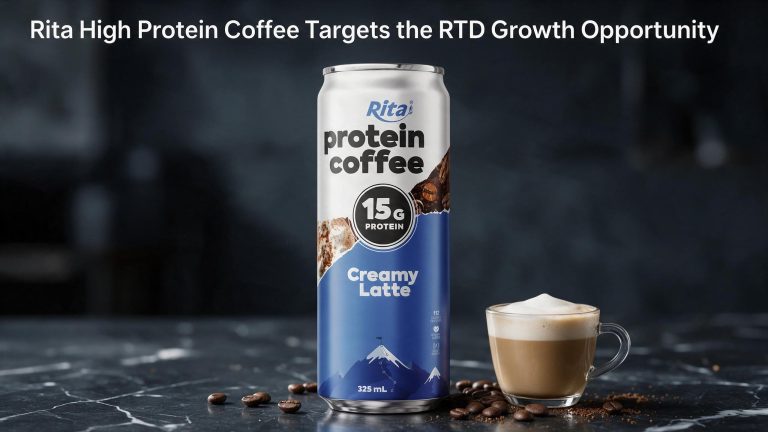
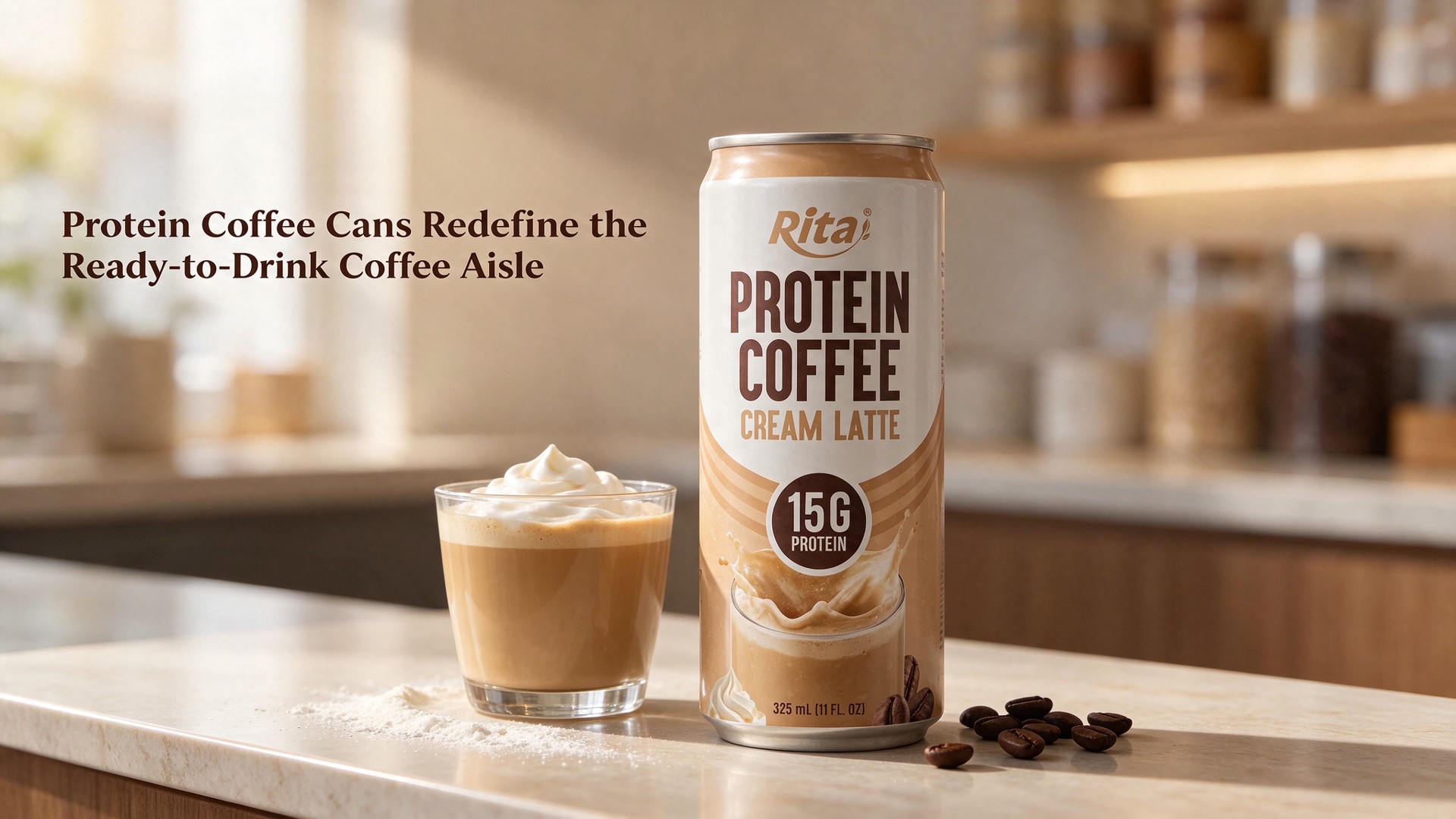
The ready-to-drink coffee aisle is absorbing a wave of protein-forward formulations, and RITA Cream Latte Protein Coffee is one of the clearest expressions of the shift. Each 325ml slim aluminum can carries 15 g of protein behind a smooth, layered latte flavor, built for shoppers who want cafe-style taste in a portable format. Across Southeast Asia, East Asia, and South Asia, buying patterns are moving toward canned drinks that state their numbers plainly, and coffee is where that change shows first.
Key Takeaways
- Protein coffee now operates as a distinct sub-category inside ready-to-drink coffee, with 15 g of protein displayed on a front-of-pack badge.
- The Cream Latte variant sits in a three-flavor range alongside Vanilla and Mocha, each using color-coded packaging for fast shelf identification.
- Declared values per 100 ml are 5.8 g protein, 1.9 g total fat and 4 g total carbohydrates, with 19 mg caffeine.
- A 24-month shelf life under cool, dry storage supports container shipping and long-distance retail distribution.
- RITA Food and Drink Co., Ltd. operates 50+ automated production lines and holds BRC, FSSC 22000, ISO, GMP, HACCP and Halal Jakim approvals.
Protein Coffee Momentum Builds Across Asian Markets
Protein coffee has moved from novelty to a standard retail listing in barely two product cycles. Across the region it now sits beside traditional canned lattes rather than behind them.
Regional context explains the speed. Consumers in Thailand, Indonesia, the Philippines, Malaysia, Vietnam, Singapore, Japan, South Korea, Taiwan, India, Bangladesh, Sri Lanka and Pakistan already buy canned and bottled coffee as routine purchases from convenience stores, office fridges, vending machines and transit retail. What a protein coffee can changes is the comparison set: shoppers weigh declared protein grams and caffeine per 100 ml alongside roast strength and sweetness. That shift rewards manufacturers who publish exact figures instead of vague descriptors, and it has pulled nutrition labelling into the centre of category marketing for wellness-oriented buyers.
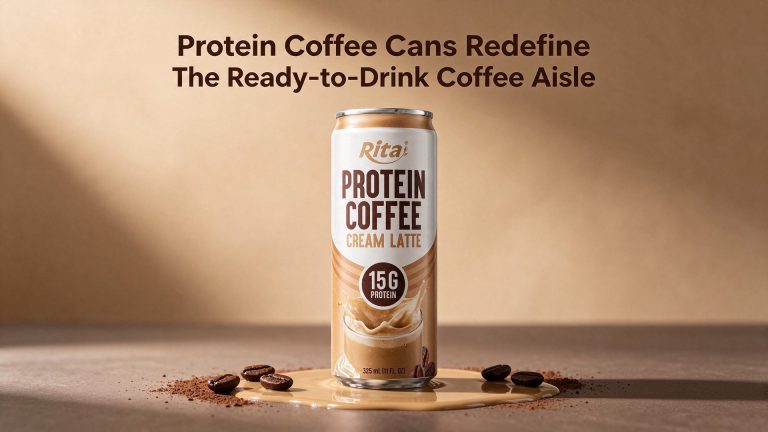
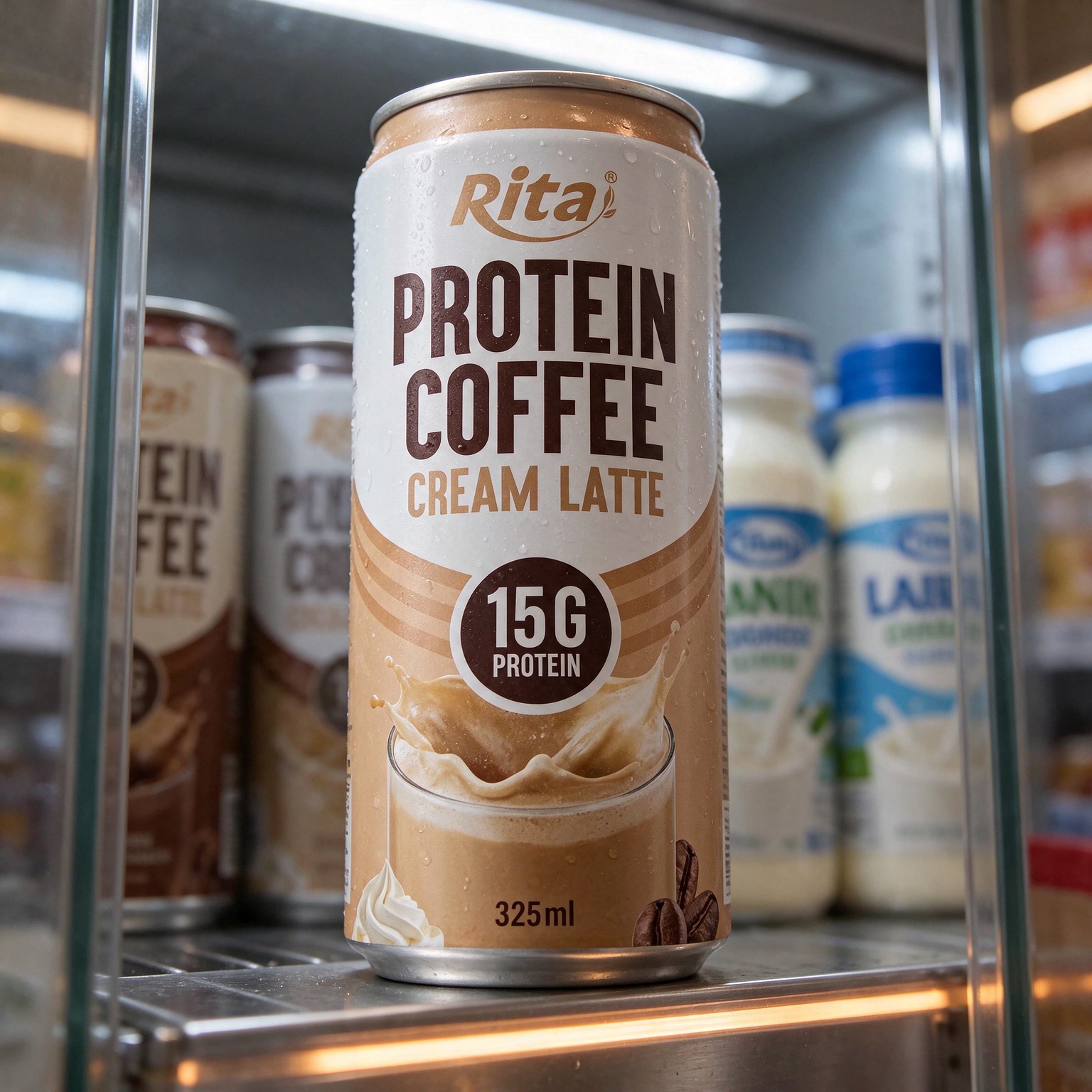
Retail buyers have noticed the effect on shelf conversation. A circular badge reading 15G PROTEIN does the work of a shelf-talker, while the warm white-to-tan gradient and espresso-brown typography of the RITA can read as coffee instantly. In a chiller door crowded with dairy drinks and fruit juices, that visual clarity shortens the moment of choice.
From Cafe Chains to the Portable Can
Cafe chains trained a generation on latte flavor, but store pricing and queue time push commuters toward the canned latte drink category. The slim can format answers with portability, recyclability and freshness retention, fitting cup holders, backpack pockets and vending coils without special merchandising.
What Draws Shoppers to Protein Coffee Cans
Purchase drivers for this category have converged across markets faster than most forecasters expected.
- Declared protein grams on the front of pack, typically 10 to 15 g per serving
- Caffeine content per 100 ml, letting shoppers pace intake across the day
- Energy and sweetness figures, including the use of high-intensity sweeteners
- Certification marks such as Halal and Kosher, plus food-scheme approvals
- Shelf life long enough to survive cross-border wholesale and retail chains
Inside the RITA Cream Latte Protein Coffee 325ml Can
The formulation is built on milk protein and instant coffee, sealed in a 325 ml (11 fl. oz) slim aluminum can.
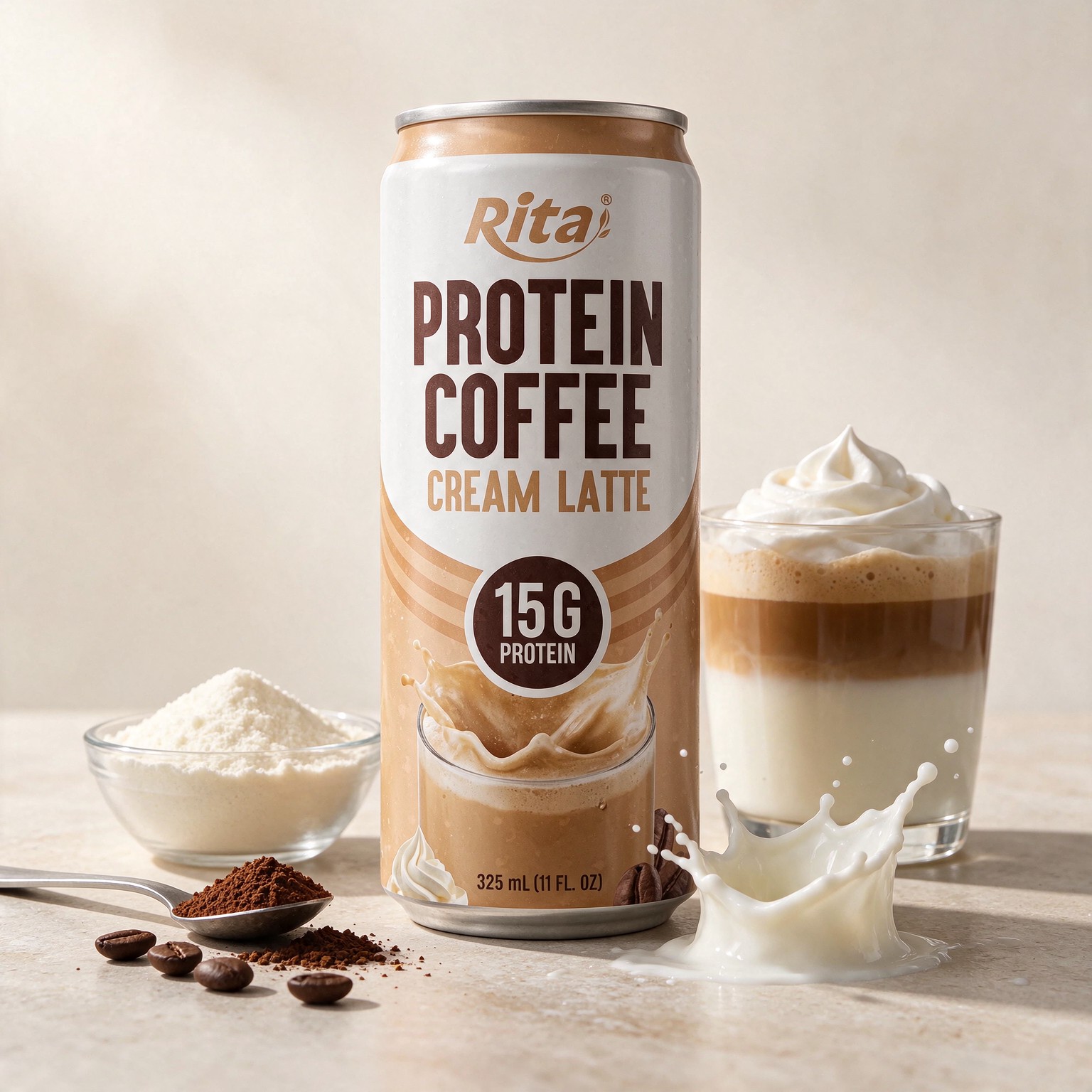
Water, whole milk powder, milk protein concentrate, instant coffee powder and sodium caseinate form the base. Artificial coffee flavor, emulsifiers, acidity regulators and stabilizers hold the texture consistent and support shelf stability across long distribution chains. Sucralose and acesulfame potassium deliver balanced sweetness that does not overpower the coffee character, a calibration that matters when one recipe must satisfy palates across very different markets. The manufacturer describes the result as a velvety latte with layered coffee and cream notes, designed for on-the-go consumption.
Declared nutrition per 100 ml stands at 5.8 g protein, 1.9 g total fat and 4 g total carbohydrates, with a can-level declaration of 15 g protein and 183 kcal. The dairy inputs come from the same house portfolio that supplies the brand’s milk series beverage range, where whole milk powder and milk protein concentrate are specified for shelf-stable drinks. Caffeine is declared at 19 mg per 100 ml, a moderate figure that keeps the product inside everyday drinking occasions rather than positioning it as a concentrated shot.
Nutrition Numbers on the Label
The panel is written for quick scanning, which is how most chilled purchases are decided.
| Declared value | Per 100 ml | Per 325 ml can |
|---|---|---|
| Protein | 5.8 g | 15 g (on-pack) |
| Total fat | 1.9 g | Not declared per can |
| Total carbohydrates | 4 g | Not declared per can |
| Energy | Not declared per 100 ml | 183 kcal (on-pack) |
| Caffeine | 19 mg | Not declared per can |
Figures are as declared by the manufacturer on pack, and full specification sheets are available from the sales desk.
A Three-Flavor Range for Shelf Recognition
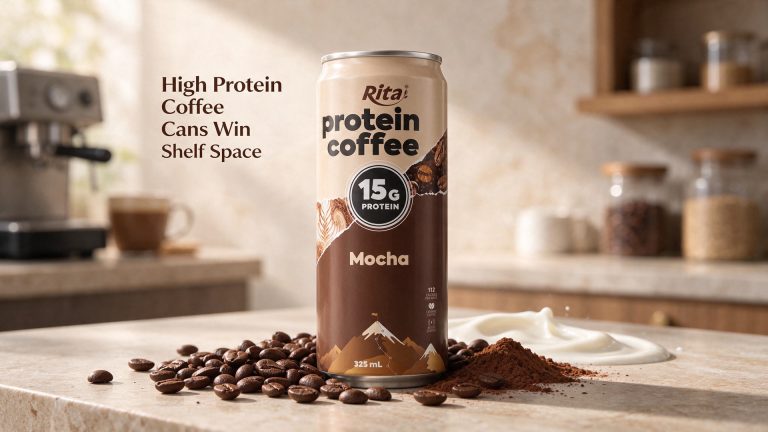
Cream Latte anchors the range, with Vanilla and Mocha extending it through color-coded packaging so variants separate at a glance in mixed displays. The Cream Latte protein coffee product page carries the full pack artwork, nutrition panel and container details for buyers evaluating the line.
| Variant | Pack design cue | Format |
|---|---|---|
| Cream Latte | Warm white-to-tan gradient, espresso-brown typography, 15G PROTEIN badge | 325 ml slim can |
| Vanilla | Color-coded variant design within the same family | 325 ml slim can |
| Mocha | Color-coded variant design within the same family | 325 ml slim can |
From Vietnam’s Coffee Highlands to the 325ml Can
Traceability starts at source, and the company documents the journey openly. RITA’s sourcing team published a field visit to Vietnam’s coffee gardens at peak harvest season, when cherries are picked and processing begins on the route toward the instant coffee powder used in canned drinks. Understanding that calendar helps buyers judge lead times when planning seasonal promotions.
The dairy inputs follow a parallel path: whole milk powder and milk protein concentrate are qualified against specification before they enter the blend, alongside sodium caseinate and the stabilizer system that keeps the latte texture even from first sip to last. Consistency at this stage is what allows the same recipe to taste identical across separate batches shipped months apart.
Video footage from the same sourcing journey is published here: https://www.youtube.com/watch?v=F2yJLjUYiuo
Export-Ready Packaging for Long-Haul Distribution
A 24-month shelf life under cool, dry conditions is the commercial backbone of this product’s export case.
Trade teams reviewing the offer can start with the RITA Cream Latte Protein Coffee specification page and then move to the wider ready-to-drink coffee drink catalogue for adjacent formats and pack sizes.
Aluminum slim cans travel well in container loads, resist the light exposure that degrades coffee flavor, and are accepted by recycling streams in most destination markets. The specification sits under BRC, FSSC 22000, Halal Jakim, Halal HCA-GCC, Kosher, ISO, GMP, HACCP and SMETA certifications, the combination a Halal certified beverage needs to clear retail onboarding in Muslim-majority markets and mainstream chains elsewhere. Behind it, the manufacturer runs 50+ automated production lines and moves more than 1,200 containers per month, a scale that matters when a single distributor order spans several SKUs.
Industry conditions colour the opportunity. Asahi Group has flagged Europe and Asia-Pacific sales tracking below plan, a reminder that mature coffee categories grow unevenly and that differentiated formats must earn their place. Recent disruptions across digital identity and logistics systems have also underscored how supply-chain visibility now sits on the agenda of every beverage firm moving product across borders, so audit trails and packing specifications form part of the purchasing decision.
OEM and Private Label Routes for Regional Buyers
RITA Food and Drink Co., Ltd. has manufactured beverages since 2004 and now serves buyers in more than 200 countries and territories, a scale that positions it as an OEM beverage manufacturer rather than a single-SKU supplier.
Private label programmes cover recipe adjustment, can artwork, certification routing and export documentation, drawing on a portfolio that already spans tropical fruit juices, coconut products, energy drinks and canned coffee. Distributors entering the protein coffee segment can start from the existing Cream Latte template or brief a new profile through the company’s coffee drinks catalogue, shortening development time against a blank-sheet formulation.
What distinguishes this route from ordinary co-packing is paperwork that travels with the goods: audits, scheme certificates and container-level tracking. For a Vietnamese beverage manufacturer supplying retail chains, that documentation often decides whether a first order converts into a repeat programme, and the RITA Cream Latte Protein Coffee 325ml can shows the finished standard a coffee drink export buyer can expect. A practical checklist for buyers evaluating an OEM coffee can partner:
- Confirm scheme coverage against the destination market’s retail requirements
- Request full specification sheets, including caffeine and protein declarations
- Check can format compatibility with existing coolers and vending equipment
- Verify minimum order quantities against forecast demand and storage capacity
- Agree artwork approval timelines before production slots are reserved
Frequently Asked Questions
What is RITA Cream Latte Protein Coffee?
It is a ready-to-drink coffee beverage produced by RITA Food and Drink Co., Ltd., supplied in a 325ml slim aluminum can with a smooth latte flavor and 15 g of protein declared per can.
How much protein and caffeine does each can declare?
Each can declares 15 g of protein and 183 kcal. Per 100 ml the label lists 5.8 g protein, 1.9 g total fat, 4 g total carbohydrates and 19 mg caffeine.
Which sweeteners are used in the formulation?
Sucralose and acesulfame potassium provide balanced sweetness that keeps the coffee character forward in the taste profile.
Which certifications support the product?
Production runs under BRC, FSSC 22000, Halal Jakim, Halal HCA-GCC, Kosher, ISO, GMP, HACCP and SMETA certifications, covering retail and foodservice requirements.
What is the shelf life and shipping profile?
The product keeps 24 months under cool, dry storage conditions, and the slim can format is designed for container shipping and long-distance distribution.