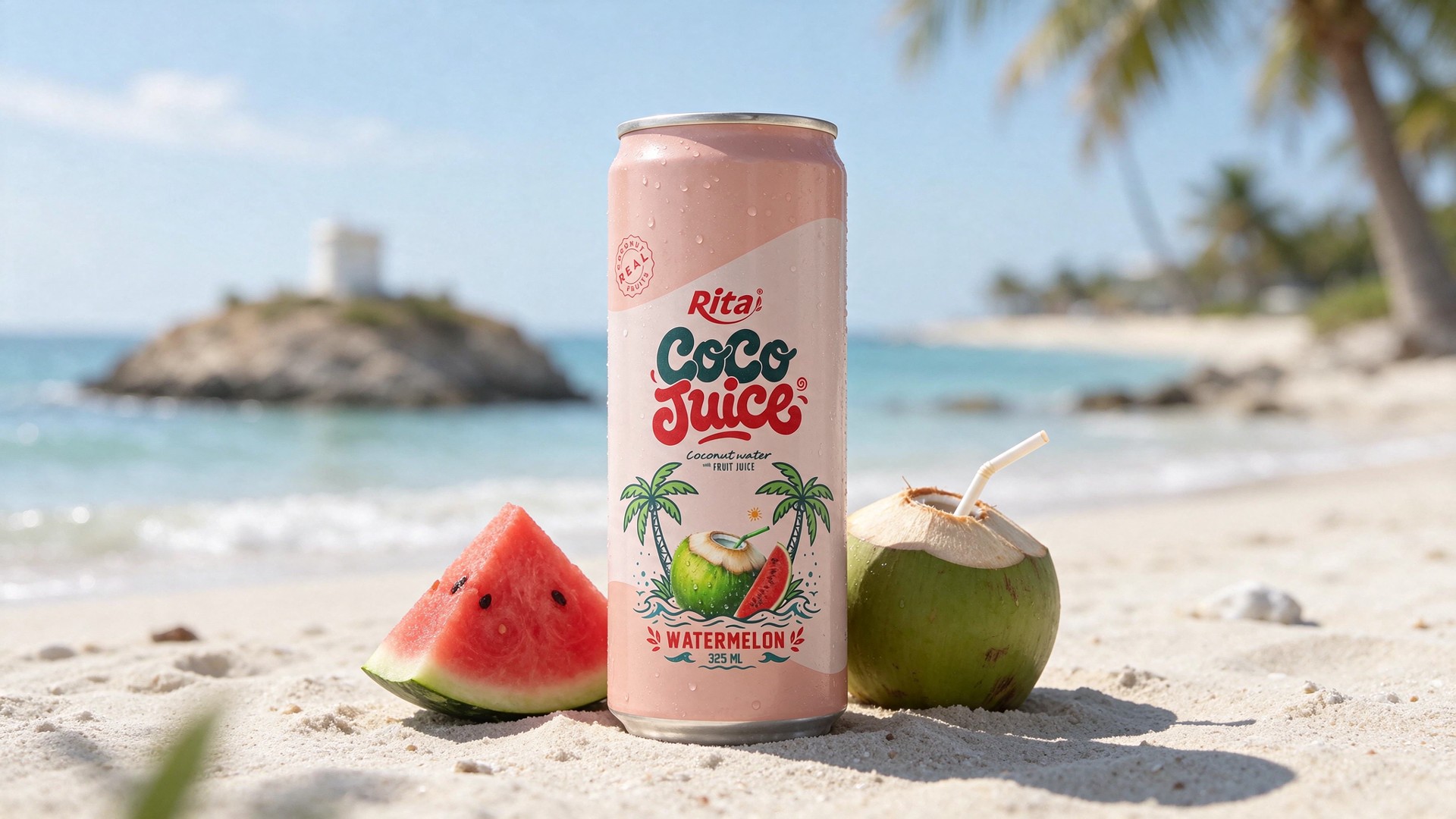
The coconut water with watermelon juice segment is moving from novelty to staple as beverage buyers across Asia, the Caucasus and the Gulf look for clean-label tropical blends in shelf-ready formats. Leading that shift is the RITA Coco Juice Coconut Water with Watermelon Juice 325ml can, a slim aluminum pack that pairs natural coconut water with real watermelon juice and carries no artificial flavors, colors or preservatives. For importers, retail chains and private-label partners, the blend answers demand for a lightly sweet drink that stays stable across long supply chains and warm-climate distribution.
Key Takeaways
- Coconut water blended with real watermelon juice is shifting from seasonal novelty to year-round listing in the 325ml slim can segment.
- The RITA Coco Juice range keeps one consistent can size across seven color-coded flavors, simplifying shelf planning, case packing and pallet building.
- Certifications including BRC, FSSC 22000, Halal Jakim, Halal HCA-GCC, Kosher, ISO, GMP, HACCP and SMETA support cross-border listings.
- RITA Food and Drink Co., Ltd runs 50+ automated production lines and exports more than 1,200 containers monthly to over 200 countries and territories.
- OEM and ODM partnerships allow custom packaging, flavor adjustment and branded artwork for regional distributors and retail chains.
Why Coconut Water With Watermelon Juice Is Winning Shelf Space
Blended coconut drinks are no longer a seasonal curiosity. Buyers from Bangladesh to Bahrain now treat them as year-round listings rather than summer promotions.
Demand is broad-based. Distributors in Indonesia, the Philippines, Thailand and Myanmar count coconut-based refreshers among everyday convenience-store movers, while importers in Japan, Taiwan and Singapore position the category as a premium chilled option. South Asian buyers in Sri Lanka, Pakistan and Nepal report steady movement of canned coconut drinks through modern trade, and retailers in Armenia, Azerbaijan, Georgia, Kazakhstan, Kyrgyzstan and Uzbekistan are opening space for tropical blends once reserved for carbonated soft drinks. In the Gulf, Kuwait, Oman, Bahrain and Yemen treat halal credentials as a listing prerequisite, which narrows the field of qualified suppliers.
Flavor is doing the persuading. The coconut water with watermelon juice pairing brings a familiar, mildly sweet top note while keeping the body light, so this watermelon coconut drink tastes clean rather than syrupy — a profile that performs well chilled from a cabinet and poured over ice at foodservice counters.
Blended Coconut Drinks Reshape Retail Shelves
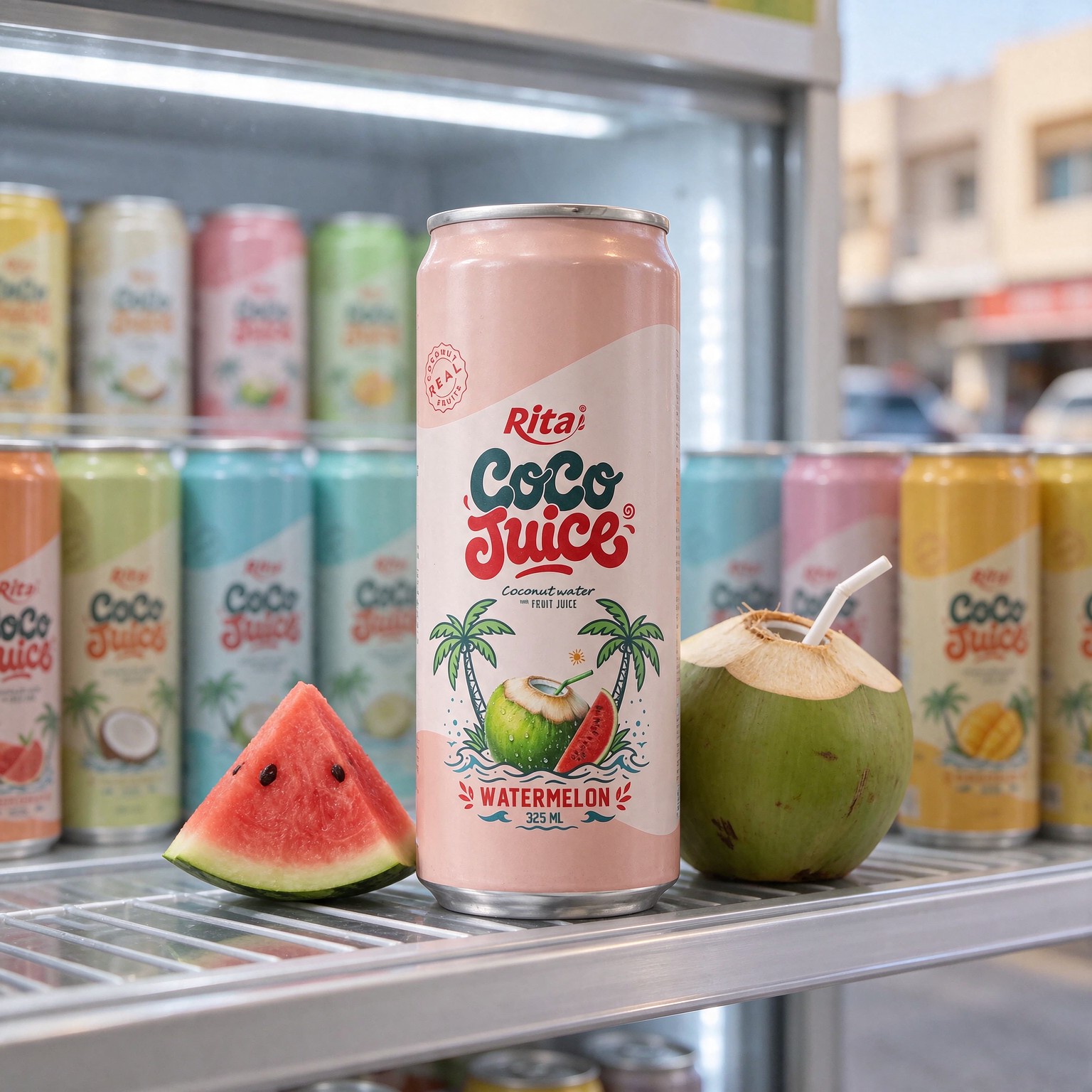
Color-coded cans have quietly become a merchandising tool across the chillers.
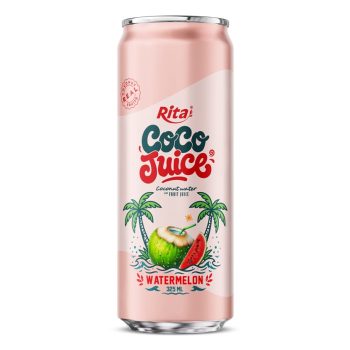
Retailers increasingly group beverages by visual family rather than by category code, and a pastel palette signals a lighter drink before a shopper reads the label. The Watermelon variant of the RITA Coco Juice line uses soft pink and peach tones with teal-green accents and bright red highlights, a combination that reads clearly from two meters away. Palm trees, ocean waves, a watermelon wedge, a young coconut with a straw and a radiant sun complete a beach-side scene that communicates the flavor without multilingual copy — an advantage in markets where shelf tags carry limited description.
What Buyers Look For In A 325ml Slim Can
Format decisions drive listing decisions more often than brand history does. The 325ml coconut water can sits comfortably in one hand, fits standard chiller trays and travels easily in a bag, which makes it a natural fit for convenience stores, supermarket grab-and-go units and hospitality minibar programs.
For distributors, the practical appeal is consistency. Every flavor in the Coco Juice range shares the same 325ml format, so case counts, pallet patterns and shelf strips remain identical across the lineup — a detail that reduces planning work whenever a buyer adds or rotates a variant. The aluminum shell is lightweight, stacks without deformation and chills quickly, while the narrow silhouette leaves room for the illustrated label to carry the brand story. Buyers sourcing for vending machines, canteens and office pantries also favor the format because it requires no glass handling and no opener.
Product Profile Of The RITA Coco Juice Watermelon 325ml Can
The packaging does most of the selling before a shopper ever opens the can.
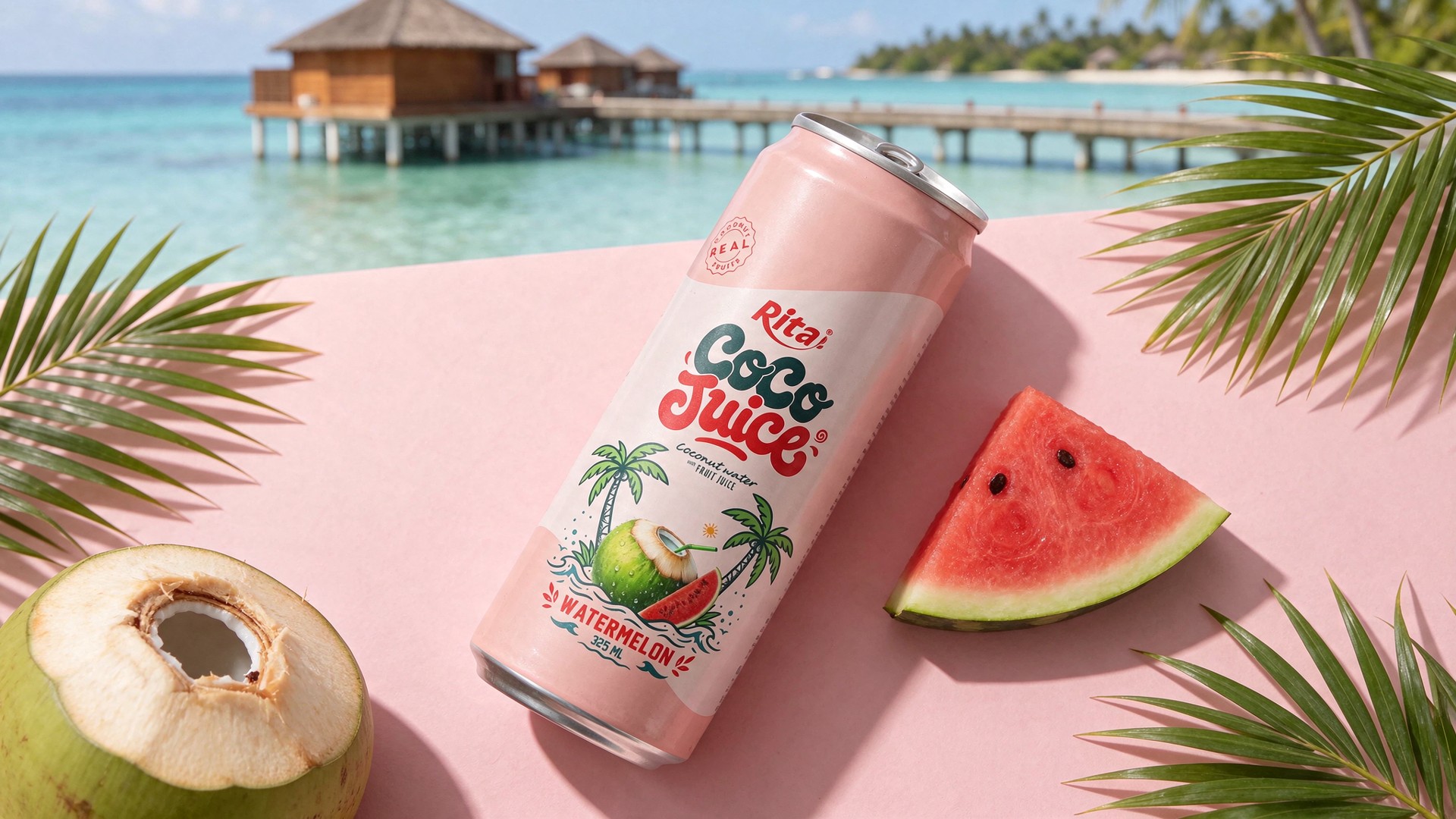
Inside, the drink is a straightforward two-part blend: coconut water and real watermelon juice, produced from natural ingredients rather than from concentrate, with no artificial flavors, colors or preservatives. A circular “Coconut Real Fruit” badge on the front label states the proposition in three words, and hand-drawn logo typography reinforces an artisanal tone. Full specifications, imagery and ordering details sit on the RITA Coco Juice Coconut Water with Watermelon Juice 325ml can product page.
Taste-wise the blend lands light and summery. The watermelon note arrives first, coconut follows with a mild, slightly nutty finish, and sweetness stays restrained enough for repeated sipping through a warm afternoon.
Inside The Coconut Water With Watermelon Juice Formula
Short ingredient lists have become a commercial requirement rather than a marketing flourish for export brands.
Importers screening new SKUs routinely ask for the declaration panel first, and a two-line list makes that conversation shorter. The RITA Coco Juice formula avoids concentrates, syrups and synthetic colorants, which simplifies labeling across jurisdictions with different additive rules. It also gives sales teams a clean point-of-sale story: what is in the can is visible on the label, from the coconut water base to the watermelon juice that shapes the taste. Buyers comparing several suppliers often reach the same conclusion — a declaration that can be translated once and reused in every market saves weeks of regulatory back-and-forth.
A Color-Coded Flavor Line For Easier Merchandising
Seven flavors share a single can size, which keeps one shelf story intact across the range.
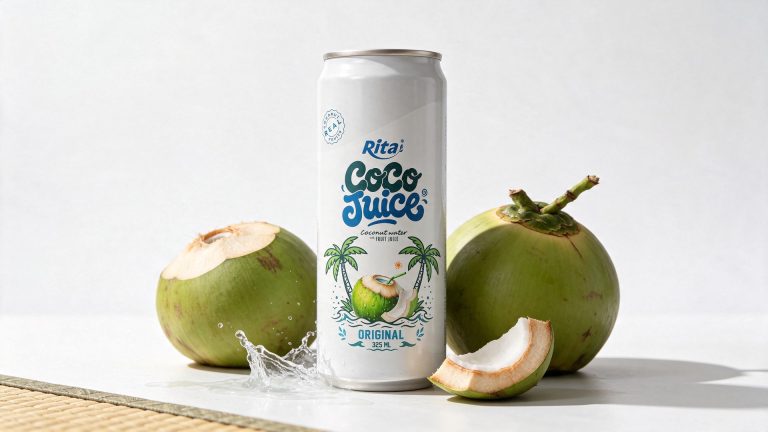
- Original — the pure coconut water reference point of the line.
- Watermelon — soft pink and peach artwork with teal-green and red accents.
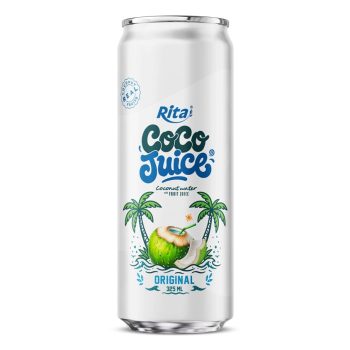
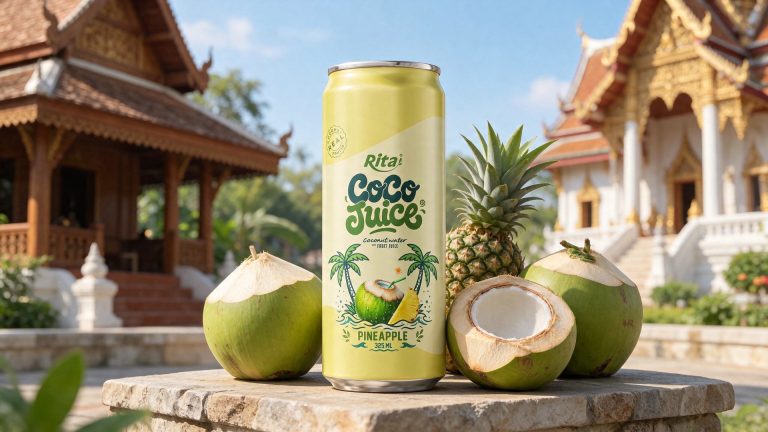
- Pineapple — a brighter tropical variant for fruit-forward assortments.
- Cucumber — a cooler profile aimed at light, savory-adjacent menus.
- Blueberry — a berry tone that contrasts with the pastel base palette.
- Mango — the richest profile in the lineup, popular in tropical markets.
- Lime & Salt — a tangy option that performs well in hot-climate retail.
Because the Watermelon variant sits inside a wider family, retailers can build a full block of Coco Juice cans without reworking fixtures, and distributors can order mixed pallets without renegotiating case specifications. That consistency is a quiet advantage when a chain tests the range in a handful of stores before committing to wider distribution.
From Our Orchards: Raw Material Farms
Blend credibility starts at the growing site, long before any can is filled and sealed.
Coconut water for the line traces back to Vietnam’s coastal coconut belt, where the producer documents its Ben Tre coconut farm journey from plantation to finished product, covering tree maturity, harvesting windows and handling between field and processing. That record gives buyers a traceable reference when they audit raw-material sourcing.
Watermelon, widely cultivated in southern Vietnam, is covered through reporting on the Mekong Delta raw material region, an area the company identifies as a high-quality sourcing base for fruit inputs. Together, the two references let importers follow both halves of the blend back to field level.
A short walk through the growing sites is available in this field video: https://www.youtube.com/watch?v=I7hlTL3FT_0
Certifications That Open Doors In Strict Import Markets
Paperwork decides shelf access more often than taste does, especially in regulated import markets.
| Credential | Role In Buyer Screening |
|---|---|
| BRC | Retail audit standard widely requested by European and Gulf chains |
| FSSC 22000 | Food safety management system recognized by global procurement teams |
| Halal Jakim | Halal certification for Southeast Asian markets |
| Halak HCA-GCC | Halal coverage for Gulf Cooperation Council destinations |
| Kosher | Dietary mark that widens eligibility in mixed-procurement markets |
| ISO / GMP / HACCP | Baseline manufacturing and process control documentation |
| SMETA | Social compliance audit requested by European and Japanese importers |
For buyers assessing the wider portfolio behind the can, the producer’s coconut products catalogue groups coconut water, coconut milk and related formats in one place, which speeds up category review meetings.
The stack matters differently by destination. Halak Jakim and HCA-GCC cover Southeast Asian and Gulf requirements respectively, Kosher broadens eligibility where dietary marks influence procurement, and BRC plus FSSC 22000 speak the language of international retail audit teams. Holding these credentials in a single file removes weeks from a typical onboarding cycle, and it gives a coconut water supplier a credible answer when a tender asks for third-party verification rather than self-declaration.
Export Outlook And Market Opportunities
Coconut-based beverages are travelling further and faster than at any point in the past decade.
Market & Export Data
Annual Trend
| Year | Transaction count (lots) | Total value (USD) | Total weight (kg) | Total quantity (units) | YoY |
|---|---|---|---|---|---|
| 2025 | 30,736 | 587,357,440 | 521,062,036 | 288,325,563 | N/A |
| 2026 | 40,525 | 566,028,847 | 862,715,925 | 339,922,262 | lots +31.8%, value -3.6%, volume +65.6%, quantity +17.9% |
Data source: Tradesparq Trade Data (tradesparq.com)
Monthly Trend
| Month | Lots | Suppliers | Buyers | Value (USD) | Weight (kg) | Quantity (units) |
|---|---|---|---|---|---|---|
| 08/2025 | 4,302 | 525 | 779 | 142,678,668 | 77,677,963 | 45,887,623 |
| 09/2025 | 7,855 | 726 | 1,094 | 139,802,666 | 117,807,295 | 75,675,783 |
| 10/2025 | 6,314 | 782 | 1,129 | 105,399,453 | 108,021,255 | 56,992,681 |
| 11/2025 | 6,063 | 706 | 1,092 | 98,089,214 | 102,970,287 | 53,182,463 |
| 12/2025 | 6,202 | 742 | 1,123 | 101,387,439 | 114,585,236 | 56,587,013 |
| 01/2026 | 5,817 | 707 | 1,054 | 92,014,530 | 104,455,785 | 54,522,281 |
| 02/2026 | 4,603 | 631 | 936 | 81,648,340 | 90,206,678 | 43,010,356 |
| 03/2026 | 5,976 | 724 | 1,049 | 96,953,671 | 127,046,703 | 51,901,384 |
| 04/2026 | 6,728 | 783 | 1,113 | 105,058,314 | 127,395,784 | 60,112,681 |
| 05/2026 | 7,110 | 788 | 1,145 | 107,163,899 | 121,724,363 | 62,956,533 |
| 06/2026 | 6,455 | 691 | 1,045 | 67,721,003 | 129,305,692 | 46,673,214 |
| 07/2026 | 3,088 | 330 | 427 | 15,469,090 | 130,130,579 | 16,567,698 |
| 08/2026 | 748 | 141 | 166 | 0 | 32,450,340 | 4,178,115 |
Data source: Tradesparq Trade Data (tradesparq.com)
HS Code Breakdown
| HS code | Description | Lots | Value (USD) | Weight (kg) | Quantity (units) | Market share | Avg. price (USD/unit) |
|---|---|---|---|---|---|---|---|
| HS 200989 | Single fruit/other seed/vegetable juices | 24,208 | 466,501,000 | 487,667,981 | 312,925,451 | 34.4% | 1.49 |
| HS 220299 | Other non-alcoholic beverages (excl. water/juice/milk/beer) | 9,126 | 77,862,232 | 70,227,940 | 22,818,047 | 12.9% | 3.41 |
| HS 200939 | Single citrus juices, not fermented, Brix >20 | 3,259 | 167,206,615 | 16,600,794 | 43,669,375 | 4.6% | 3.83 |
| HS 330300 | Perfumes/ toilet waters | 2,029 | 2,761,138 | 527,788 | 190,725 | 2.9% | 14.48 |
| HS 210690 | Other food preparations | 1,949 | 18,397,993 | 37,784,144 | 22,397,211 | 2.8% | 0.82 |
| HS 200990 | Mixtures of juices | 1,916 | 11,640,495 | 11,953,665 | 3,881,245 | 2.7% | 3.00 |
| HS 220210 | Waters/mineral waters sweetened or flavoured | 1,833 | 1,855,697 | 7,119,711 | 1,136,130 | 2.6% | 1.63 |
| HS 200969 | Other grape juices | 1,616 | 111,500,040 | 34,905,877 | 54,631,113 | 2.3% | 2.04 |
| HS 481190 | Other paper/paperboard | 1,294 | 13,713,003 | 0 | 7,359,894 | 1.8% | 1.86 |
| HS 200819 | Other prepared nuts and seeds | 839 | 38,164,473 | 42,311,897 | 1,445,048 | 1.2% | 26.41 |
Data source: Tradesparq Trade Data (tradesparq.com)
Top Origin & Destination Countries
| Type | Country | Transaction count (lots) | Total value (USD) | Weight (kg) | Market share | Avg. price (USD/unit) |
|---|---|---|---|---|---|---|
| Origin | N/A | N/A | N/A | N/A | N/A | N/A |
| Origin | N/A | N/A | N/A | N/A | N/A | N/A |
| Origin | N/A | N/A | N/A | N/A | N/A | N/A |
| Origin | N/A | N/A | N/A | N/A | N/A | N/A |
| Origin | N/A | N/A | N/A | N/A | N/A | N/A |
| Destination | United States | 33,501 | 376,251,733 | 1,118,492,507 | 47.3% | 1.51 |
| Destination | Australia | 3,262 | 54,453,356 | 438,020 | 4.6% | 2.46 |
| Destination | Vietnam | 3,175 | 40,383,813 | 8,023,765 | 4.5% | 1.37 |
| Destination | Singapore | 3,122 | 89,723,882 | 9,651,955 | 4.4% | 0.79 |
| Destination | Netherlands | 2,347 | 108,766,617 | 30,248,792 | 3.3% | 4.05 |
| Destination | Peru | 1,766 | 7,125,398 | 1,247,942 | 2.5% | 3.73 |
| Destination | United Kingdom | 1,604 | 40,931,218 | 37,707,131 | 2.3% | 5.54 |
| Destination | Mexico | 1,399 | 11,812,236 | 10,699,694 | 2.0% | 2.40 |
| Destination | Costa Rica | 1,242 | 60,704,775 | 948,396 | 1.8% | 113.25 |
| Destination | Canada | 1,167 | 37,373,105 | 17,070,499 | 1.6% | 3.28 |
Data source: Tradesparq Trade Data (tradesparq.com)
The dataset covers August 2025 to August 2026 (AI TradeSeek, Aug 2025–Aug 2026) and reports destination-country aggregates only; no origin-country breakdown is included in this source, so those rows are marked N/A. The “2025” and “2026” figures are partial-year periods drawn from that coverage window and should not be read as complete calendar years or as directly comparable year-on-year growth; the YoY percentages shown are reproduced exactly as reported by the source. A reported value of 0 in a given cell does not establish that actual trade value was zero.
Aggregate trade in coconut water shows transaction activity rising to 40,525 lots with total weight of 862,715,925 kg, while total value is reported at 566,028,847 USD and average price per unit moves from ~2.04 USD (2025) to ~1.67 USD (2026). The United States is the largest destination by transaction count at 33,501 lots and 47.3% market share (1.51 USD average price), followed by Australia (3,262 lots, 4.6%), Vietnam (3,175 lots, 4.5%), Singapore (3,122 lots, 4.4%) and Netherlands (2,347 lots, 3.3%). On the product side, HS 200989 leads with 34.4% of lots at 1.49 USD per unit, while HS 220299 holds 12.9% at 3.41 USD per unit; monthly volumes peak at 7,855 lots in 09/2025 and 7,110 lots in 05/2026, with the lowest reported month at 748 lots in 08/2026.
The practical implication for buyers is supplier depth. Capacity, documentation and logistics now matter as much as recipe, and a producer able to run large volumes on short notice protects a retailer’s promotional calendar when a listing performs above forecast. Seasonality in coconut harvests and fruit crops adds another layer, so multi-flavor portfolios help smooth ordering across the year.
Within that portfolio, the coconut water aseptic brands category offers an alternative format for chains that prefer carton or brick packaging alongside cans, letting a single supplier cover both chilled and ambient plans. The same logic applies to the blend itself: a buyer can start with the coconut water with watermelon juice 325ml can and expand into adjacent coconut SKUs without changing partners, which matters when freight costs and lead times dominate margin discussions in coconut water export contracts.
Private Label And OEM Partnerships For Regional Distributors
For distributors, the fastest route to a differentiated shelf is a branded version of a proven blend.
RITA Food and Drink Co., Ltd, established in 2004, operates as a Vietnamese OEM and ODM beverage manufacturer supplying brands in more than 180 countries. The company runs over 50 automated production lines and ships more than 1,200 containers each month to over 200 countries and territories, covering tropical fruit juices, coconut products, functional ranges and canned or bottled drinks in aluminum, glass, PET and PP formats. Its private-label service allows custom packaging, adjusted flavor profiles and branded artwork while drawing on the same certification set used for export orders — a combination that makes it straightforward for a regional OEM beverage manufacturer brief to move from concept to shipment.
That scale matters when a retail chain wants the coconut water with watermelon juice 325ml can under its own banner across hundreds of outlets. Sampling programs, mixed-flavor trial pallets and coordinated shipment windows are standard parts of the conversation, and the seven-flavor lineup gives a private-label partner room to grow the range after the first listing succeeds.
Frequently Asked Questions
What is RITA Coco Juice Coconut Water with Watermelon Juice 325ml can?
It is a 325ml slim aluminum can beverage that blends natural coconut water with real watermelon juice. It is one of seven color-coded flavors in the RITA Coco Juice range, all produced in the same can format for consistent shelf and case planning.
Does the drink contain artificial flavors, colors or preservatives?
No. The formula uses coconut water and real watermelon juice from natural ingredients, not from concentrate, and carries a “Coconut Real Fruit” badge on the front label. The ingredient declaration stays short and easy to translate for import labeling.
Which certifications support the product for export?
The production environment holds BRC, FSSC 22000, Halak Jakim, Halal HCA-GCC, Kosher, ISO, GMP, HACCP and SMETA credentials, covering food safety, halal and social compliance requirements across different destination markets.
Can distributors order private label or OEM versions?
Yes. The producer offers OEM and ODM services with custom packaging, flavor adjustment and branded artwork, supported by 50+ automated production lines and monthly shipments of more than 1,200 containers.
How many flavors are in the Coco Juice range?
Seven: Original, Watermelon, Pineapple, Cucumber, Blueberry, Mango and Lime & Salt, each in the same 325ml can for straightforward merchandising.