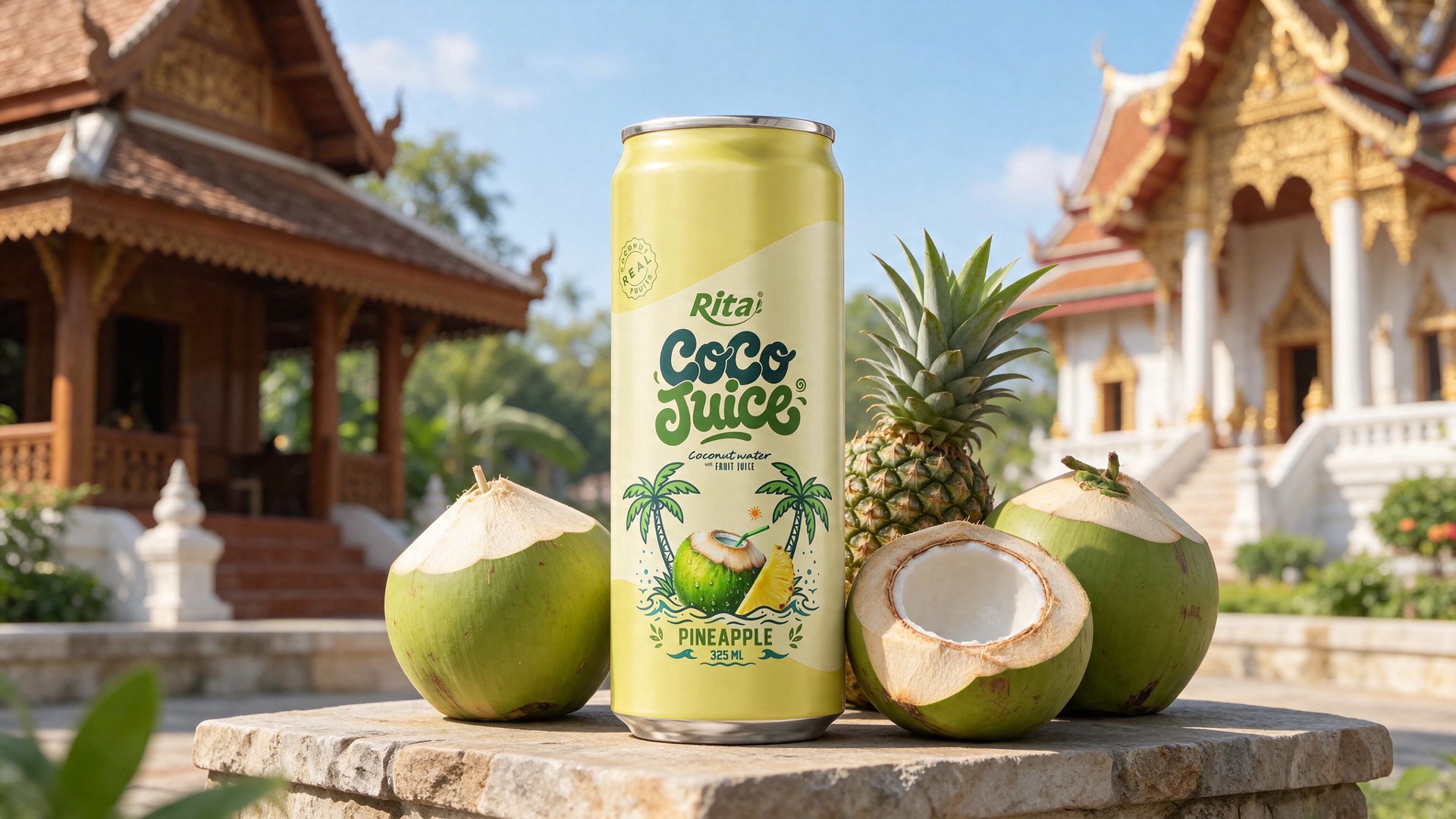
As beverage regulators across Asia tighten scrutiny of imported ready-to-drink products, coconut water with pineapple juice has moved onto the compliance agenda of distributors from Bangkok to Manama. The 325 ml aluminium can, the two-ingredient formulation and the certificate trail behind every shipment now decide whether a product clears customs and earns shelf space. For buyers comparing suppliers, the regulatory map matters as much as the tasting bench, and beverage regulatory compliance has become a purchasing criterion in its own right.
Key Takeaways
- Customs authorities across ASEAN, South Asia and the Gulf verify ingredient declarations, batch records and certificate validity before granting clearance.
- Halal Jakim and Halal HCA-GCC approvals remain decisive for coconut water with pineapple juice entering Bahrain, Kuwait, Oman, Yemen and Pakistan.
- Labels must state net volume, batch code, storage guidance and the ingredient list in the language required by each destination market.
- A combined BRC, FSSC 22000, ISO, GMP, HACCP and SMETA dossier shortens review cycles and speeds up retail listing.
- OEM and ODM partnerships let buyers adjust formulation and artwork while keeping the 325 ml can specification unchanged.
Regulatory Landscape for Coconut Water with Pineapple Juice in Asia
Importers now face stricter document checks for canned coconut drinks before clearance.
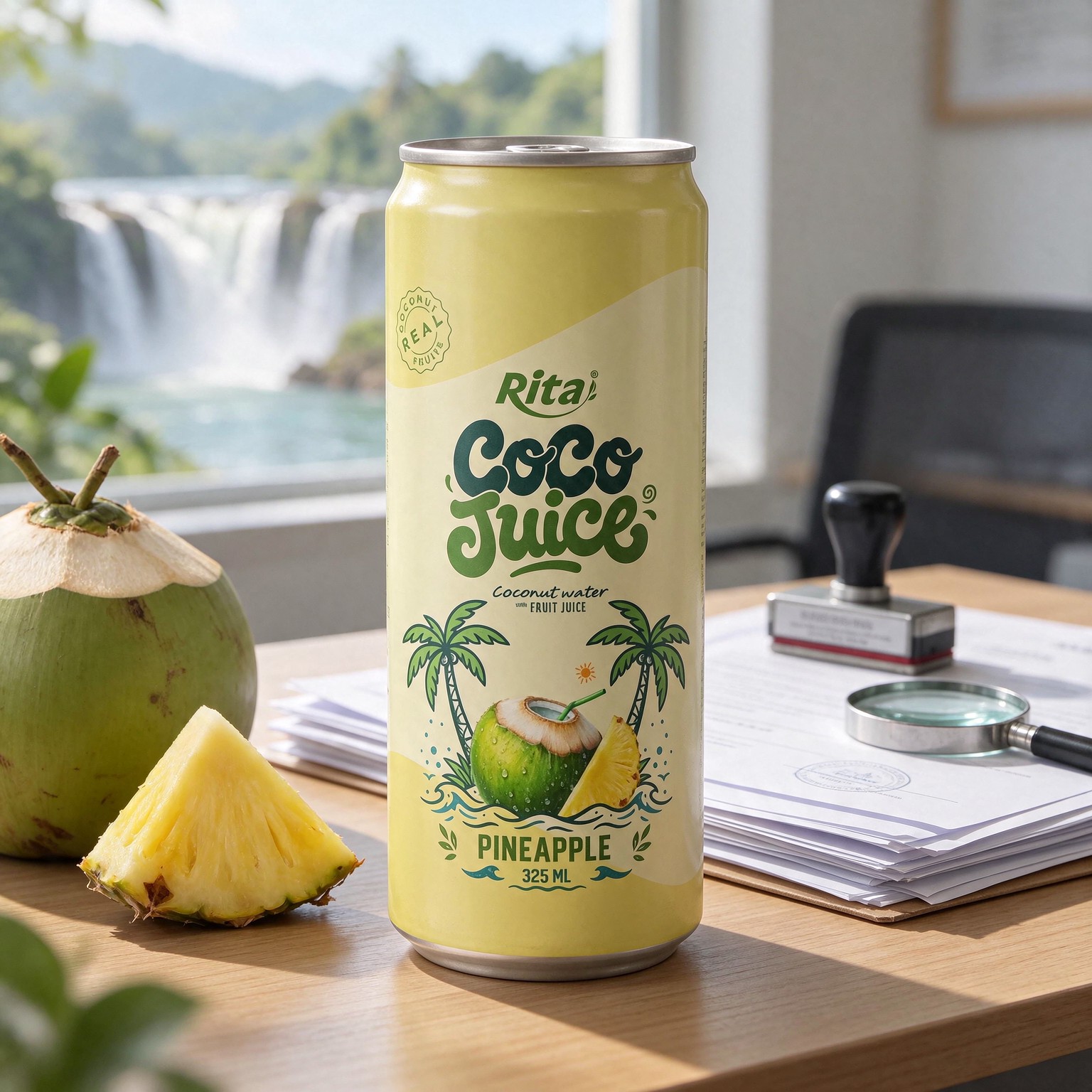
Customs desks in Thailand, Indonesia, the Philippines and Vietnam routinely request full ingredient declarations, batch traceability and shelf-life evidence for consignments of ready-to-drink coconut beverages. A single mismatch between label artwork and certificate file can hold a container at port for weeks. Buyers who source the RITA Coco Juice Coconut Water with Pineapple Juice 325ml Can work with a documentation pack already aligned to what most Asian customs stations ask for on first submission.
Classification is a second pressure point. Coconut water blended with fruit juice is not always filed under the same tariff line as plain coconut water, and officers in Bangladesh, Sri Lanka and Pakistan have raised questions about juice percentage and declared sugar levels. Importers who attach a specification sheet to the invoice usually resolve these points in one exchange instead of a fortnight of correspondence.
Halal Certification and Gulf Market Access
Halal paperwork decides entry into several priority markets.
Bahrain, Kuwait, Oman, Yemen, Syria and the Palestinian Territories require a valid certificate issued by a recognised body before a beverage can be registered for retail sale. RITA holds both Halal Jakim and Halal HCA-GCC approvals, covering the two certification routes most often requested across Malaysia and the Gulf Cooperation Council, which makes the blend a halal certified beverage ready for registration in those markets. Distributors in Jordan and Lebanon usually accept the same documents as supporting evidence during product registration, removing a round of local testing from the launch calendar.
Japan and South Korea sit at the other end of the spectrum, where halal status is optional but ingredient transparency is not. Reviewers there focus on additive declarations and processing aids, asking suppliers to confirm that the two-ingredient statement printed on the can matches the production record filed with the shipment.
Certification Stacks That Shorten Supplier Review
A complete certificate file speeds up qualification.
FSSC 22000, BRC, ISO, GMP and HACCP form the core set that importers in Singapore, Taiwan and India request when onboarding a new beverage brand, and a current FSSC 22000 certification is usually the first document asked for. SMETA adds the social-compliance layer that larger retail chains increasingly expect before listing. Each file answers a different question: FSSC 22000 addresses food safety management systems, BRC covers global standards for food manufacturing, HACCP confirms hazard control at process level, and SMETA documents ethical audit practice. Together they cut the number of follow-up queries a buyer has to handle.
Retail buyers in Malaysia and India frequently ask for certificate validity dates and scope statements rather than the certificates themselves, so suppliers need an updated dossier ready at every shipment cycle. An expired scope page is one of the most common reasons a first order slips behind schedule.
Labeling and Ingredient Compliance for RTD Coconut Beverages
Label text is regulated as tightly as the liquid inside the aluminium can.
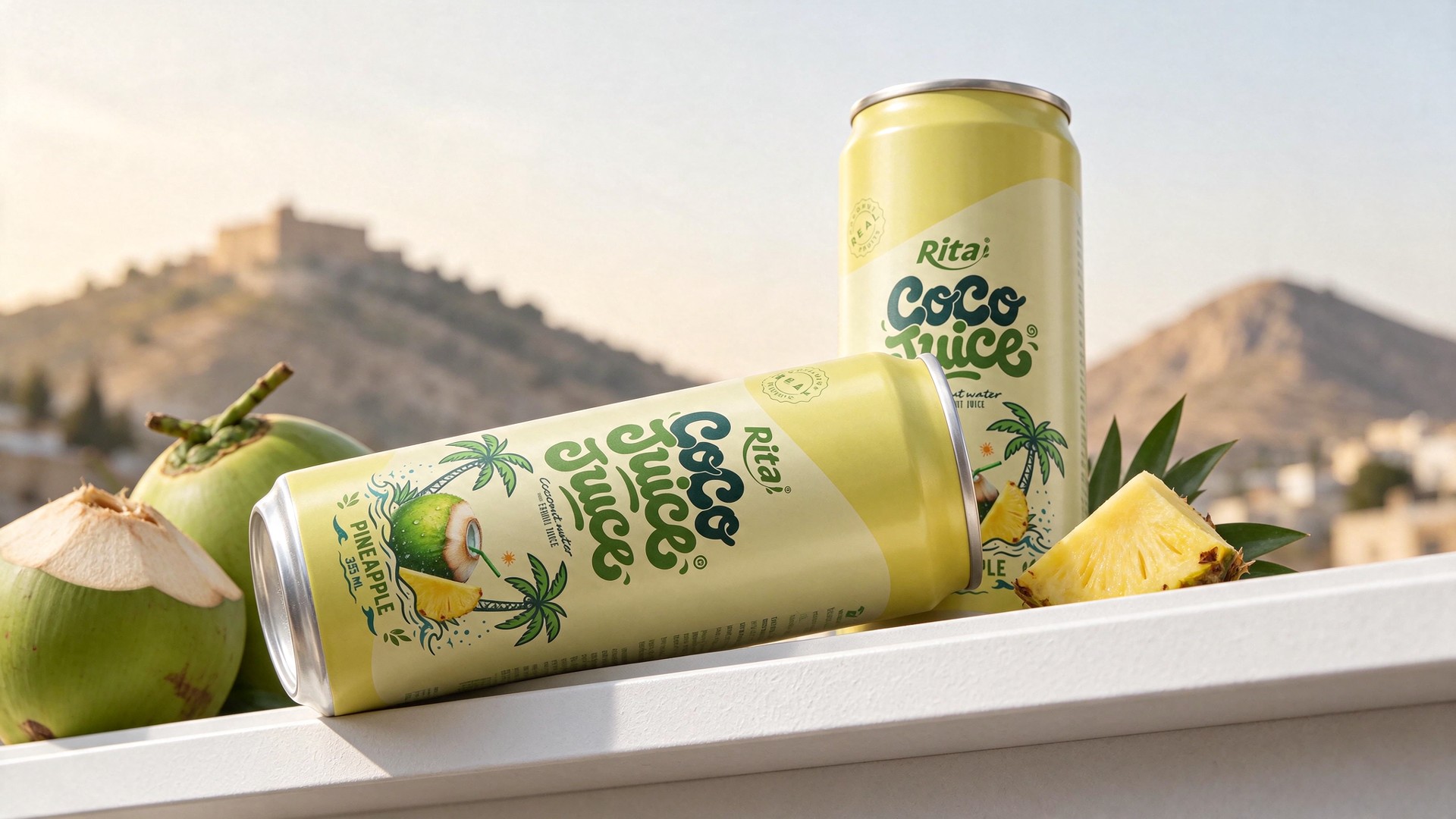
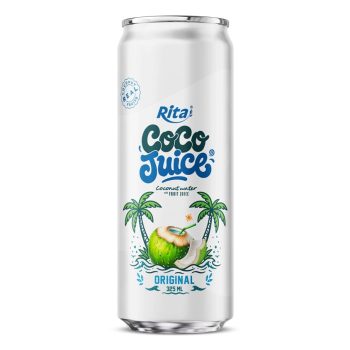
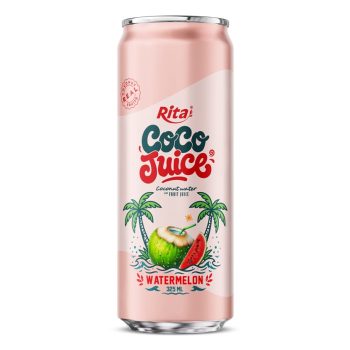
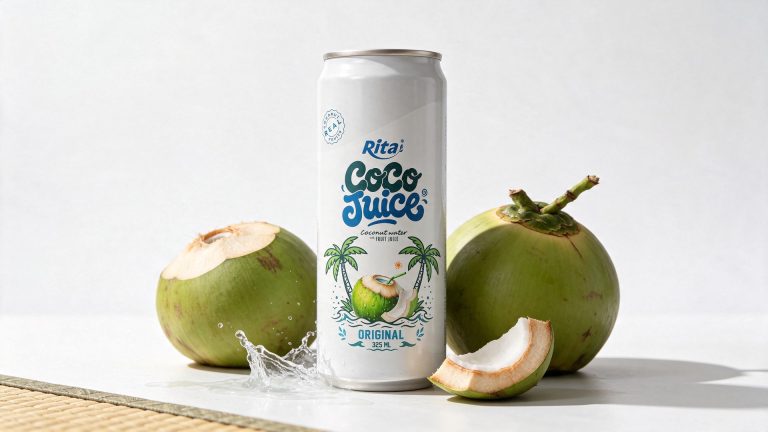
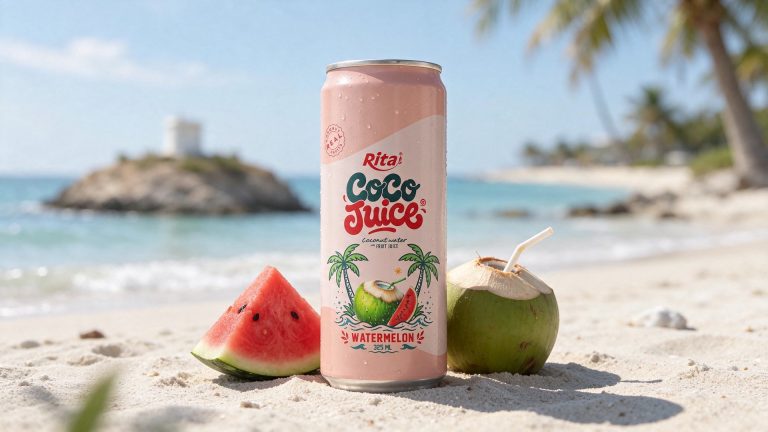
The RITA Coco Juice Coconut Water with Pineapple Juice 325ml Can carries a retro-inspired design: a pale yellow base fading into a creamy off-white diagonal band, leaf-green and deep teal accents, hand-lettered CoCo Juice typography, stylised palm trees, a tender coconut illustration and a COCONUT REAL FRUIT seal. Behind that artwork sits a set of mandatory fields that inspectors check line by line. Net content of 325 ml, the ingredient list, batch code, best-before date and storage guidance must all stay legible after months at sea.
Every RTD coconut beverage faces the same core checks, but language rules vary by destination. Indonesia, Thailand, Vietnam and Cambodia expect the local script on the primary display panel, while Japan and South Korea accept English alongside Japanese or Korean text provided the importer is named on the pack. In the Gulf, Arabic text is required for retail registration in most markets, which is why buyers request a bilingual artwork version at quotation stage rather than after the first container ships.
What Inspectors Check on a Coconut Water with Pineapple Juice Can
The inspection checklist is remarkably consistent across Asian ports.
- Net volume in millilitres, matching the declared quantity on the shipping documents.
- Complete ingredient list in descending order of weight, showing only coconut water and pineapple juice for this formulation.
- Batch code and best-before date printed clearly enough to survive condensation and handling.
- Storage guidance and importer details for markets that require a locally responsible party.
- Certificate references that match the product name and can size shown on the artwork.
Claims deserve particular attention. Statements such as not from concentrate or no artificial flavours, colours or preservatives must be backed by the production record, and inspectors in Singapore and Taiwan have requested supporting documents during sampling rounds. An unevidenced claim becomes a compliance issue rather than a marketing asset, and it can delay an entire consignment even when the liquid itself is fully compliant.
| Destination market | Core requirement | Certificates typically requested |
|---|---|---|
| Thailand, Indonesia, Vietnam | Local-language label and import notification | HACCP, ISO, GMP |
| Japan, South Korea, Taiwan | Additive declaration and importer registration | FSSC 22000, BRC |
| Bahrain, Kuwait, Oman, Yemen | Halal certificate and Arabic artwork | Halal Jakim, Halal HCA-GCC |
| Bangladesh, Sri Lanka, Pakistan | Tariff classification and juice percentage | ISO, HACCP, SMETA |
| Singapore, Malaysia | Retail social-compliance audit | BRC, FSSC 22000, SMETA |
Compiled from typical importer documentation requests across RITA export markets.
From Our Orchards: Raw Material Sourcing and Farm Traceability
Traceability from field to can is now part of the compliance conversation.
The coconut component comes through the Ben Tre coconut farm programme, where plantation records document harvest periods and handling steps that feed each production batch. Buyers who ask for raw-material documentation during an audit can follow the chain from the growing area to the finished can without switching systems halfway through the review.
Pineapple supply follows a parallel route via the RITA pineapple farm network, where fruit maturity at harvest sets the natural sweetness and tang that define the blend. Harvest records from those areas support the ingredient declarations that customs officers verify on arrival.
A field walkthrough of the growing area is published at https://www.youtube.com/watch?v=I7hlTL3FT_0
Both sourcing programmes sit inside the same quality system that governs the finished beverage, so one audit trail covers field practice, intake checks and final filling. That continuity is what lets a supplier answer a regulator question about origin without opening a separate investigation.
Export Readiness and Market Access Across Asia
Scale and certification together determine how fast a shipment moves.
RITA Food and Drink Co., Ltd., established in 2004 and counted among Vietnam top five beverage companies, runs more than 50 automated production lines and ships over 1,200 containers a month to more than 200 countries and territories. For a distributor, that throughput translates into predictable lead times and consistent batch documentation across repeat orders, a practical advantage when a regulator requests historical records for a previous consignment.
Market & Export Data
Annual Trend
| Year | Transactions | Total Value (USD) | Total Weight (kg) | Total Quantity | YoY |
|---|---|---|---|---|---|
| 2025 | 0 | N/A | 0 | 0 | N/A |
| 2026 | 1 | N/A | 20,671 | 1,977 | 100% |
Data source: Tradesparq Trade Data (tradesparq.com)
Top Origin & Destination Countries
| Origin Country | Transactions | Total Value (USD) | Weight (kg) | Market Share % | Average Price |
|---|---|---|---|---|---|
| Guatemala | 1 | N/A | 20,671 | 100% | N/A |
| N/A | N/A | N/A | N/A | N/A | N/A |
| N/A | N/A | N/A | N/A | N/A | N/A |
| N/A | N/A | N/A | N/A | N/A | N/A |
| N/A | N/A | N/A | N/A | N/A | N/A |
| Destination Country | Transactions | Total Value (USD) | Weight (kg) | Market Share % | Average Price |
|---|---|---|---|---|---|
| N/A | N/A | N/A | N/A | N/A | N/A |
| N/A | N/A | N/A | N/A | N/A | N/A |
| N/A | N/A | N/A | N/A | N/A | N/A |
| N/A | N/A | N/A | N/A | N/A | N/A |
| N/A | N/A | N/A | N/A | N/A | N/A |
Data source: Tradesparq Trade Data (tradesparq.com)
The reported period covers August 2025 – August 2026 (13 months). Within it, 2025 shows 0 recorded transactions, 0 kg and 0 units, while 2026 records 1 transaction totalling 20,671 kg and 1,977 units; trade value was not available in the source, so no unit prices or average prices can be calculated, and a zero reported value should not be read as zero actual trade value. The stated 100% year-on-year change reflects a first market entry rather than a like-for-like comparison, since the two periods cover unequal partial-year spans (August–December 2025 versus January–August 2026). All activity is concentrated in August 2026, which represents 100% of the volume, while August 2025 – July 2026 recorded zero activity.
Guatemala is the sole origin country in the dataset, accounting for 100% of the trade volume with 1 transaction and 20,671 kg; Vietnam does not appear in the reported origin data, and destination countries were not provided in the source, so destination shares cannot be stated. All observed volume is tied to a single formulation, “Coconut Water With Electrolytes And Pineapple Flavor”, with no differentiated sub-categories by packaging size or concentration and no HS codes supplied, leaving too little data to assess price trends or market averages.
The 325 ml tall slim aluminium can is built for exactly these supply chains. The silver-rimmed shell resists denting and pressure changes during ocean freight, and the printed label survives humidity better than paper-wrapped alternatives, which keeps mandatory fields readable when the container is opened for inspection. That durability is a quiet part of compliance, since a damaged label can trigger the same document query as a missing certificate.
A single-serve format also suits the consumption pattern that drives coconut water export volumes across Thailand, Indonesia, the Philippines, Malaysia, Japan and India, where shoppers pick up chilled cans at convenience stores and transit kiosks rather than buying multipacks for the home.
OEM and ODM Routes for Regulatory Customisation
Custom artwork and formulation changes are handled without changing the can format.
Markets with specific labeling rules often need more than a translation. Through RITA OEM beverage manufacturing service, flavour ratios, ingredient declarations and label artwork can be tailored while the 325 ml can specification stays fixed, keeping tooling and line setup unchanged. The ODM route goes further, allowing a buyer to develop a formulation from a brief and own the resulting specification outright.
The wider portfolio supports range-building under one compliance file. The coconut products catalogue covers coconut water, coconut milk and coconut-based blends, while the coconut water aseptic brands range gives distributors an alternative packaging format for the same ingredient story. Extending into pineapple-led lines is equally straightforward through the fruit juice catalogue.
Buyers who need a documented starting point can review the full specification, artwork details and available variants on the RITA Coco Juice Coconut Water with Pineapple Juice 325ml Can page. The range already spans seven flavours, Original, Watermelon, Cucumber, Blueberry, Mango, Lime & Salt and Pineapple, so a distributor can test one SKU or present a full shelf block under a unified design.
Frequently Asked Questions
Which certifications does the RITA Coco Juice Coconut Water with Pineapple Juice 325ml Can hold?
The product is manufactured under BRC, FSSC 22000, Halal Jakim, Halal HCA-GCC, Kosher, ISO, GMP, HACCP and SMETA certifications, covering the documentation most importers in Asia and the Gulf request during supplier qualification and retail registration.
Which Asian markets require halal certification for canned coconut beverages?
Bahrain, Kuwait, Oman, Yemen, Syria, the Palestinian Territories, Jordan, Lebanon and Pakistan all expect a valid halal certificate before retail registration, and Malaysia commonly asks for Halal Jakim approval as part of the import file.
What label information is mandatory on a 325ml coconut water can?
Net content in millilitres, the full ingredient list in descending order of weight, batch code, best-before date, storage guidance and importer details are required, with local-language text on the primary display panel in most ASEAN markets.
Can distributors adjust formulation and artwork for local regulatory requirements?
Yes. OEM and ODM services allow buyers to change flavour ratios, ingredient declarations and label artwork while retaining the 325 ml aluminium can specification, with flexible minimum order quantities for both established chains and emerging brands.
How is raw material sourcing documented for this blend?
Coconut supply is recorded through the Ben Tre coconut farm programme and pineapple supply through the RITA pineapple farm network, with harvest and intake records feeding the same audit trail used for the finished beverage.