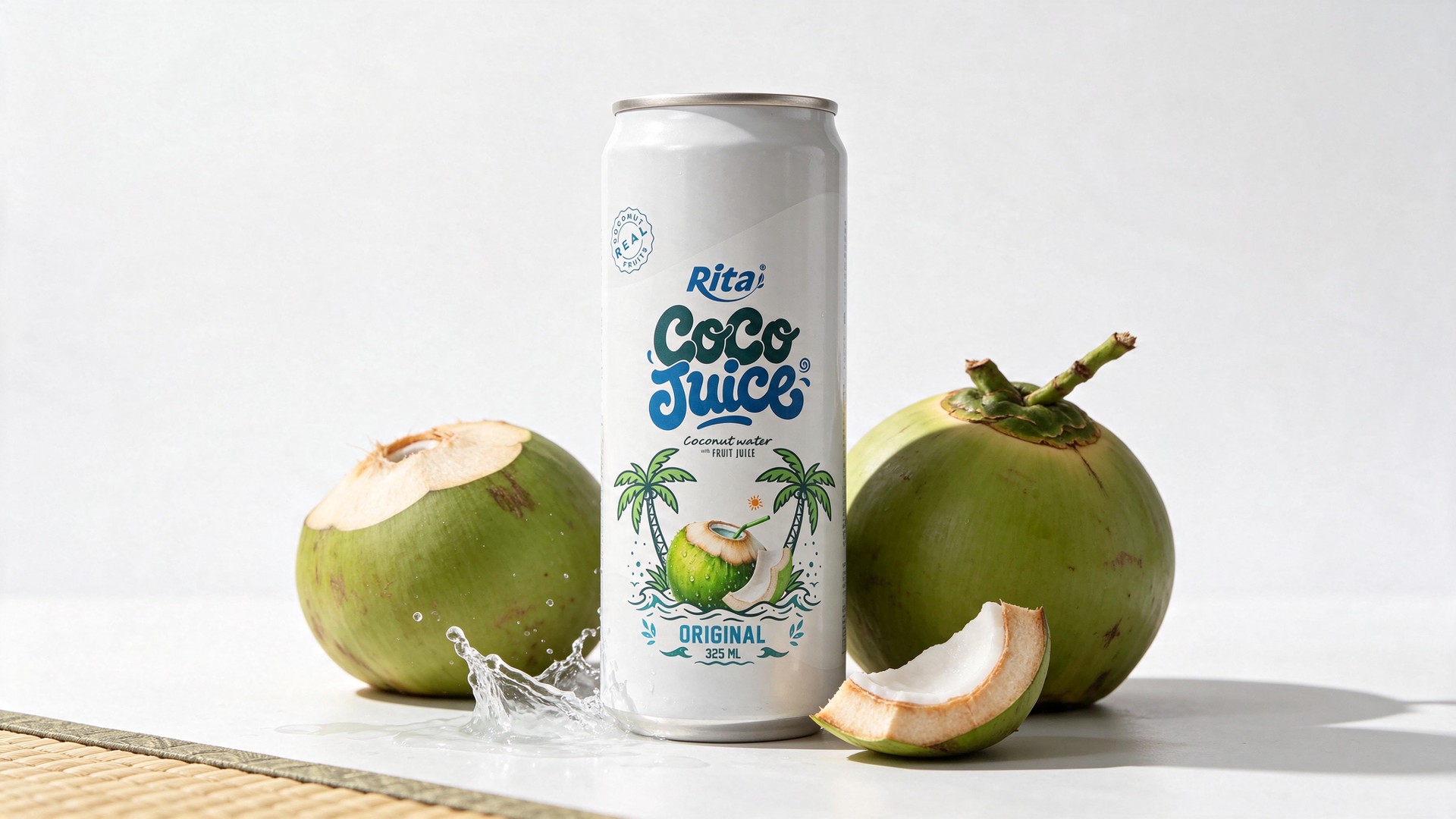
Coconut water has stepped out of the tropical drink aisle and onto mainstream shelves worldwide, and the ready-to-drink can is the format driving that movement. Coconut water now sits beside carbonated soft drinks and iced teas in chilled cabinets, where single-serve cans are the default grab-and-go choice for commuters and office workers. RITA Coco Juice Original Coconut Water 325ml Can is one of the SKUs attracting steady interest from importers who need a consistent, export-ready product backed by a complete flavor range. This article examines demand patterns, buyer specifications, packaging decisions and the manufacturing infrastructure behind the can.
Key Takeaways
- Ready-to-drink coconut water in 325ml cans is winning listings in convenience and supermarket channels across fast-growing import markets.
- Buyers now filter suppliers on certification stacks, fill consistency and packaging that survives long transit routes.
- RITA Coco Juice Original anchors a seven-flavor coconut water range, letting distributors stock a full lineup from one source.
- Private label programs with free label design and barcode support lower the entry barrier for new market players.
- Aluminum cans combine light weight, stackability and recyclability, matching sustainability expectations in modern retail.
Coconut Water Demand Strengthens Across Asia, the Middle East and Central Asia
Import inquiries for canned coconut water are climbing faster than buyers anticipated even two seasons ago.
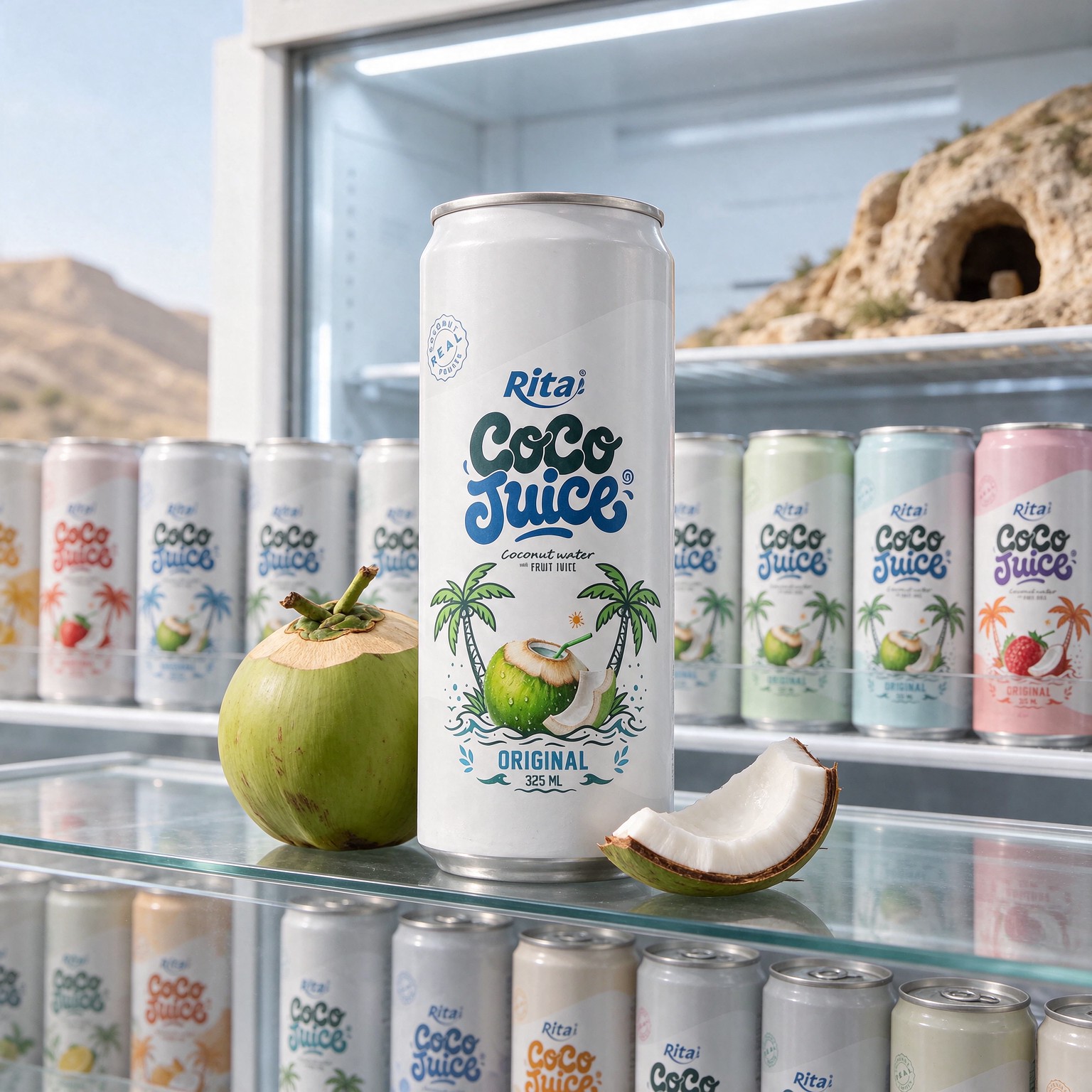
Demand is broad rather than concentrated. Distributors in Armenia, Bangladesh, Cambodia, Georgia, Indonesia, Japan, Kazakhstan, Kyrgyzstan, Kuwait, Laos, Maldives, Mongolia, Nepal, Oman, Pakistan, the Philippines, Sri Lanka, Tajikistan, Thailand, Uzbekistan and Yemen are reporting stronger interest in single-serve cans, while trial shipments are moving into Bahrain, Bhutan, Brunei, Cyprus, Jordan, Lebanon, Myanmar, the Palestinian Territories, Timor-Leste, Turkmenistan and North Korea. The pattern repeats across every conversation: retailers want a product that travels well, chills quickly and looks premium in a refrigerated cabinet.
What has changed is the channel mix. Coconut water used to move through specialty outlets and wellness-leaning stores; today mainstream supermarket chains and round-the-clock convenience operators list it on the same terms as iced coffee and flavored sparkling water, judging each SKU on turnover rate, shelf life and packaging integrity rather than on brand story alone.
Why ready-to-drink coconut water cans win shelf space
The 325ml aluminum can answers several retail requirements at once. It is light enough to ship economically by the pallet, stackable in both back-room storage and front-of-house chillers, and opaque enough to shield the contents from light during long sea freight legs and warehouse staging.
Design does the rest of the work. Bright, color-coded graphics let shoppers distinguish flavors at a glance, which matters in a cabinet where a decision is made in under three seconds. Younger, lifestyle-oriented consumers respond to the tropical artwork and clean white negative space, and the compact can fits cup holders, desk edges and delivery bags without the bulk of a glass bottle.
What importers check before placing a coconut water order
Certification paperwork has become the first filter in supplier screening, not the final checkpoint.
Importers in Halal-sensitive markets ask for recognized certificates before they ask about price, and Gulf buyers in particular expect a Halal certified beverage with a documented chain from raw material intake to finished can. Audit reports, fill-weight records and shelf-life data usually travel with the first quotation from any established coconut water supplier.
- Halal certification from recognized bodies for markets across Southeast Asia and the Gulf
- Kosher certification to widen retail acceptance in additional channels
- BRC, FSSC 22000, HACCP, ISO and GMP audit trails with traceable batch records
- Consistent 325ml fill and can integrity after palletization and sea transit
- Container loading efficiency and minimum order quantities that suit regional distributors
- Private label capability for buyers building their own branded range
Trade flows tell the same story as the shelf.
Market & Export Data
Annual Trend
| Period | Transaction count (lots) | Total value (USD) | Total weight (kg) | Total quantity (units) | Year-on-year (YoY) |
|---|---|---|---|---|---|
| Annual 2025 | 30,736 | 587,357,440 | 521,062,036 | 288,325,563 | N/A (base period) |
| Annual 2026 | 40,525 | 566,028,847 | 862,715,925 | 339,922,262 | +31.8% lots / -3.6% value / +65.6% weight / +17.9% quantity |
Data source: Tradesparq Trade Data (tradesparq.com)
Coverage: August 2025 – August 2026 (AI TradeSeek). The two “annual” rows cover unequal partial-year windows (2025 = Aug–Dec 2025; 2026 = Jan–Aug 2026, with August 2026 still in progress), so they are not directly comparable full-year periods and the YoY percentages are indicative only. A reported value of 0 in August 2026 reflects incomplete reporting, not zero actual trade value.
Top Origin & Destination Countries
| Country | Role | Transaction count (lots) | Total value (USD) | Weight (kg) | Market share % | Average price (USD/unit) |
|---|---|---|---|---|---|---|
| United States | Destination | 33,501 | 376,251,733 | 1,118,492,507 | 47.3% | 1.51 |
| Australia | Destination | 3,262 | 54,453,356 | 438,020 | 4.6% | 2.46 |
| Vietnam | Destination | 3,175 | 40,383,813 | 8,023,765 | 4.5% | 1.37 |
| Singapore | Destination | 3,122 | 89,723,882 | 9,651,955 | 4.4% | 0.79 |
| Netherlands | Destination | 2,347 | 108,766,617 | 30,248,792 | 3.3% | 4.05 |
| Peru | Destination | 1,766 | 7,125,398 | 1,247,942 | 2.5% | 3.73 |
| United Kingdom | Destination | 1,604 | 40,931,218 | 37,707,131 | 2.3% | 5.54 |
| Mexico | Destination | 1,399 | 11,812,236 | 10,699,694 | 2.0% | 2.40 |
| Costa Rica | Destination | 1,242 | 60,704,775 | 948,396 | 1.8% | 113.25 |
| Canada | Destination | 1,167 | 37,373,105 | 17,070,499 | 1.6% | 3.28 |
| Origin countries | Origin | N/A | N/A | N/A | N/A | N/A |
Data source: Tradesparq Trade Data (tradesparq.com)
Origin-country breakdown was not included in the source extract, so origin figures are shown as N/A rather than estimated. Destination figures cover August 2025 – August 2026.
Top HS Codes by Transaction Count
| HS code | Description | Transaction count (lots) | Total value (USD) | Weight (kg) | Market share % | Average price (USD/unit) |
|---|---|---|---|---|---|---|
| 200989 | Single fruit/vegetable juices, other | 24,208 | 466,501,000 | 487,667,981 | 34.4% | 1.49 |
| 220299 | Other non-alcoholic beverages | 9,126 | 77,862,232 | 70,227,940 | 12.9% | 3.41 |
| 200939 | Citrus juices, not fermented, Brix >20 | 3,259 | 167,206,615 | 16,600,794 | 4.6% | 3.83 |
| 330300 | Perfumes / toilet waters | 2,029 | 2,761,138 | 527,788 | 2.9% | 14.48 |
| 210690 | Other food preparations | 1,949 | 18,397,993 | 37,784,144 | 2.8% | 0.82 |
| 200990 | Mixtures of fruit/vegetable juices | 1,916 | 11,640,495 | 11,953,665 | 2.7% | 3.00 |
| 220210 | Waters, sweetened/flavoured | 1,833 | 1,855,697 | 7,119,711 | 2.6% | 1.63 |
| 200969 | Grape juices, other | 1,616 | 111,500,040 | 34,905,877 | 2.3% | 2.04 |
| 481190 | Other paper/board cellulose | 1,294 | 13,713,003 | 0 kg | 1.8% | 1.86 |
| 200819 | Other prepared nuts and seeds | 839 | 38,164,473 | 42,311,897 | 1.2% | 26.41 |
Data source: Tradesparq Trade Data (tradesparq.com)
Across the August 2025 – August 2026 window, the United States is the dominant destination market with 33,501 lots, 47.3% market share, USD 376,251,733 in declared value and 1,118,492,507 kg of weight, at an average price of 1.51 USD per unit — close to the global average. Australia (4.6%, 2.46 USD), Singapore (4.4%, 0.79 USD), the Netherlands (3.3%, 4.05 USD) and the United Kingdom (2.3%, 5.54 USD) follow, with Vietnam accounting for 4.5% of lots at 1.37 USD per unit. Higher average prices appear in the United Kingdom, Canada (3.28 USD) and Costa Rica (113.25 USD), while Singapore and the Netherlands operate as regional re-export and distribution hubs at lower and mid-to-high price points respectively.
By product category, single juices under HS 200989 lead with 34.4% of lots at 1.49 USD per unit, while non-alcoholic beverages under HS 220299 hold 12.9% of lots at a higher 3.41 USD per unit, indicating demand for value-added, flavoured and functional coconut water formats. Monthly activity is seasonal, peaking at 7,855 lots in 09/2025 and 7,110 lots in 05/2026 and falling to 748 lots in 08/2026 during the low season; the 08/2026 value of 0 reflects incomplete reporting for that month rather than an absence of trade.
Buyers reading those figures are already adjusting coconut water export volumes, shipment windows and promotional calendars to match the pace.
Product Spotlight: RITA Coco Juice Original Coconut Water 325ml Can
The Original variant is the anchor of the range, and it is the reference 325ml coconut water can against which buyers sample the rest.
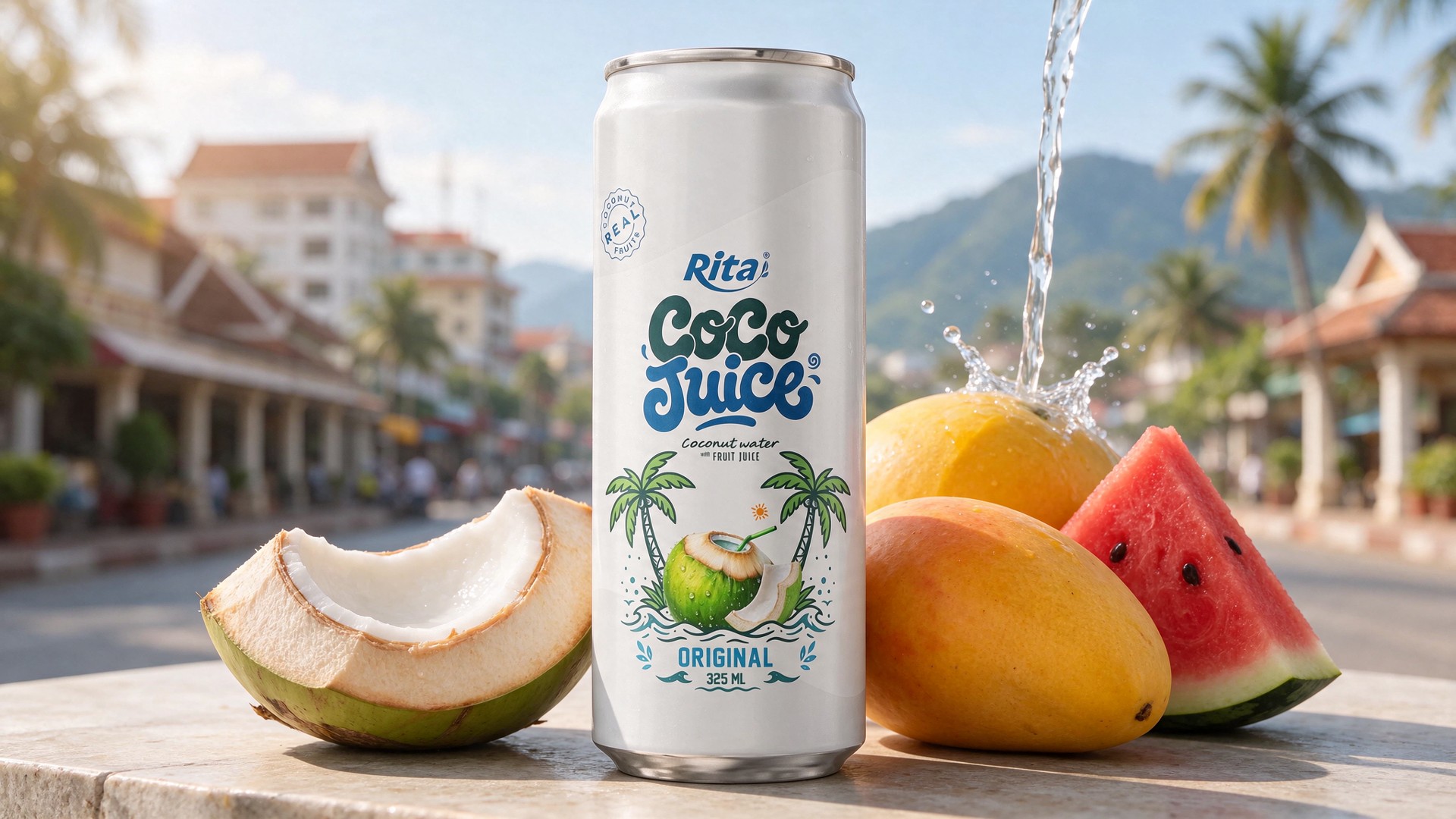
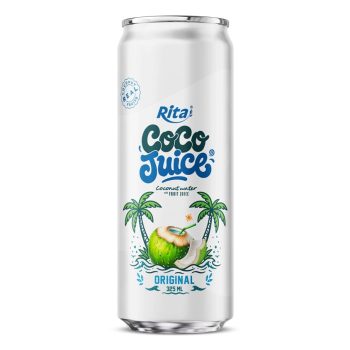
The RITA Coco Juice Original Coconut Water 325ml Can is a ready-to-drink beverage that blends coconut water with fruit juice and displays a circular “Coconut Real Fruit” seal on the front panel. The formulation carries no artificial flavors, no artificial colors and no preservatives, and it is not made from concentrate. On the palate the drink reads clean and lightly sweet, with a crisp finish that suits chilled sipping straight from the can.
Those label claims matter commercially. Buyers building a range around transparent ingredient lists can present the product without rewriting the back panel, and the not-from-concentrate positioning gives sales teams a simple answer when shoppers compare cans side by side in the aisle.
Packaging design built for modern retail
The tall, slim can uses a silver-white base with sky-blue and teal-green accents. Stylized palm trees, a young coconut pierced by a straw, a cut coconut wedge and hand-drawn water splashes create a tropical scene, while generous white negative space keeps the panel uncluttered and modern. The brand name sits in bold blue-green lettering that stays legible under chiller lighting.
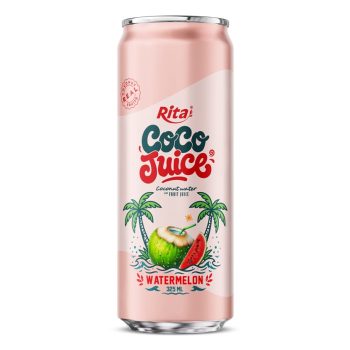
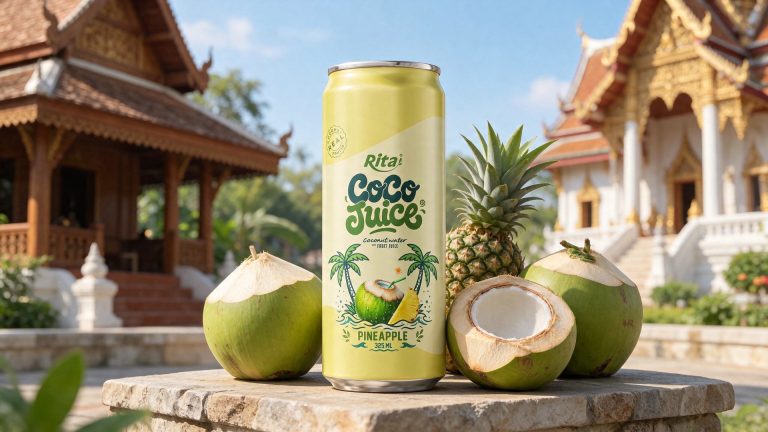
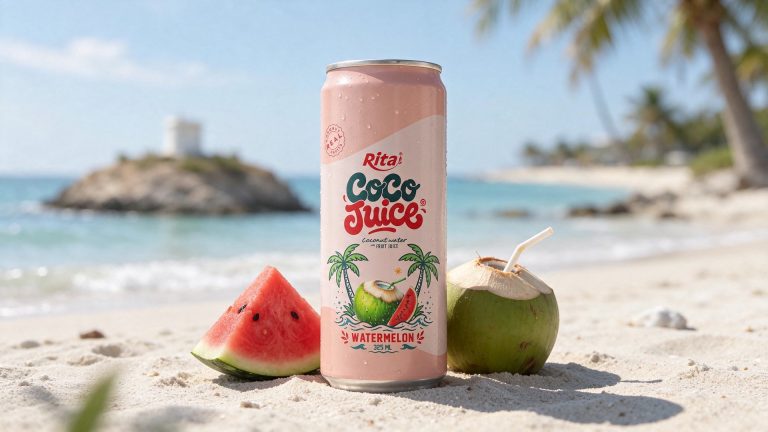
Across the seven flavors, the same layout is retained but the accent colors shift, so a pineapple variant, a watermelon variant and the Original can be told apart from two meters away. That color-coding supports shelf blocking, where a full row of coordinated cans reads as a deliberate range rather than a single stray SKU.
Aluminum also solves a logistics problem that plastic and carton formats handle less neatly.
A seven-flavor lineup from a single source
The Original sits alongside Pineapple, Watermelon, Cucumber, Blueberry, Mango and Lime & Salt, all in the same 325ml can. For a distributor, that means one purchase order, one set of shipping documents and one delivery schedule can cover an entire coconut water fixture instead of six separate supplier relationships.
Buyers reviewing the full coconut products catalog can see how the Original variant fits within a wider portfolio that also covers coconut milk, coconut cream and blended coconut drinks. The Original 325ml can is typically the reference SKU for sampling, because it sets the flavor baseline against which the other six are judged.
From Our Orchards: Raw Material Sourcing and Farm Partnerships
Sourcing credibility starts in the field, long before a can is sealed on the line.
RITA’s coconut sourcing story runs through the Ben Tre coconut farm in Vietnam’s Mekong Delta, where plantation-level inspections set the baseline for raw material selection and establish traceability from harvest to finished beverage.
A walkthrough of the plantation and its handling process is available here: https://www.youtube.com/watch?v=I7hlTL3FT_0
For importers, this chain of custody is more than a marketing asset. It underpins the batch records and lot traceability that auditors request during certification reviews, and it gives sales teams a concrete answer when retail customers ask where the coconut water comes from.
Export Infrastructure Behind the Can
Scale, not enthusiasm, is what turns a good product into a dependable multi-container supply contract.
RITA Food and Drink Co., Ltd, established in 2004, operates as a Vietnamese OEM beverage manufacturer and ODM partner with more than 50 automated production lines and over 1,200 containers shipped every month. The company supplies brands in more than 180 countries and reports export reach across 200-plus countries and territories, covering tropical fruit juices, coconut products, functional drinks, energy drinks and teas in aluminum cans, glass bottles, PET and PP formats. That infrastructure is what allows a distributor to scale from a trial pallet to a recurring programme without renegotiating the entire supply arrangement.
Certification coverage is equally broad, and each standard answers a different buyer question:
| Certification | What it signals to a buyer |
|---|---|
| BRC | Retail-grade food safety audit recognized by major global chains |
| FSSC 22000 | Food safety management system built for international supply chains |
| HACCP | Documented hazard controls at every production stage |
| Halal Jakim and Halal HCA-GCC | Acceptance in Southeast Asian and Gulf markets |
| Kosher | Wider retail and foodservice eligibility |
| ISO, GMP, SMETA | Quality systems, manufacturing practice and ethical audit compliance |
Trade buyers can open the RITA Coco Juice Original Coconut Water 325ml can page for pack details and export specifications, then compare it with the aseptic coconut water brands category when a different container format suits the route to market better.
Private Label Opportunities for Distributors and Brand Owners
For distributors building their own label, the entry cost has just fallen sharply.
RITA runs flexible private-label programs that let buyers adjust flavor profiles, packaging designs and labeling while drawing on the same production infrastructure used for the Coco Juice range. Additional formats including glass, PET and PP bottles, plus aseptic options, are available when a market prefers a different format or when a retail chain specifies one.
- Free product samples for evaluation before committing to an order
- Free label design support to get artwork retail-ready quickly
- Barcode creation for immediate listing in modern trade systems
- Promotional material assistance for launch campaigns
- Container planning guidance to match order size with shipping cost
The practical effect is a shorter path from decision to shelf. A regional importer can test a private label coconut water programme in one market, review sell-through data, and then extend the programme to neighbouring territories without redesigning the product or requalifying the factory. Buyers who want to see the broader coconut portfolio before committing can start with the coconut drinks range and move into sampling from there.
For brands weighing their options, the calculation is straightforward. A single supplier that can deliver certified quality, a complete flavor lineup, flexible packaging and documented export experience removes several layers of coordination from the supply chain, and that efficiency tends to show up in margin long before it shows up in press coverage.
Frequently Asked Questions
What is RITA Coco Juice Original Coconut Water?
It is a ready-to-drink coconut water beverage supplied in a 325ml aluminum can, blending coconut water with fruit juice and carrying a Coconut Real Fruit seal, with no artificial flavors, colors or preservatives and no concentrate.
Which flavors are available alongside the Original?
The Coco Juice range includes Pineapple, Watermelon, Cucumber, Blueberry, Mango and Lime & Salt, all in the same 325ml can format for a coordinated shelf presentation.
Can the product be supplied under a private label?
Yes. RITA offers private label programs covering flavor adjustment, packaging design and labeling, supported by free samples, free label design, barcode creation and promotional assistance.
What certifications support export orders?
The manufacturing base holds BRC, FSSC 22000, HACCP, ISO, GMP, Halal (Jakim and HCA-GCC), Kosher and SMETA certifications, covering food safety, dietary requirements and ethical compliance.
What packaging formats are available beyond the can?
Glass bottles, PET and PP bottles and aseptic options are available, giving buyers flexibility to match local retail preferences and distribution routes.