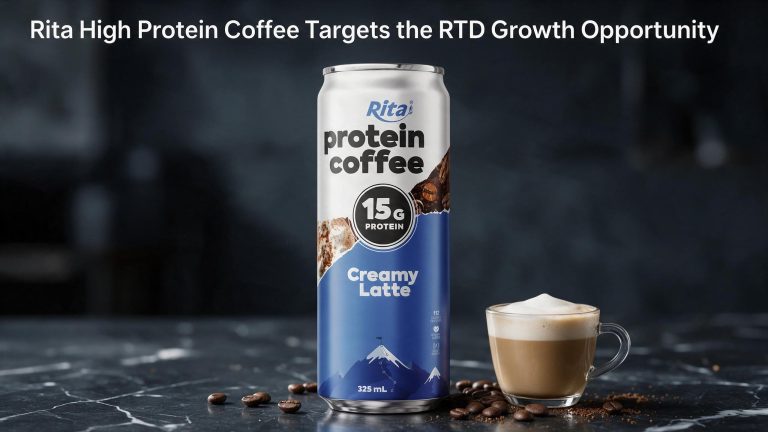
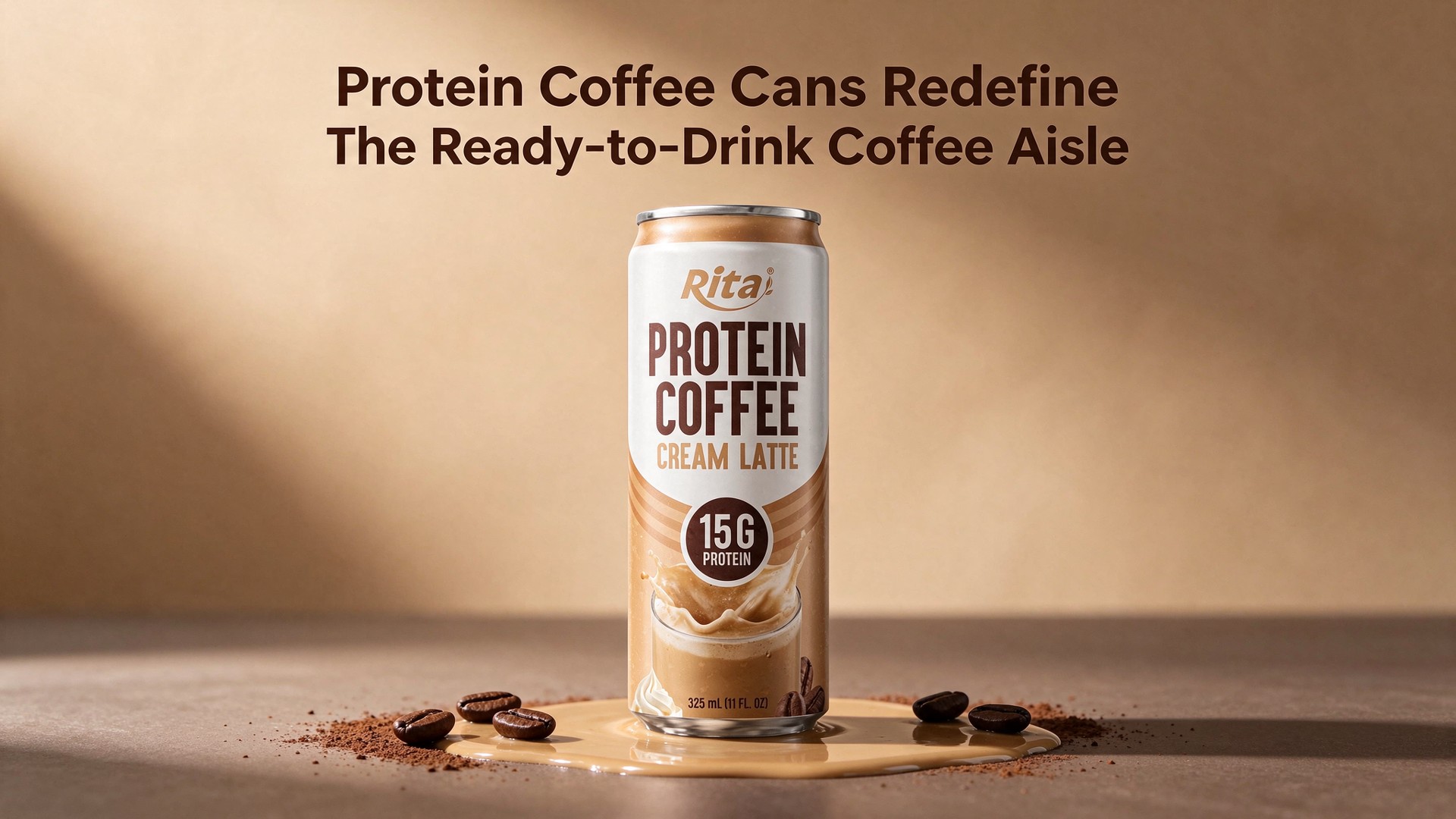
The ready-to-drink coffee aisle is being redrawn by a single format, the protein coffee can. Canned coffee blended with milk protein has moved from novelty experiment to mainstream chilled and ambient shelf, and the newest entrants are engineered for taste first, texture second, and label clarity third. RITA Cream Latte Protein Coffee 325ml Can with 15g Protein is a clear expression of that shift: a cafe-style cream latte delivered in a sleek aluminum can for commuters, students and office workers who buy coffee from a cooler door rather than an espresso bar. For importers and private label buyers, the format pairs a familiar taste memory with a protein figure that reads in three seconds at shelf.
Key Takeaways
- Protein-enriched canned coffee is moving from novelty to routine across convenience and supermarket channels.
- Each 325ml can delivers a 15g protein claim, 183 kcal and 62 mg of caffeine in a cafe-style cream latte.
- Clean-label positioning with no artificial flavors, colors or preservatives now shapes premium coffee purchases.
- BRC, FSSC 22000, ISO, GMP, HACCP and Halal credentials underpin export readiness to more than 200 countries and territories.
- A 24-month ambient shelf life plus OEM and private label capability reduces distribution risk for buyers.
Protein Coffee Demand Moves From Novelty To Routine Across Asia
Momentum is no longer driven by novelty. Shoppers compare protein grams and sugar levels at the cooler the way they once compared roast profiles.
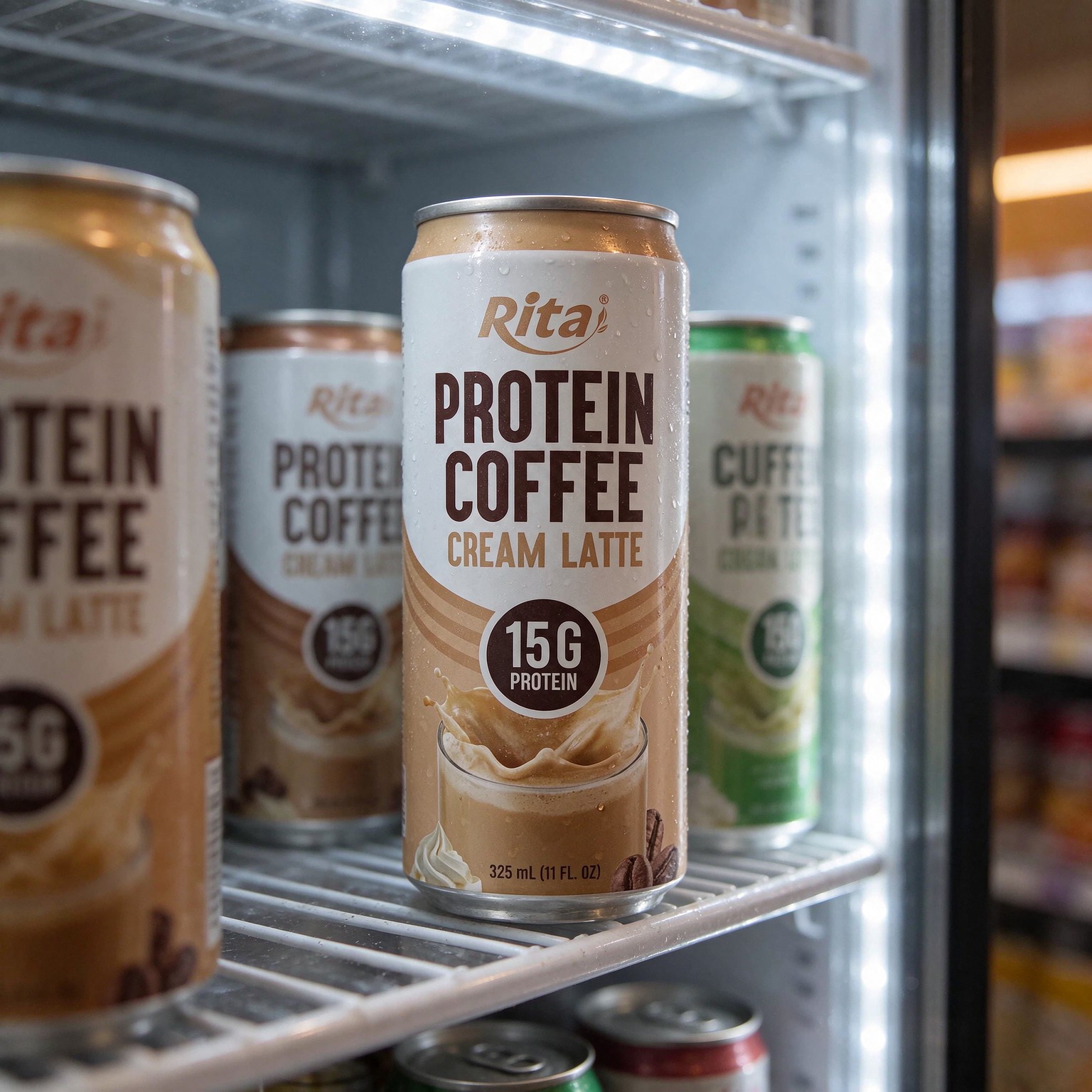
Across Southeast Asia, East Asia and South Asia, canned coffee occupies a strategic position in convenience stores, supermarkets and vending channels where portability, price and pack visibility decide the sale. The category has matured well beyond sweetened black coffee and milk tea, and protein coffee variants now appear among the most visible new launches each season. Retail buyers describe the segment as a bridge between the cafe counter and the snack chiller, capturing consumers who want coffee taste without queuing.
Why Protein Coffee Wins At The Cooler Door
Consumer research across Asian beverage markets repeatedly points to the same purchase sequence: flavor expectation first, then pack format, then the nutrition panel. A cream latte delivers a familiar taste memory, while the 15G figure gives shoppers a concrete number to compare against rival cans and sachets. The 325ml (11 fl. oz) size sits comfortably in cup holders and desk drawers, and the slim aluminum can chills quickly in open-front coolers. For retailers, that combination translates into faster turns in a category dominated by impulse decisions.
Portability is the quiet advantage. A sealed can travels from store to desk without a lid, a sleeve or a spill risk.
That practicality matters in dense urban markets where morning routines are compressed and where coffee is increasingly purchased outside the home. It also supports multiple consumption occasions, from a mid-morning desk drink to an afternoon desk break, without asking the shopper to switch brands or formats.
Clean-label expectations complete the picture. When a can lists no artificial flavors, colors or preservatives, the ingredient deck stops being a barrier and becomes a talking point for shelf staff, in-store tasting teams and e-commerce listings alike. Buyers report that the absence of a long additive list shortens conversations with category managers during listing appointments, and it simplifies label copy for private label partners who must translate claims for several markets at once.
Inside The 325ml Can: Formulation, Taste And Packaging
The recipe is deliberately short and recognisable. Whole milk powder, milk protein concentrate and instant coffee powder carry the flavor.
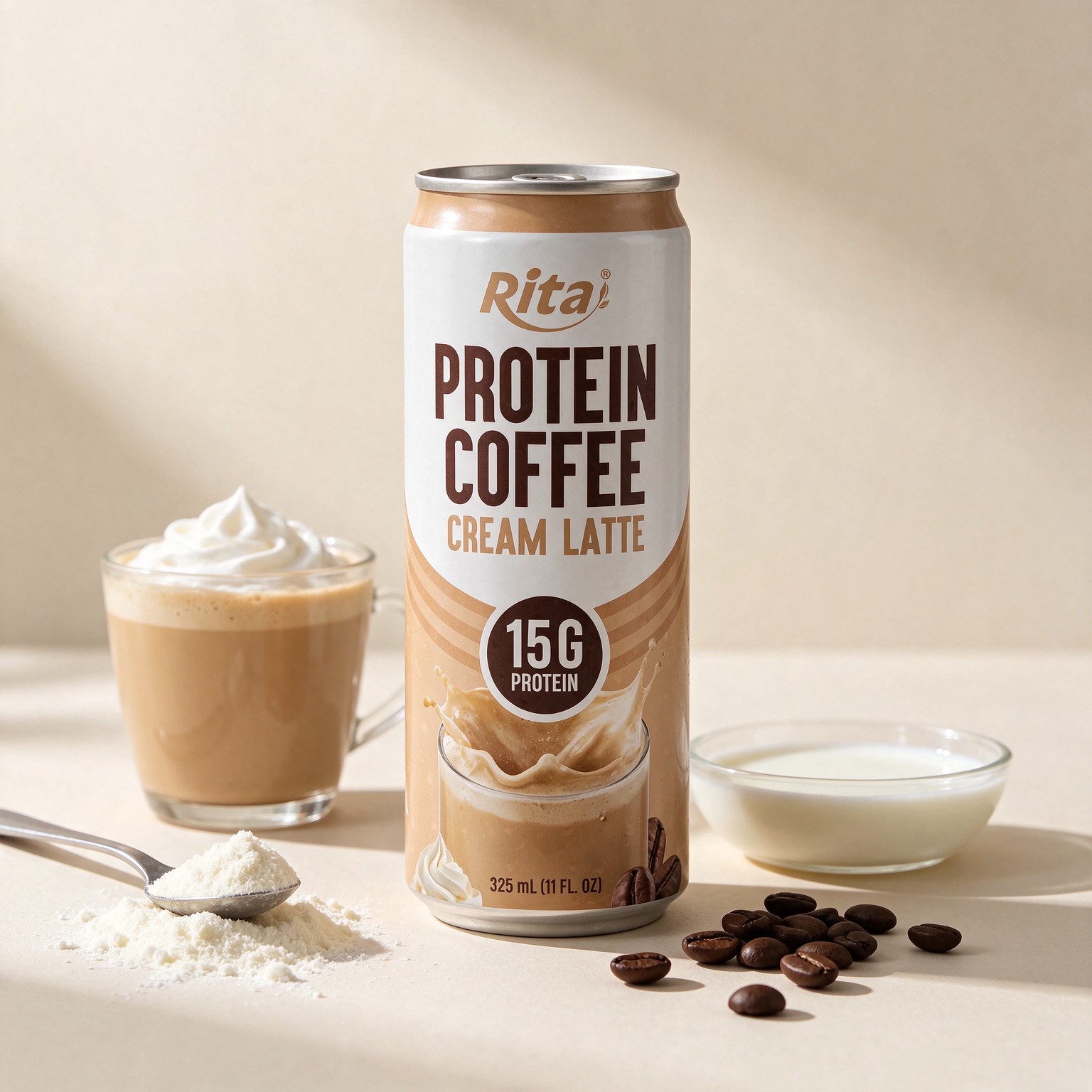
RITA Cream Latte Protein Coffee 325ml Can with 15g Protein builds its profile on a dairy-forward base: whole milk powder and milk protein concentrate supply body and a rounded sweetness, while instant coffee powder contributes roasted top notes. Stabilizers and emulsifiers keep texture consistent from the first sip to the last, an important detail for a product with a 24-month shelf life held in cool, dry conditions. The formulation carries no artificial flavors, colors or preservatives, aligning with the clean-label expectations that now shape purchases in premium coffee segments.
| Parameter | RITA Cream Latte Protein Coffee |
|---|---|
| Pack format | 325ml (11 fl. oz) sleek aluminum can |
| Protein claim | 15g per can |
| Energy | 183 kcal |
| Caffeine | 62 mg |
| Total fat | 6.2 g |
| Total carbohydrates | 13 g |
| Total sugars | 11.4 g |
| Sodium | 254 mg |
| Shelf life | 24 months in cool, dry storage |
| Label claims | No artificial flavors, colors or preservatives |
A Cream Latte Profile Built On Whole Milk And Instant Coffee
The flavor target is a cafe-style cream latte rather than a bitter long black: rich dairy sweetness up front, a roasted coffee middle, and a smooth, velvety finish. That profile travels well in markets where milk coffee outperforms black coffee in ready-to-drink formats, and it gives distributors a single hero SKU to anchor a wider coffee range.
Dairy ingredients are central to the mouthfeel. Milk protein concentrate lends the density consumers associate with a freshly poured latte, while the milk powder base softens the acidity of the instant coffee. Buyers assembling a mixed chilled portfolio often pair the can with items from RITA’s milk series so the assortment reads as one family of drinks rather than a scattered set of singles.
Packaging Designed For Shelf Recognition
The can does most of the selling before the tab is pulled, and the artwork is built for a three-second glance.
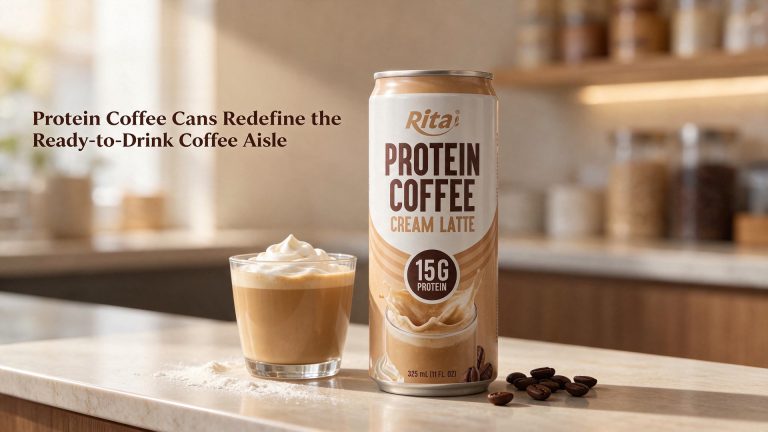
A clean white upper field transitions into warm tan and coffee-brown tones, accented by a realistic latte splash, a whipped cream swirl and scattered roasted coffee beans. A dark-brown circular badge displays the 15G protein figure in high contrast, giving shoppers an immediate reason to lift the can from a crowded cooler.
For an aluminum can beverage, chill speed and print registration matter as much as graphic design. Slim aluminum chills fast in open-front coolers, prints with sharp registration for fine badge detail, and shields coffee flavors from light and oxygen across a long ambient life, practical considerations for importers shipping through warm supply chains. The format also photographs cleanly for marketplace listings, where the badge and the splash graphic carry the message without extra copy.
From Highlands To Can: Coffee Sourcing Behind The Recipe
Flavor consistency in a canned latte begins long before the filling stage. The instant coffee powder in the recipe traces back to highland harvests, and decisions at origin shape the roast profile consumers taste months later.
RITA’s technical teams document that chain directly: field visits to Vietnam’s coffee gardens at peak harvest season record cherry maturity, drying conditions and lot selection before beans move into processing. Those observations feed back into specification work for instant coffee powders used in ready-to-drink formulations, helping manufacturers hold flavor steady across production runs and across seasons.
Footage from the same harvest-season visit offers a visual account of the journey from garden to can: https://www.youtube.com/watch?v=F2yJLjUYiuo
Export Trade Outlook For Canned Coffee
Ambient canned coffee travels well across long lanes, and that is half the export argument for importers.
The RTD coffee market rewards formats that survive long lanes and warm warehouses, and ambient cans fit that brief. For buyers, the practical questions are shelf life, certification coverage and pack integrity. A 24-month ambient life under cool, dry storage gives distributors room to plan promotional calendars without write-off pressure, while slim cans stack efficiently in mixed pallets. Certification scope matters just as much at customs, where tender packs increasingly demand a single audit trail rather than a patchwork of national documents.
RITA Food and Drink Co., Ltd, established in 2004, runs more than 50 automated production lines and ships over 1,200 containers a month, a scale that supports both branded export programs and contract volumes. The company’s credentials include BRC, FSSC 22000, ISO, GMP, HACCP, Halal Jakim, Halal HCA-GCC, Kosher and SMETA, covering the documentation most importers request before the first purchase order.
Halal coverage deserves separate mention in coffee. It is often the deciding file in markets where certification is a listing precondition rather than a preference, and having both Jakim and GCC schemes on file removes a common delay at onboarding.
Manufacturing Scale And OEM Partnership Model
Private label demand in coffee is rising faster than branded shelf space can absorb.
For a coffee drink supplier evaluating a launch, the RITA Cream Latte Protein Coffee 325ml can works as a reference specification: formulation, can format, label claims and shelf life are already defined, which shortens the approval cycle for a new market. RITA’s wider coffee drinks portfolio shows how the same platform extends into different roast levels, sweetness profiles or pack sizes under OEM and ODM agreements.
The OEM model covers the full chain, recipe development, ingredient sourcing, can decoration, filling and export documentation, so a buyer can enter a category without building production capacity. ODM work goes further, with RITA’s R&D team adapting flavor systems to local palates, whether that means a sweeter latte for one market or a lighter roast for another.
As an OEM beverage manufacturer exporting to more than 200 countries and territories, RITA positions itself as a single-source partner for a 15g protein drink concept, from first sample to container loading. Buyers hold one point of contact for recipe sign-off, label artwork, Halal documentation and shipment scheduling, which shortens communication loops when launches run against tight retail calendars.
Plant efficiency is also on the industry agenda, with food and beverage producers examining waste-heat recovery to trim energy costs across continuous filling operations.
Channel Strategy And Competitive Positioning
The can is built for three channels, and each rewards a different message.
Convenience stores favour the front-of-pack protein badge and cold visibility; supermarkets respond to take-home multipacks and shelf blocking; vending, transport and workplace retail reward a sealed, spill-free format. Positioning a protein coffee can against established milk coffee brands is therefore less about price and more about the clarity of the front panel. Buyers browsing the coffee drink category can compare the RITA Cream Latte Protein Coffee 325ml can against adjacent SKUs before requesting samples.
- Convenience and forecourt stores: single-serve cold grab, badge-led decisions at the door
- Supermarkets and hypermarkets: multi-can take-home packs and flavor-family blocking
- Vending, transport and workplace retail: sealed format with no preparation equipment
- Modern trade e-commerce: subscription bundles and mixed coffee assortments
Competitive context is sobering. Major brewers have reported sales tracking below expectations in parts of Europe and Asia-Pacific, a reminder that coffee volumes are not automatic and that new formats must earn their facings. Category watchers also note that discussions around ready-to-drink taxation in European markets can reshape pricing assumptions for exporters planning long-range launches.
For mid-size manufacturers, the opening lies in taste consistency plus documentation discipline rather than marketing spend.
Frequently Asked Questions
What is RITA Cream Latte Protein Coffee?
It is a ready-to-drink cream latte packed in a 325ml (11 fl. oz) aluminum can, formulated with whole milk powder, milk protein concentrate and instant coffee powder. Each can carries a 15g protein claim, 183 kcal and 62 mg of caffeine, with no artificial flavors, colors or preservatives.
How should the product be stored and how long does it keep?
The can holds a 24-month shelf life when stored in cool, dry conditions away from direct sunlight.
Which certifications support export of this product?
Production runs under BRC, FSSC 22000, ISO, GMP and HACCP systems, with Halal Jakim and Halal HCA-GCC coverage plus Kosher and SMETA audits. RITA Food and Drink Co., Ltd exports to more than 200 countries and territories from a base of over 50 automated production lines.
Can buyers order the product under OEM or private label?
Yes. RITA offers OEM and ODM services covering formulation, can decoration, filling and export documentation, and can adapt roast level, sweetness level and pack size to a local brief.
Which channels perform best for this format?
Convenience stores, supermarkets, vending and transport retail are the core channels, since the sealed can suits cold single-serve grab, multipack take-home and equipment-free locations.