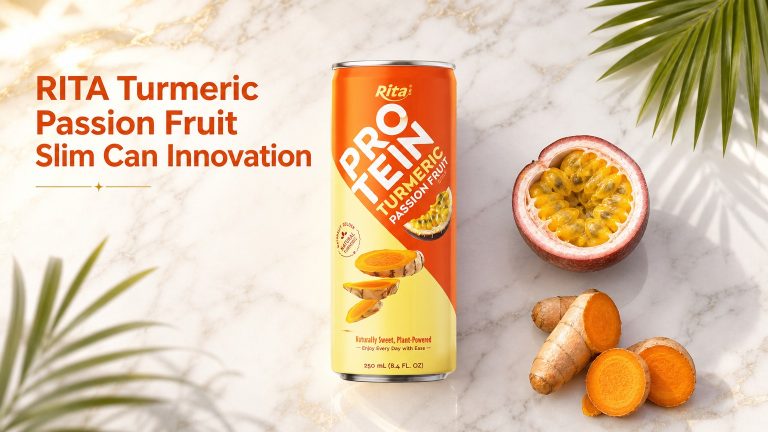
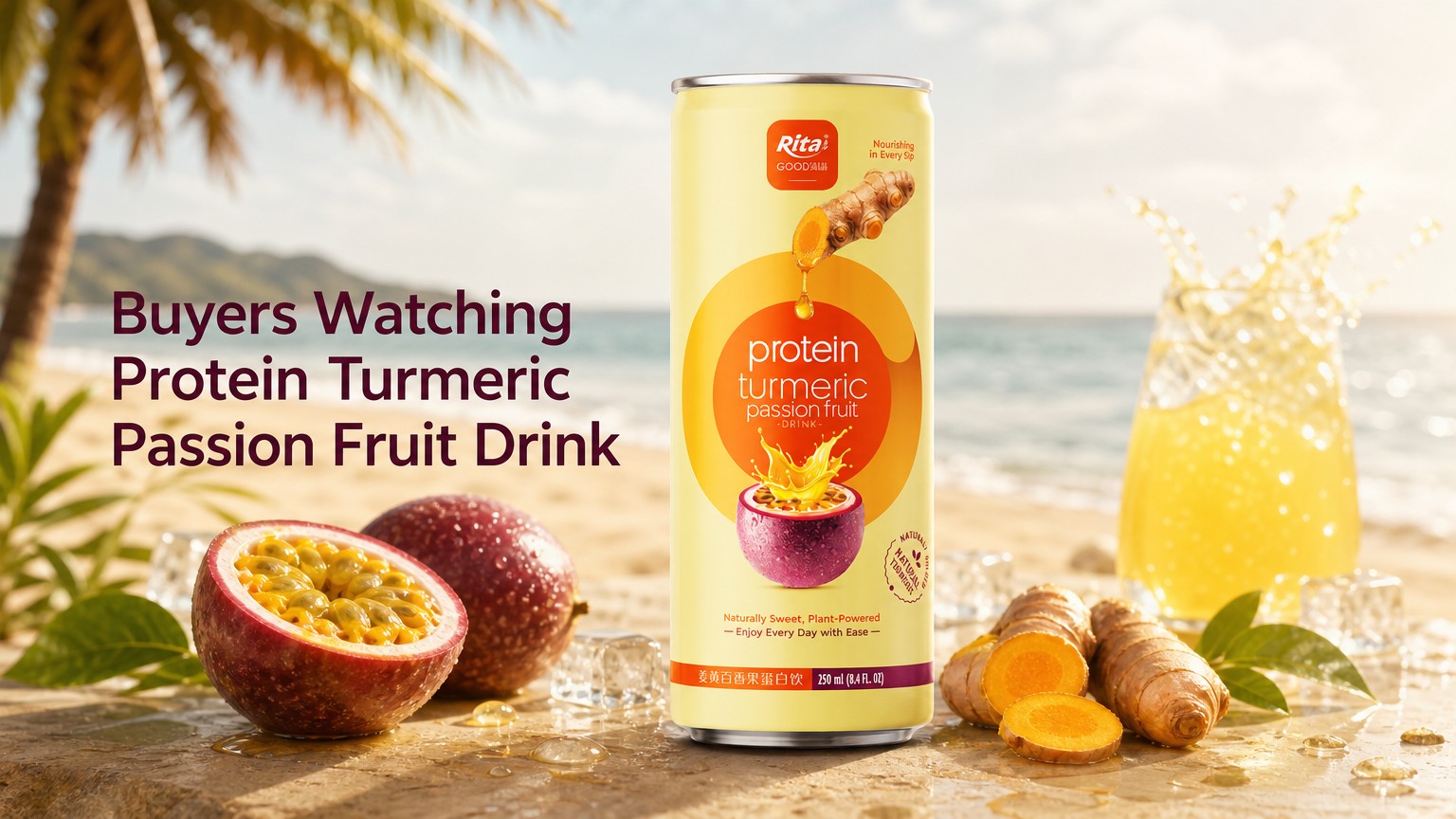
The plant-based protein beverage category has moved well beyond niche shelf space, and one format is now drawing steady attention from buyers: the protein turmeric passion fruit drink packaged in a 250 ml slim can. RITA Food and Drink Co., Ltd has brought the product to market as part of a wider push into tropical, protein-enriched ready-to-drink beverages that pair real fruit juice with plant-derived protein and a low-sugar sweetening system. For distributors, retailers and foodservice operators scanning portfolios for differentiated stock-keeping units, the offering points clearly to where category demand is heading.
Key Takeaways
- The drink combines 10% real passion fruit juice, 3% plant-based protein and monk fruit sweetness in a 250 ml slim aluminum can.
- The ingredient list stays short: water, passion fruit juice, plant protein, turmeric extract and monk fruit sweetener, with no artificial flavors, colors or preservatives.
- Dual-language labeling and a compact format support multi-market distribution and grab-and-go retail.
- Production sits behind RITA’s export infrastructure, with BRC, FSSC 22000, Halal, Kosher, ISO, GMP, HACCP and SMETA certifications and shipments to more than 200 countries and territories.
- Passion fruit sourcing draws on growing regions in Vietnam’s Central Highlands.
Market Momentum for the Protein Turmeric Passion Fruit Drink
Protein-enriched ready-to-drink beverages have moved from experiment to staple in a remarkably short span of time.
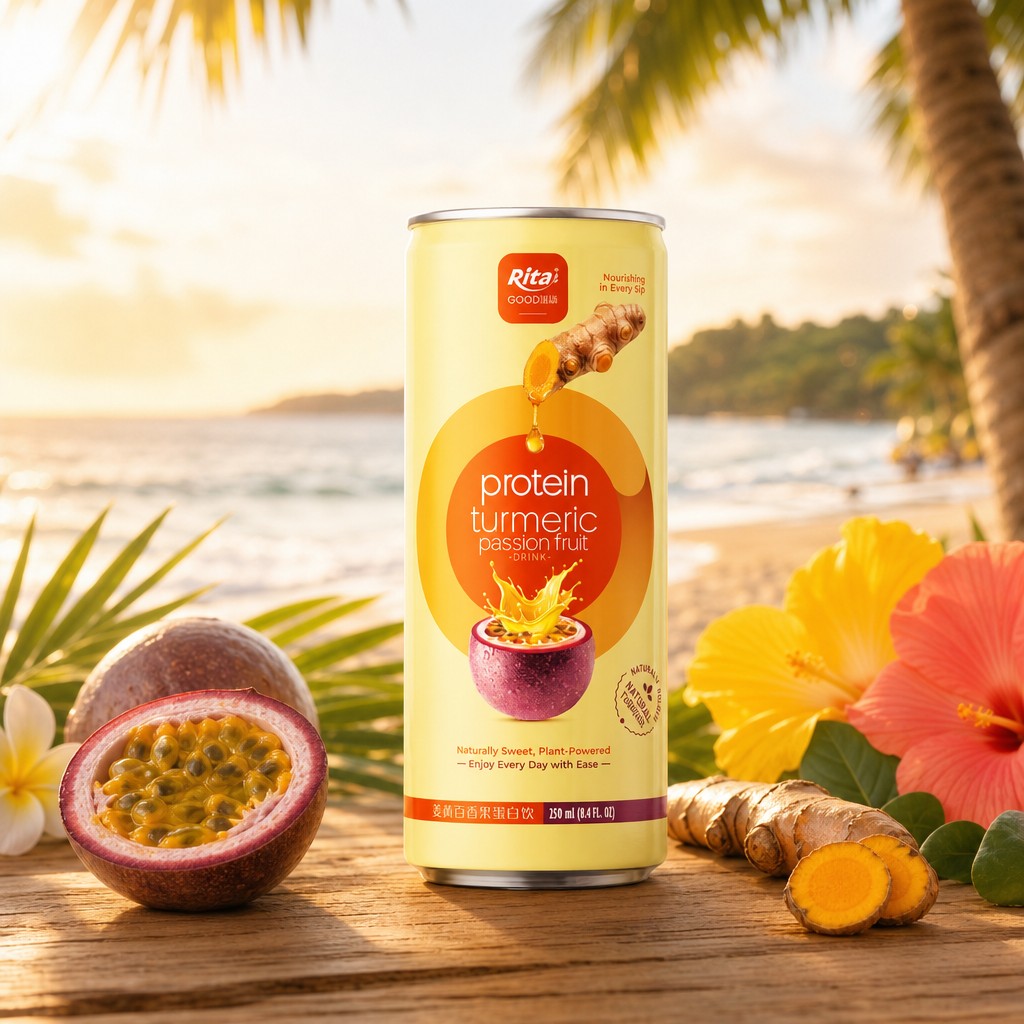
Across Southeast Asia, East Asia and South Asia, the buying conversation has shifted toward drinks that deliver a short ingredient list, a recognizable fruit flavor and a format that travels well. In Thailand, Indonesia, the Philippines, Malaysia, Vietnam and Singapore, convenience-store chilled cabinets increasingly carry small-format cans alongside traditional juice and tea. In Japan, South Korea and Taiwan, shoppers have grown accustomed to reading labels closely and comparing sweetener types before purchase. India, Bangladesh, Sri Lanka and Pakistan add a large, price-sensitive consumer base where single-serve packaging and clear value cues matter at the point of sale.
The category is also benefiting from a broader pivot toward simpler formulations. Buyers are reading front-of-pack claims with more skepticism and turning instead to short, transparent ingredient panels. That shift favors products built around a handful of recognizable inputs rather than long formulations assembled from layered flavor systems. The protein turmeric passion fruit drink is designed around exactly that logic, listing water, passion fruit juice, plant protein, turmeric extract and monk fruit sweetener as its complete composition.
Clean Labels and Shorter Ingredient Lists
Short ingredient lists have become a commercial asset, not merely a marketing line.
Formulators across the beverage industry have spent the past several years stripping products back to essential components, and the trend shows no sign of slowing. Drinks that avoid artificial flavors, artificial colors and preservatives are easier to explain on shelf talkers, in sales decks and during private-label negotiations. For a 250 ml can that must communicate its proposition within a second or two of shelf glance, simplicity translates directly into speed of comprehension. It also simplifies compliance work when the same artwork travels across several regulatory regimes, because fewer declared additives means fewer questions from importing authorities and retail technical teams.
Plant-Based Protein Moves Beyond the Dairy Aisle
Plant protein has left the specialty shelf and entered mainstream ready-to-drink formats.
Where protein drinks once meant thick dairy-based shakes, the market has broadened considerably. Lighter, fruit-forward formulations now sit alongside them, offering 3% plant-based protein in a body that drinks more like a juice than a meal replacement. That lighter profile widens the consumption window: casual sipping during a commute, a pairing alongside a meal, or a between-task refresher during a busy day. Retailers looking to extend the category without cannibalizing existing dairy lines can find room for a tropical option in the same fixture. RITA’s milk series portfolio illustrates how the manufacturer approaches protein-bearing drink formats across different bases, fill volumes and packaging options.
- Plant-based protein at 3% keeps the drink light in body rather than heavy or chalky.
- Monk fruit sweetening keeps sugar levels low while preserving a rounded sweetness.
- Turmeric extract adds an earthy counterpoint to the bright acidity of passion fruit.
- A crisp finish supports repeat sipping across an afternoon rather than a single gulp.
Inside the Protein Turmeric Passion Fruit Drink: Formulation and Packaging
The formulation is deliberately compact, and the packaging does much of the selling.
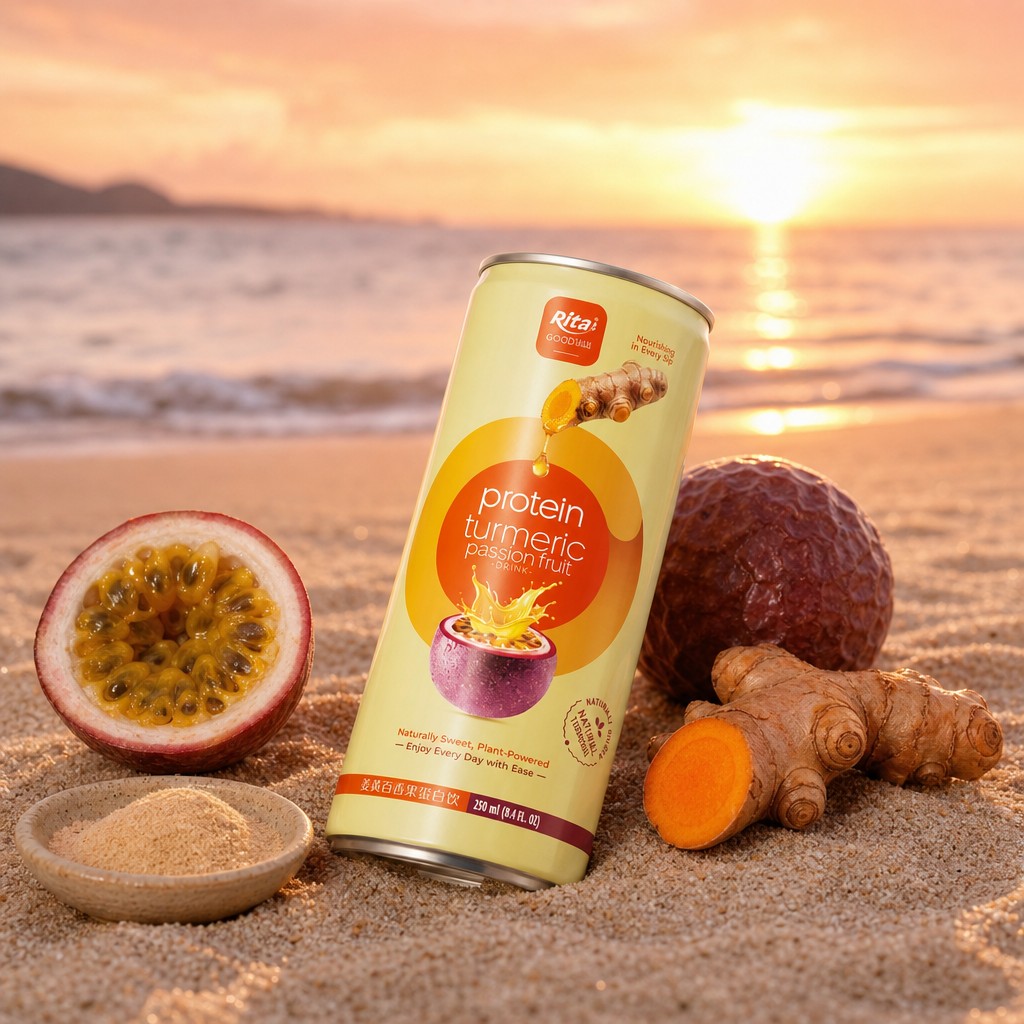
Ten percent real passion fruit juice anchors the flavor, giving the drink its tart, tropical top note. Three percent plant-based protein adds body without turning the beverage heavy, while monk fruit sweetener replaces conventional sugar to keep the sweetness clean and the sugar level low. Turmeric extract rounds out the profile with a warm, earthy undertone that lingers briefly after the fruit fades. Water completes the list. There are no artificial flavors, colors or preservatives in the formula, a detail that matters increasingly in export documentation and retailer questionnaires. Buyers who want the full specification can review the protein turmeric passion fruit drink product page, which sets out the complete composition, fill volume and case configuration.
The 250 ml Slim Can and Grab-and-Go Consumption
Format choice decides where a drink is sold and how often it is picked up.
The 250 ml (8.4 fl oz) slim aluminum can is a deliberate selection for modern retail. Its tall, narrow silhouette reads as premium in a chilled cabinet and fits comfortably in a hand, a bag compartment or a vending spiral. The format suits grab-and-go consumption, vending machines, travel catering, hotel minibars and foodservice outlets where portion control and speed of service both matter. Aluminum also provides a dependable barrier for shelf life and chills quickly, which counts in warmer retail environments across the region. Compared with larger 330 ml or 500 ml formats, the smaller can encourages trial purchases and repeat buys at a lower entry price, a useful dynamic for listings that are still building velocity.
Dual-Language Labeling for Cross-Border Distribution
One artwork, several markets, fewer production runs.
The label carries a bold sans-serif typeface over a vivid orange-yellow gradient, with dual-language text that lets a single production run serve different linguistic markets. A red square RITA logo sits at the top of the panel, while a circular badge frames the natural positioning of the drink and the tagline “Nourishing in Every Sip” runs across the mid-panel. Front-of-pack copy highlights the naturally sweet, plant-powered angle in plain language, alongside imagery of turmeric root and cut passion fruit. For distributors managing mixed shipments, dual-language labeling reduces the number of SKUs to stock and simplifies promotional material creation. The design language also photographs cleanly, which supports e-commerce listings and social content in markets where online grocery continues to expand.
From Our Orchards: Passion Fruit Sourcing and Raw Material Quality
Flavor consistency starts long before a can is filled.
Passion fruit quality varies significantly with altitude, rainfall and harvest timing, and the fruit behind this drink traces back to the growing regions profiled in RITA’s visits to passion fruit gardens in Vietnam’s Central Highlands, where highland conditions produce fruit with pronounced acidity and aromatic intensity. Sourcing from a defined origin gives the R&D team a stable raw-material baseline when adjusting juice ratios between production runs, and it gives buyers a concrete sourcing story to repeat in category presentations.
A closer look at the growing regions and harvest practices is available in this field visit recording: https://www.youtube.com/watch?v=HjYZTn8BZL4
Manufacturing Scale, Certifications and Export Readiness
Product ideas only travel if the manufacturing base behind them can scale with them.
RITA Food and Drink Co., Ltd, established in 2004, operates as a Vietnamese OEM and ODM beverage manufacturer and exporter, supplying brands in more than 180 countries. The company runs over 50 automated production lines and ships more than 1,200 containers per month, covering tropical fruit juices, coconut products, protein-bearing drinks, energy drinks and teas across aluminum cans, glass bottles, PET and PP formats. That breadth matters to buyers evaluating a single supplier for multiple categories, because packaging, fill volumes and label artwork can be coordinated under one production relationship rather than three. Private label programs are available for companies that want a tropical protein drink under their own brand without building formulation, artwork and compliance work from scratch.
Certification coverage functions as a practical gatekeeper in beverage trade, and the plant’s audit portfolio addresses the requirements importers most often ask about:
- BRC and FSSC 22000 covering food safety management systems
- Halal Jakim and Halal HCA-GCC supporting Middle Eastern and Southeast Asian distribution
- Kosher certification for markets where religious dietary standards apply
- ISO, GMP, HACCP and SMETA covering quality systems and ethical audit requirements
Together these credentials shorten the onboarding process with retail buying teams, who can move from supplier qualification to listing discussions without waiting on new audits. The same infrastructure supports buyers who start with a single SKU, such as the 250 ml slim-can protein drink, and expand into adjacent formats once category performance has been confirmed in their channels.
Trade Data and Export Outlook
Export performance gives the clearest signal of where a category is gaining traction.
What the trade picture reinforces is the value of flexible packaging and export-ready documentation. A slim aluminum can travels well, stacks efficiently and carries label artwork that can be adapted for different destinations without changing the filling format. For suppliers and buyers planning assortment decisions across several destinations, that combination reduces friction at the point of shipment and keeps lead times predictable.
Competitive Positioning on a Crowded Beverage Shelf
Differentiation in this category comes from formulation clarity and format, not from claim volume.
| Attribute | RITA 250 ml Slim Can | Typical ready-to-drink protein drink |
|---|---|---|
| Fruit content | 10% real passion fruit juice | Often flavoring-based |
| Protein source | 3% plant-based protein | Dairy or blended sources |
| Sweetener | Monk fruit | Sugar or artificial sweeteners |
| Format | 250 ml aluminum slim can | 330 ml can or PET bottle |
| Labeling | Dual-language artwork | Single-market artwork |
| Artificial additives | None declared | Varies by brand |
Category context is worth noting for anyone building a 2025 buying plan. The no-and-low segment continues to attract investment, with non-alcoholic beer brand RationAle forming a partnership with LA Libations to widen distribution. Meanwhile, larger groups are reworking cost structures in their beverage divisions, as Tilray pursues further cost cuts in its U.S. business and Campari’s chief executive reiterated that the company knows its strategic priorities and the actions needed in that market. The consistent signal for suppliers is that portfolio discipline and clear product positioning matter more than broad line extensions.
Against that backdrop, a single well-defined SKU with a distinctive flavor pairing carries an advantage. Turmeric and passion fruit is an unusual combination on shelf, and the earthy-bright contrast gives sales teams an easy story to tell in tastings, category reviews and buyer presentations. The passion fruit juice drink angle keeps the proposition familiar enough for trial, while the turmeric note provides the point of difference that a listing needs to justify its space.
Opportunities for Distributors, Retailers and Foodservice
The strongest case for listing the product is the breadth of channels it fits without reformulation.
Convenience stores and supermarkets can position the can in chilled protein or juice fixtures, where its slim silhouette and orange-yellow artwork stand out against taller bottles. Vending operators gain a compact unit that dispenses reliably and chills fast. Foodservice and hospitality buyers can add it to breakfast service, meeting-room refreshments and in-room minibars, where a single-serve format with a short ingredient list simplifies menu descriptions. E-commerce sellers benefit from packaging that survives shipping and photographs cleanly for product pages. Ordering and specification details sit on the product page for the protein turmeric passion fruit drink, alongside packaging and case-pack information for each destination.
Buyers who want to broaden the range beyond a single SKU can start with RITA’s fruit juice product range, which covers tropical juice formats in cans, glass bottles, PET and PP, then extend into protein and plant-based lines as category performance is confirmed. That staged approach lets a distributor test consumer response in one channel before committing to a wider assortment across several markets, and it keeps inventory exposure modest during the first listing cycle.
For companies evaluating manufacturing partners rather than finished goods, the same production base supports OEM and ODM engagements, from flavor development and sweetness optimization to label design and export documentation. Lead times, case configurations and minimum order quantities are discussed per destination market, which keeps entry flexible for first-time importers as well as established regional wholesalers looking for a monk fruit sweetened drink to add to an existing tropical range.
Frequently Asked Questions
What is in the RITA protein turmeric passion fruit drink?
The formula contains water, 10% real passion fruit juice, 3% plant-based protein, turmeric extract and monk fruit sweetener. No artificial flavors, colors or preservatives are declared on the label, and the drink is positioned around a short, readable ingredient panel.
What packaging does the product use?
It is filled in a 250 ml (8.4 fl oz) slim aluminum can with a tall silhouette suited to chilled cabinets, vending machines and grab-and-go fixtures. The label uses a bold sans-serif typeface, an orange-yellow gradient and dual-language text for cross-border distribution.
Which markets can it be shipped to?
The manufacturer exports to more than 200 countries and territories and holds BRC, FSSC 22000, Halal Jakim, Halal HCA-GCC, Kosher, ISO, GMP, HACCP and SMETA certifications, which cover the documentation most importing buyers request during supplier qualification.
Is OEM or private label production available?
Yes. RITA operates as an OEM and ODM beverage manufacturer with over 50 automated production lines, so the same platform can produce this drink under a buyer’s own brand, with formulation, artwork and fill format adjusted to the destination market.
Where does the passion fruit come from?
The fruit is sourced from growing regions in Vietnam’s Central Highlands, documented through field visits to local gardens that supply the juice used in the formulation.