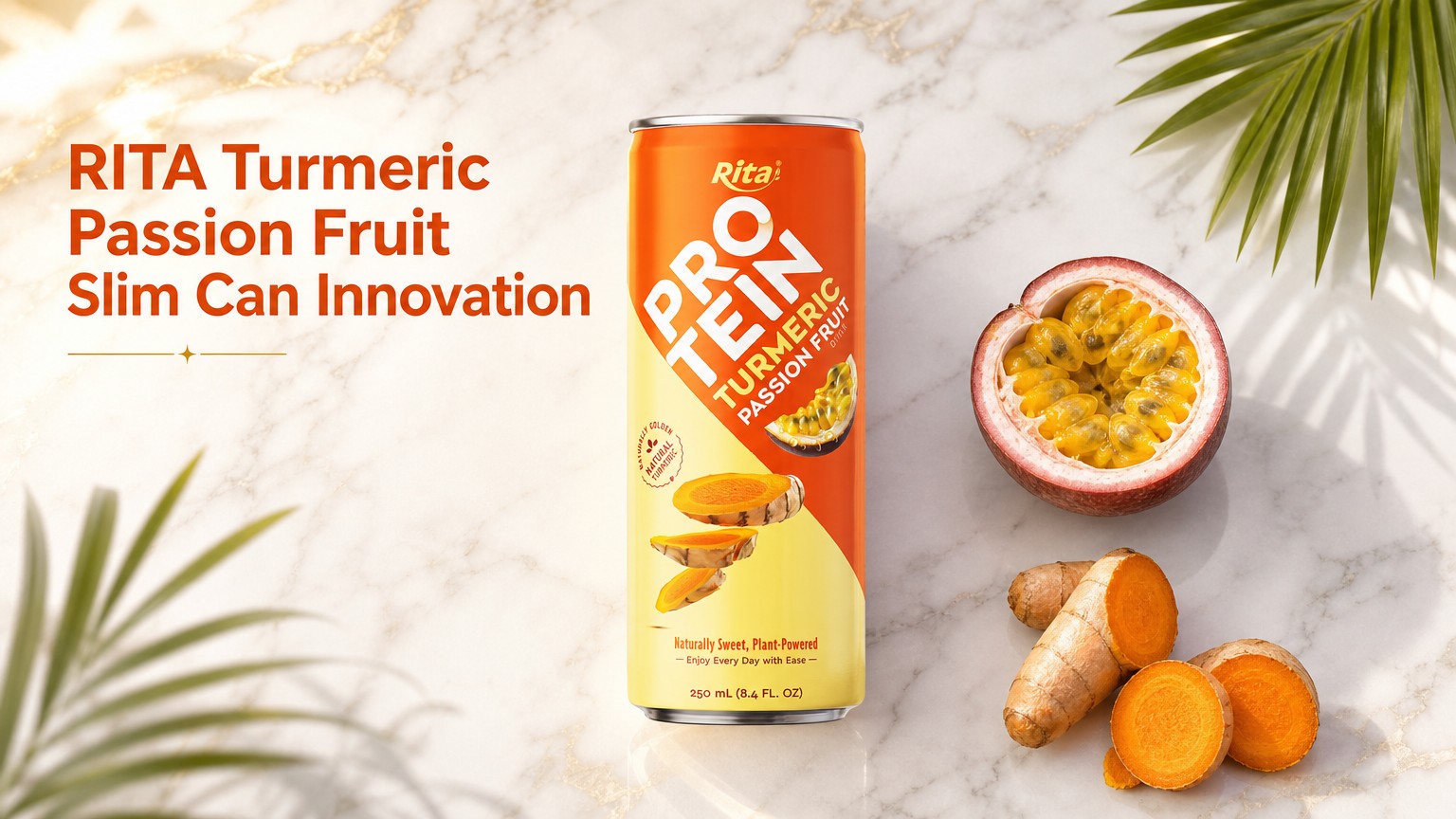
The 250ml RITA Turmeric Passion Fruit Drink enters the market at a point when ready-to-drink innovation is being judged less by the volume of on-pack promises and more by formulation discipline, packaging efficiency and export readiness. Produced by RITA Food and Drink Co., Ltd, a Vietnamese OEM and ODM beverage manufacturer founded in 2004, the drink combines ten percent real passion fruit juice with natural turmeric extract and monk fruit sweetener, and is offered in two variants, Original and Protein, that address different shopper missions inside a single visual shelf block. For buyers across Asia, the launch reads as a compact case study in how tropical flavor, low-sugar formulation and slim-can logistics are converging.
Key Takeaways
- Two variants, Original and Protein, share one 250ml aluminium slim can format and one diagonal orange-yellow label system.
- Ten percent real passion fruit juice, natural turmeric extract and monk fruit sweetener define the low-sugar formulation of the 250ml RITA Turmeric Passion Fruit Drink.
- The Protein variant adds three percent plant-based protein, addressing demand for a convenient plant protein beverage in a tropical flavor profile.
- RITA operates more than 50 automated lines, ships over 1,200 containers a month and exports to more than 200 countries under BRC, FSSC 22000, Halal Jakim, ISO, GMP and HACCP certifications.
- Private label partners can adjust formulation, sweetness level and label artwork through RITA’s OEM and ODM service programs.
Formulation Precision Is Redefining Ready-to-Drink Beverages
Low-sugar formulation has moved from a niche position to a baseline expectation across modern beverage aisles.
Across Southeast Asia, covering Thailand, Indonesia, the Philippines, Malaysia, Vietnam and Singapore, and extending into East Asia and South Asia, buyers are screening incoming drinks on ingredient declarations rather than front-of-pack claims alone. Sweetener choice, juice percentage and the absence of artificial colors or preservatives increasingly decide whether a sample survives a first retail review. That screening pressure is exactly where the 250ml RITA Turmeric Passion Fruit Drink positions itself, using monk fruit sweetener instead of cane sugar and ten percent real passion fruit juice as the flavor base for a low-sugar profile that still tastes complete.
Sweetness Recalibrated
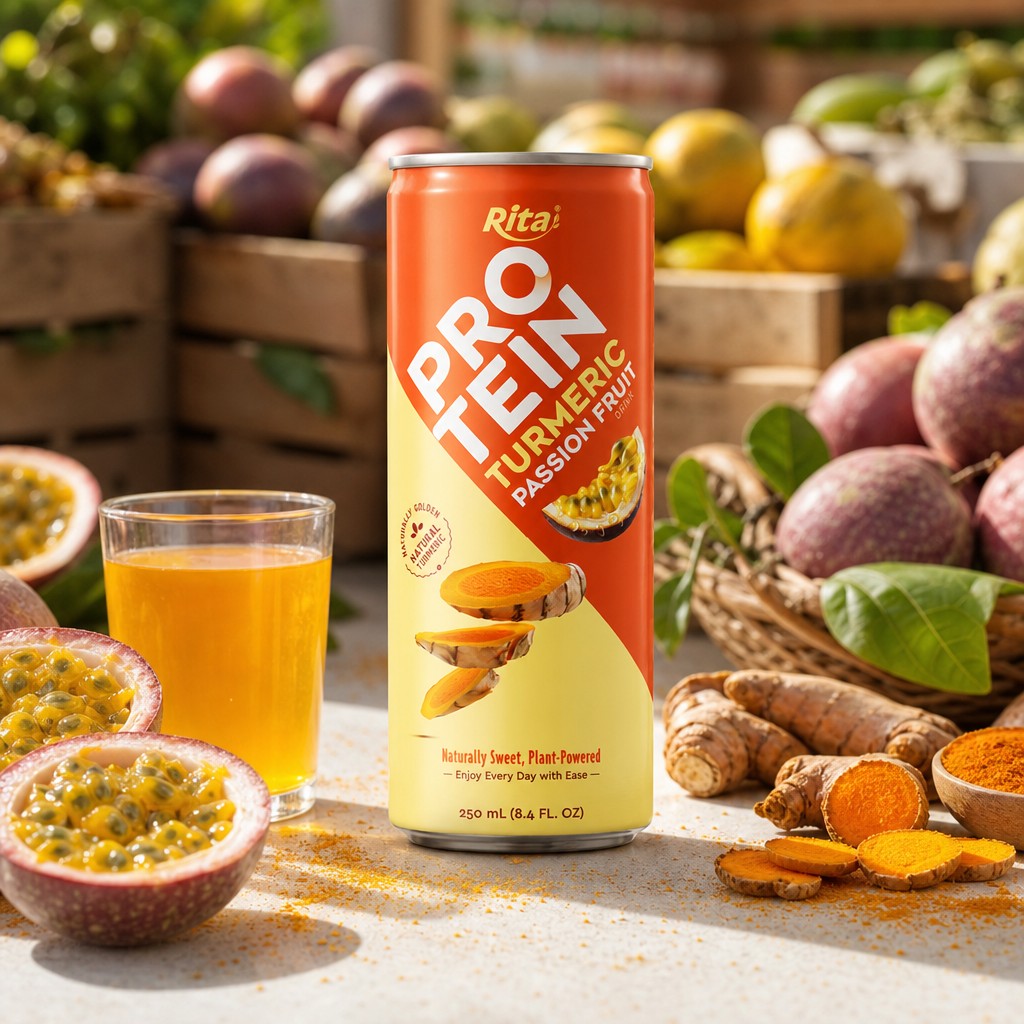
Monk fruit sweetener has become a practical answer to the low-sugar brief because it lets formulators hold a target Brix level without leaning on syrup density. RITA states that the drink is pH-balanced and calibrated to a specific Brix for a refreshing mouthfeel and stability throughout distribution, a technical detail that matters when a pallet moves through tropical warehouses before reaching a cooler. The sensory result reads as naturally sweet rather than thin, which is the profile most tropical fruit juice beverage buyers request in comparative tastings.
Tropical Flavor as a Shared Language
Passion fruit and turmeric form an unusual but increasingly legible pairing for shoppers. The passion fruit supplies brightness and tang, while turmeric contributes warm, earthy depth and a golden color derived from the plant material itself rather than from added coloring. For a distributor building a tropical range, that combination offers a recognizable flavor story that crosses language barriers, from convenience shelves in Jakarta to vending coolers in Tokyo and modern trade aisles in Mumbai.
The 250ml RITA Turmeric Passion Fruit Drink in Two Variants
One recipe direction, two shopper missions, and that is the logic behind the Original and Protein split.
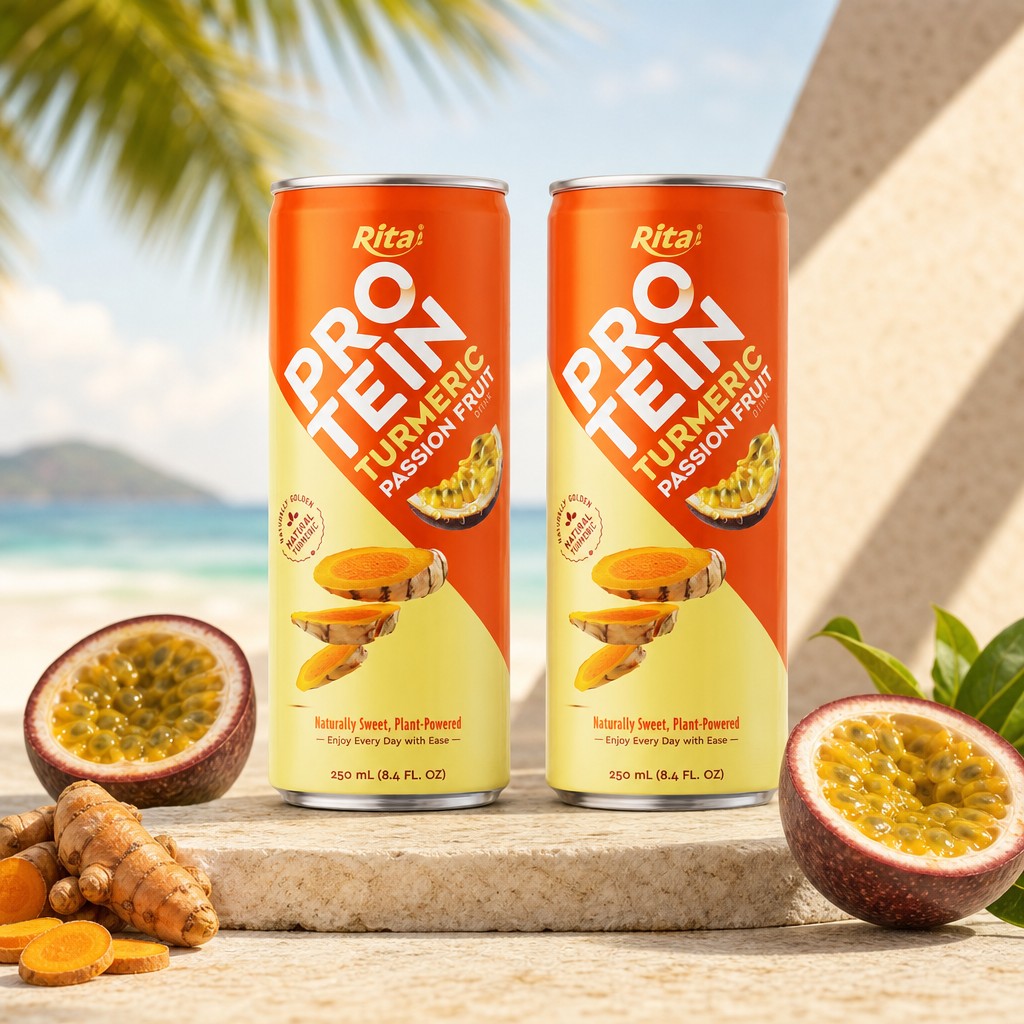
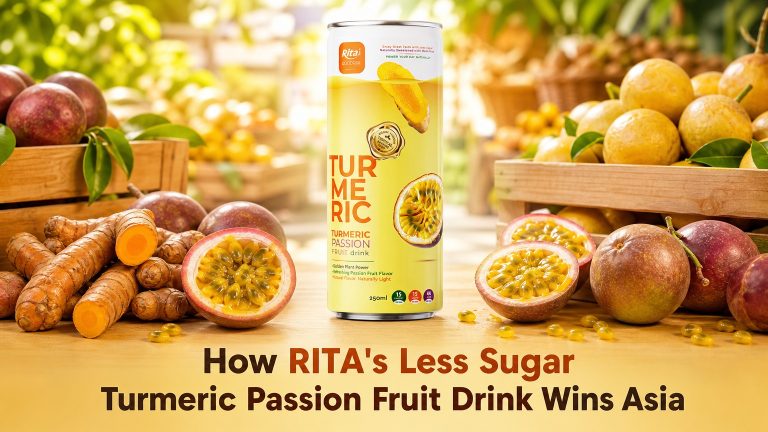
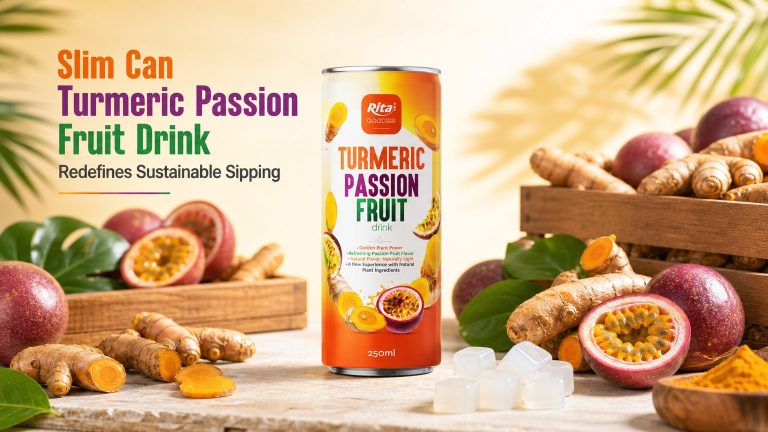
The 250ml RITA Turmeric Passion Fruit Drink in Original and Protein variants shares the same slim can body and the same diagonal orange-yellow label split, so the two SKUs read as a family on shelf while still signaling different occasions. The label artwork carries halved passion fruit with visible pulp and seeds beside sliced turmeric root, a circular badge reading ‘Naturally Golden, Natural Turmeric’, and the tagline ‘Naturally Sweet, Plant-Powered’. The Protein variant adds large diagonal PROTEIN lettering so differentiation is legible from two meters away. RITA’s wider fruit juice products catalog covers the broader tropical range from which this flavor platform is drawn.
Original and Protein at a Glance
| Attribute | Original | Protein |
|---|---|---|
| Format | 250ml aluminium slim can | 250ml aluminium slim can |
| Passion fruit juice | 10 percent | 10 percent |
| Turmeric | Natural extract | Natural extract |
| Sweetener | Monk fruit | Monk fruit |
| Plant-based protein | Not declared | 3 percent |
| Shelf message | Naturally Sweet, Plant-Powered | Plant protein with tropical flavor |
- Sealed 250ml aluminium slim can, 8.4 fluid ounces, lightweight for freight and rigid for stacking.
- No artificial flavors, colors or preservatives in the formulation.
- pH-balanced liquid calibrated to a defined Brix level for a consistent mouthfeel.
- Compact diameter suited to lunch bags, gym kits, retail coolers and vending machines.
- Two-SKU shelf block that lets a retailer merchandise an everyday drink and a protein-oriented drink side by side.
Packaging Built for Distribution
The 250ml aluminium slim can is a deliberate export choice: light enough to reduce freight cost per unit, rigid enough for pallet stacking, and a barrier that protects flavor through long transit legs. Its compact footprint fits contested facings without demanding shelf width, which helps in stores where every centimeter is negotiated. Because the product is sealed and shelf-stable, the drink arrives with the profile it left production with, whether the shipment lands in Bangkok, Osaka or Karachi.
From Our Orchards, Raw Material Sourcing
Flavor credibility starts with the fruit itself.
Passion fruit is the flavor anchor of this drink, and RITA’s sourcing visits to passion fruit gardens in Vietnam’s Central Highlands illustrate how harvest timing, pulp ratio and natural brix at picking influence the finished profile. Turmeric root, selected for its warm earthy character and golden interior, is handled as a natural extract rather than a powdered colorant, which keeps the ingredient declaration short and readable for import reviewers.
A closer look at the sourcing journey behind the flavor: https://www.youtube.com/watch?v=HjYZTn8BZL4
Export Readiness and Market Positioning
Aluminium slim cans are favored by exporters for one straightforward reason, they survive distance.
The formulation sits comfortably inside RITA’s soft drinks portfolio, giving buyers who already distribute the company’s ranges a familiar commercial route to add a differentiated SKU. Bulk ordering logic is supported by more than 50 automated production lines and monthly shipments exceeding 1,200 containers, which allows replenishment to be planned against forecast rather than against spot availability. Certification coverage including BRC, FSSC 22000, Halal Jakim, Halal HCA-GCC, Kosher, ISO, GMP, HACCP and SMEMA shortens the documentation trail for tenders and retail listings.
Aluminium Slim Can as an Export Asset
For a RITA OEM beverage manufacturer supplying more than 200 countries and territories, the slim can format solves three recurring export problems at once: weight, integrity and shelf presence. Weight affects container math, integrity affects claims and returns, and shelf presence decides whether a first listing gets a reorder. A golden-colored drink with a diagonal label split and a compact body addresses all three without requiring a redesign for each destination market, which is a meaningful advantage for private label partners managing multiple banners across regions.
Industry Signals Worth Watching
Recent beverage headlines underline how quickly the competitive picture shifts.
The National Alcohol Beverage Control Association reported a notable rise in United States spirits sales around Labor Day, a reminder that occasion-driven spikes still anchor traditional categories even as everyday drinking patterns fragment. Meanwhile, non-alcoholic beer brand RationAle has formed a partnership with LA Libations, evidence that no- and low-alcohol concepts continue to attract distribution muscle rather than staying in artisanal niches.
Data security also landed on the industry agenda when a website breach exposed customer records at Yakult Honsha. For beverage companies building direct-to-consumer subscriptions or loyalty programs, the incident is a prompt to review how customer data is stored and shared with third-party platforms, particularly as digital retail grows across Asian markets.
On the balance sheet side, Tilray is pursuing additional cost cuts for its United States beverage business, while Campari’s chief executive expressed confidence in the company’s domestic strategy, stating ‘We know what we need to do.’ The contrast captures the current mood: margin discipline on one side, disciplined investment on the other, with both approaches converging on the same requirement, portfolios that justify their shelf space through clear positioning rather than promotional volume alone.
OEM and Private Label Pathways with RITA
For buyers who want the formulation but their own brand, the route is already documented.
The 250ml RITA Turmeric Passion Fruit Drink product page is the reference point for specifications, variant details and packaging notes, while RITA’s OEM service program explains how a partner briefs a target sweetness level, approves a sample, and locks label artwork ahead of the first production run. Founded in 2004, the company supplies brands in more than 180 countries from a platform of over 50 automated lines, with research and development support for flavor adjustment, sweetness recalibration and format changes across cans, glass bottles, PET and PP.
- Formulation flexibility, juice percentage, sweetener system and protein level can be tuned to a target price architecture.
- Format range, aluminium slim cans, glass bottles, PET and PP containers for different retail environments.
- Certification stack, BRC, FSSC 22000, Halal Jakim, Halal HCA-GCC, Kosher, ISO, GMP, HACCP and SMETA for multi-market listing requirements.
- Export infrastructure, more than 1,200 containers shipped monthly to over 200 countries and territories.
That combination is why a low-sugar tropical drink in a 250ml slim can travels well commercially as well as physically. It gives a distributor a trend-aligned story, a retailer a two-SKU block, and a private label owner a formulation that already clears the documentation tests most importers apply.
Frequently Asked Questions
What is the 250ml RITA Turmeric Passion Fruit Drink?
It is a 250ml aluminium slim can beverage that combines ten percent real passion fruit juice with natural turmeric extract and monk fruit sweetener, produced by RITA Food and Drink Co., Ltd and offered in Original and Protein variants.
What is the difference between the Original and Protein variants?
The Original variant is positioned as an everyday refresher under the tagline ‘Naturally Sweet, Plant-Powered’, while the Protein variant adds three percent plant-based protein for shoppers seeking a convenient plant protein beverage with tropical flavor.
What sweetener is used in the drink?
Monk fruit sweetener is used to deliver a naturally sweet taste without added sugars, and the formulation contains no artificial flavors, colors or preservatives.
Can the drink be produced under private label or OEM?
Yes. RITA operates OEM and ODM programs with flexible formulation options and label artwork customization, supported by BRC, FSSC 22000, Halal Jakim, Halal HCA-GCC, Kosher, ISO, GMP, HACCP and SMETA certifications.
How is the product prepared for long-distance export?
The sealed aluminium slim can is lightweight and shelf-stable, and RITA ships more than 1,200 containers monthly to over 200 countries and territories, keeping flavor consistent through long transit legs.