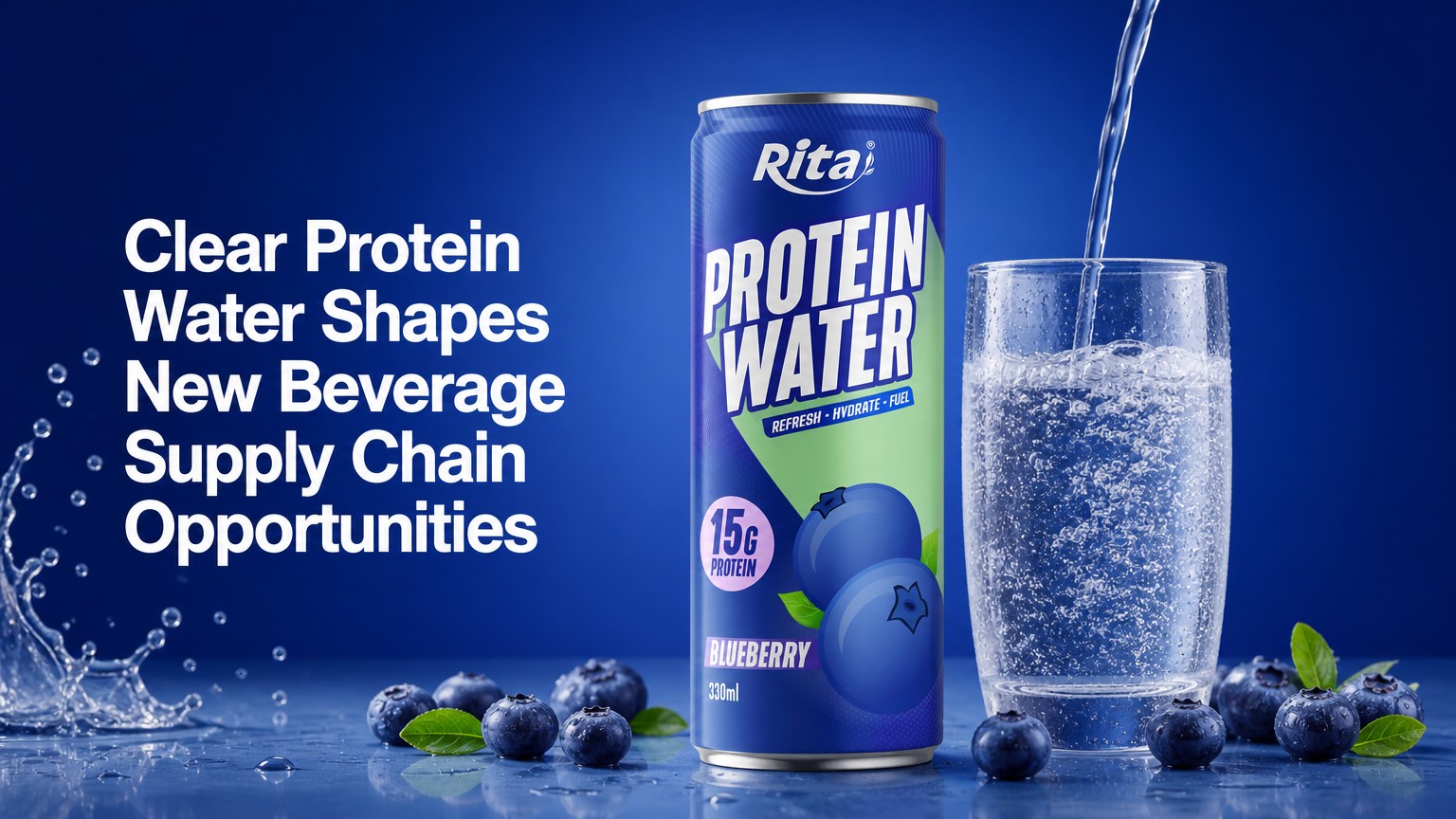
The functional beverage market across Asia is entering a new chapter, and protein water is one of the fastest-moving categories inside it. What began as a niche supplement format has matured into a mainstream retail product, sold in convenience stores, gyms, supermarkets, and online marketplaces from Bangkok to Jakarta to Singapore to Mumbai. The appeal is straightforward: a light, drinkable format that slots into daily routines without the texture, mixing, or preparation associated with traditional powder-based products. For beverage brands and distributors, that shift carries a second implication that extends well beyond consumer preference — it has changed the supply chain requirements behind the category.
Clear protein formats demand different ingredients, different filling tolerances, different packaging choices, and different quality documentation than the opaque protein beverages that came before them. Brands sourcing from overseas manufacturers now evaluate suppliers on how well those requirements are met: clarity stability, flavor consistency, cold-chain independence, certification coverage, and the ability to produce at scale without compromising the visual character of the liquid. Against that backdrop, manufacturers with mature export infrastructure are gaining ground with buyers across the region.
Key Takeaways
- Clear protein water is moving from category experiment to retail staple across Southeast Asia, East Asia, and South Asia, supported by convenience-store expansion and online retail growth.
- RITA’s 15G protein RITA protein water with blueberry delivers 15 grams of protein per 330ml aluminum can, with a Brix of 10.6 and a pH of 4.1.
- Clear pea protein enables a translucent appearance and smooth mouthfeel, separating the format from opaque shakes on the shelf.
- Manufacturing scale, BRC and FSSC 22000 certification, Halal and Kosher coverage, and a shelf life of up to 24 months make the format commercially viable for private label and distribution partners.
- Supply chain reliability, packaging versatility, and multi-format production capacity are becoming decisive factors in export sourcing decisions across the continent.
Clear Protein Water Moves From Category Experiment to Retail Staple
Across Asia, clear protein water has quietly shifted from a novelty shelf item into a category with real distribution depth. In Singapore and Japan, where functional beverages occupy premium convenience-store space, clear formats are now positioned alongside ready-to-drink coffee and tea rather than in the supplement aisle. In Thailand and the Philippines, they appear in gyms, pharmacies, and modern trade stores. Indonesia and Malaysia show a similar pattern, with local brands testing translucent formats while international suppliers scale into the same channels.
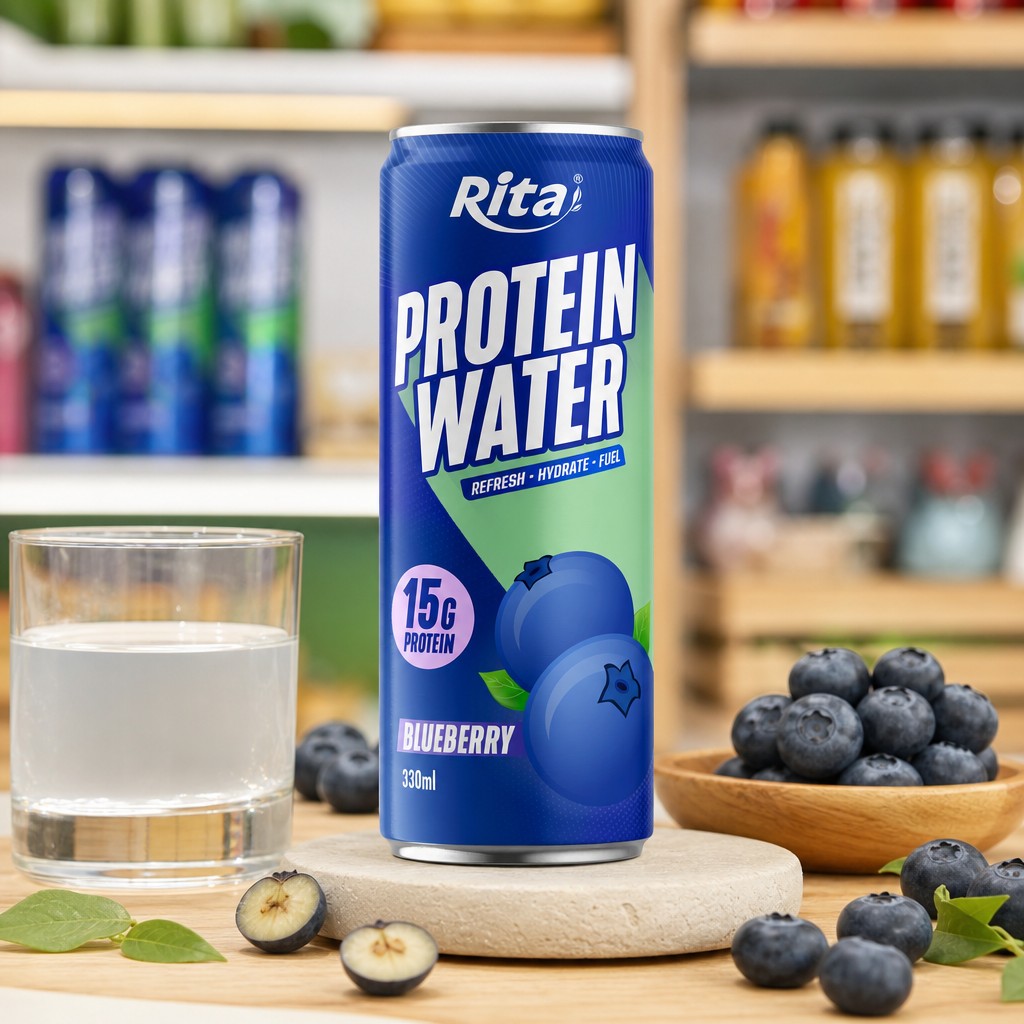
What distinguishes the format is not only its protein content but its clarity. Consumers describe the experience in consistent terms: light, refreshing, easy to finish, and visually clean. That visual dimension matters more than it might seem. A translucent liquid signals a different product category to shoppers, one closer to an isotonic sports drink than to a milk-based protein shake. Manufacturers who can deliver that translucency reliably — batch after batch, across months of storage — hold a meaningful advantage in procurement discussions.
Flavor Engineering and the Blueberry Profile
Flavor remains the primary point of differentiation in a crowded category. RITA’s blueberry variant, part of the company’s 15G protein RITA protein water with blueberry, is formulated around a balance that buyers have come to expect from clear formats: a Brix of 10.6 for moderate sweetness, and a pH of 4.1 that supports a crisp, fruit-forward finish without heaviness. The blueberry profile is crafted to read as fresh and berry-forward rather than syrupy, a balance that has proven easier to replicate at industrial scale than darker, more complex fruit notes.
Across the wider Asian market, berry-forward profiles have expanded their reach over the past several years, helped by imported blueberry consumption rising steadily in East Asia and by the growing availability of freeze-dried and concentrate ingredients used in beverage formulation. For manufacturers, the practical question is not whether blueberry resonates with consumers — the evidence suggests it does — but whether a supplier can source consistent raw materials, hold the color and flavor through shelf life, and adjust sweetness levels to suit different national taste preferences without reformulating from scratch.
Product Architecture and Technical Specification
Buyers evaluating a clear protein beverage rarely stop at flavor. They move quickly to formulation details, filling characteristics, and packaging performance. RITA’s blueberry protein water is built around clear pea protein, which gives the liquid its characteristic translucent appearance while delivering a smooth, non-opaque mouthfeel that avoids the chalkiness associated with some protein formulations. The drink is filled in a 330ml aluminum can — a format that has gained strong traction across Asian convenience retail for its durability, portability, and shelf-appeal.
| Specification | Detail |
|---|---|
| Product name | RITA Blueberry Protein Water |
| Volume | 330 ml |
| Packaging | Aluminum can |
| Protein per serving | 15 grams |
| Protein source | Clear pea protein |
| Brix | 10.6 |
| pH | 4.1 |
| Shelf life | Up to 24 months |
| Key certifications | BRC, FSSC 22000, Halal Jakim, Halal HCA-GCC, Kosher, ISO, GMP, HACCP |
The formulation deliberately avoids artificial flavors, colors, and preservatives — a positioning choice that has become increasingly standard in the category as buyers in regional markets tighten their ingredient lists. For procurement teams, the practical benefit is predictable: a simpler declaration list simplifies import registration in countries with strict additive rules, and fewer declared additives tend to reduce the documentation burden during market entry.
Shelf life is another specification that carries disproportionate commercial weight. A 24-month shelf life on a canned clear protein beverage means inventory can be held across long ocean freight cycles and regional distribution buffers without formulation risk. For distributors operating across multiple Southeast Asian markets with different replenishment rhythms, that stability translates directly into fewer write-offs and more flexible merchandising.
Manufacturing Scale as a Supply Chain Advantage
Manufacturing capability, rather than formulation alone, increasingly decides which suppliers win regional tenders. RITA Food & Drink Co., Ltd., the Vietnamese OEM and ODM beverage manufacturer established in 2004, operates more than 50 automated production lines and exports over 1,200 containers monthly to buyers across the globe. The company’s export footprint spans more than 200 countries and territories, giving it a distribution base that few regional competitors can match in breadth.
That scale matters for a specific reason. Clear protein beverages are sensitive to process control — fill temperature, protein dispersion, carbonation or lack thereof, and canning tolerances all affect the visual result the consumer sees. Automated lines with consistent monitoring reduce the batch-to-batch variation that plagues smaller producers, and they allow large orders to be fulfilled without the schedule volatility that disrupts retail launches. Brands entering new Asian markets, where launch windows are tight and shelf resets are frequent, tend to weight this reliability heavily.
For buyers exploring manufacturing partnerships, the company’s OEM beverage manufacturing service covers formulation support, packaging development, and export documentation, while its broader corporate profile — the full RITA corporate overview — details the R&D capacity and certification infrastructure behind that output. The combination of technical formulation work and export logistics is what distinguishes a supplier from a factory.
Certification Coverage and Regulatory Readiness
Regulatory alignment is where many international sourcing decisions are won or lost. RITA’s blueberry protein water is produced under ISO, GMP, and HACCP frameworks, with BRC and FSSC 22000 certification providing the additional traceability documentation that buyers in regulated markets increasingly request. The product is also Halal certified under both Jakim and HCA-GCC schemes and carries Kosher certification, a combination that broadens its accessibility across the Asia-Pacific consumer base considerably.
This multi-scheme coverage is not an incidental detail. Halal certification remains a practical requirement for large retail groups in Indonesia and Malaysia, and for distributors serving Muslim-majority populations across South Asia. Kosher certification supports access to premium retail channels in Japan, South Korea, and parts of Southeast Asia. Having both on the same SKU reduces the number of separate production runs and audits a supplier must manage, which in turn shortens lead times for buyers.
The certification stack also extends to packaging and raw material traceability — areas that buyers scrutinize closely when a product is imported for the first time. Documentation of can linings, protein source traceability, and batch-level records has become a routine part of supplier qualification, and manufacturers who maintain audit-ready records tend to move through that qualification process faster.
Packaging, Shelf Life, and the Logistics Case
Supply chain efficiency for canned beverages across Asia rests on a few unglamorous factors: can integrity under tropical storage conditions, resistance to label scuffing during containerization, and shelf life long enough to absorb port congestion or seasonal demand swings. The 330ml aluminum format used for the blueberry protein water addresses each of these. Aluminum cans are lightweight relative to their volume, stack efficiently in pallets, and tolerate the temperature fluctuations common in Southeast Asian distribution networks far better than glass alternatives.
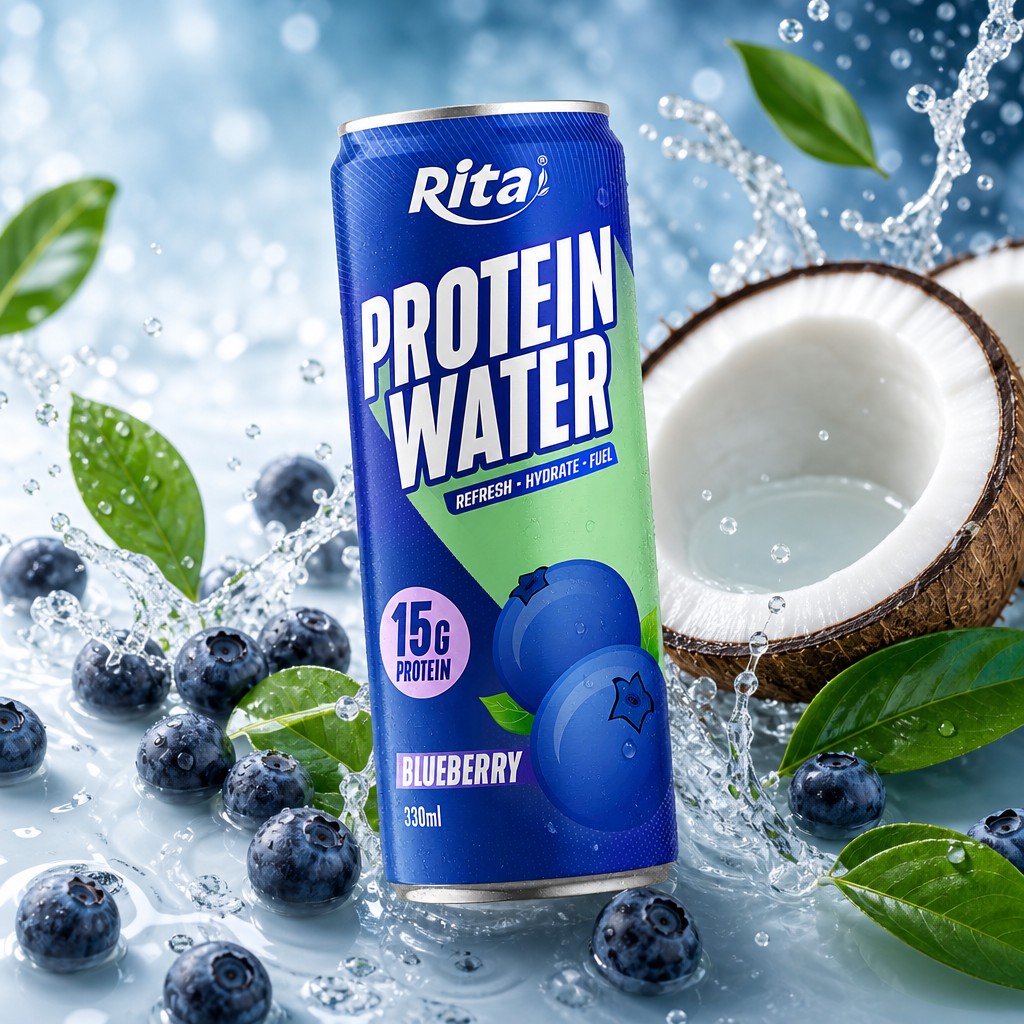
The shelf life deserves particular attention from a logistics standpoint. Ocean freight from Vietnam to Singapore, Malaysia, and the Philippines typically consumes between five and twelve days, but inland distribution, warehouse dwell time, and retail rotation cycles can add months to the effective shelf life a product consumes before reaching the consumer. A 24-month formulation gives buyers room to plan seasonal allocations, promotional cycles, and multi-market rollouts without aggressive inventory discounting.
For distributors evaluating whether to bring a clear protein format into a new market, that combination — durable packaging, long shelf life, and a category with expanding retail presence — reduces the practical risk of the decision. The commercial question narrows to channel strategy and pricing, rather than to whether the product will survive the journey.
Private Label and Distribution Opportunities
The clear protein water category has developed a strong private label segment, particularly in markets where retail chains operate their own functional beverage ranges. RITA’s private label capabilities are positioned for exactly this demand: formulation customization, flavor adaptation to local preferences, packaging design support, and export-ready documentation handled within the same manufacturing framework. The product page for the blueberry protein water details the specification set, which serves as a reference for buyers considering co-branded or retailer-exclusive variants.
Independent distributors, meanwhile, have a different set of priorities: consistent supply volume, transparent pricing structures, and the ability to expand the SKU range without renegotiating manufacturing relationships from scratch. A supplier that already produces clear protein beverages alongside coconut products, fruit juices, functional drinks, and energy beverages gives distributors room to grow a portfolio rather than a single line item. That breadth has become a competitive differentiator in its own right as retail buyers consolidate their vendor lists.
The regional market context reinforces the opportunity. Across Southeast Asia, convenience store density continues to rise, functional beverage shelf space is being actively redefined, and consumer willingness to trial imported canned formats is at its highest point in the category’s history. East Asian markets remain the reference point for premium functional beverage presentation, while South Asian markets represent the fastest-growing volume base. A manufacturer that can serve all three with the same quality documentation and packaging standards is positioned at a structural advantage.
What Buyers Should Evaluate Next
For procurement teams and distributors considering a clear protein water entry, the evaluation criteria have become increasingly specific. Buyers are looking beyond flavor samples and unit cost, and examining how a supplier handles clarity stability over shelf life, how certifications cover the target markets in question, and whether production capacity can absorb a regional rollout without schedule risk. Those are supply chain questions as much as they are product questions.
The blueberry protein water from RITA offers a clear reference point for what that standard looks like in practice: a defined specification set, a transparent formulation approach, multi-scheme certification coverage, and manufacturing infrastructure built for export at volume. Whether it becomes the foundation of a new retail line or the addition to an existing functional beverage portfolio, it illustrates how the category has matured — from a formulation experiment into a supply chain-ready product line.
Frequently Asked Questions
What is RITA Blueberry Protein Water?
RITA Blueberry Protein Water is a clear functional beverage produced by RITA Food & Drink Co., Ltd. It delivers 15 grams of protein per 330ml aluminum can, using clear pea protein to achieve a translucent appearance, with a Brix of 10.6 and pH of 4.1.
What certifications cover RITA Blueberry Protein Water?
The product is manufactured under ISO, GMP, and HACCP standards and holds BRC and FSSC 22000 certification, along with Halal Jakim, Halal HCA-GCC, and Kosher certifications, supporting distribution across a wide range of markets.
What packaging is used for the blueberry protein water?
The product is filled in a 330ml aluminum can, which offers durability, portability, and shelf stability for distribution across tropical and high-humidity markets in Asia.
Is the product available for private label manufacturing?
Yes. RITA provides OEM and ODM beverage manufacturing services, including formulation customization, packaging development, and export documentation, supporting private label and distributor programs across more than 200 countries and territories.
What is the shelf life of the product?
The beverage carries a shelf life of up to 24 months, supporting long ocean freight cycles, regional distribution buffers, and extended retail rotation.