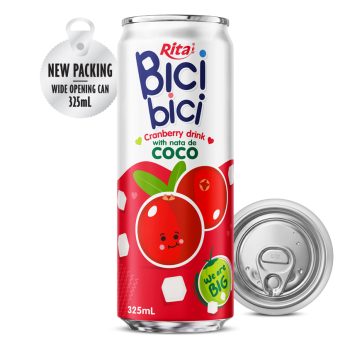
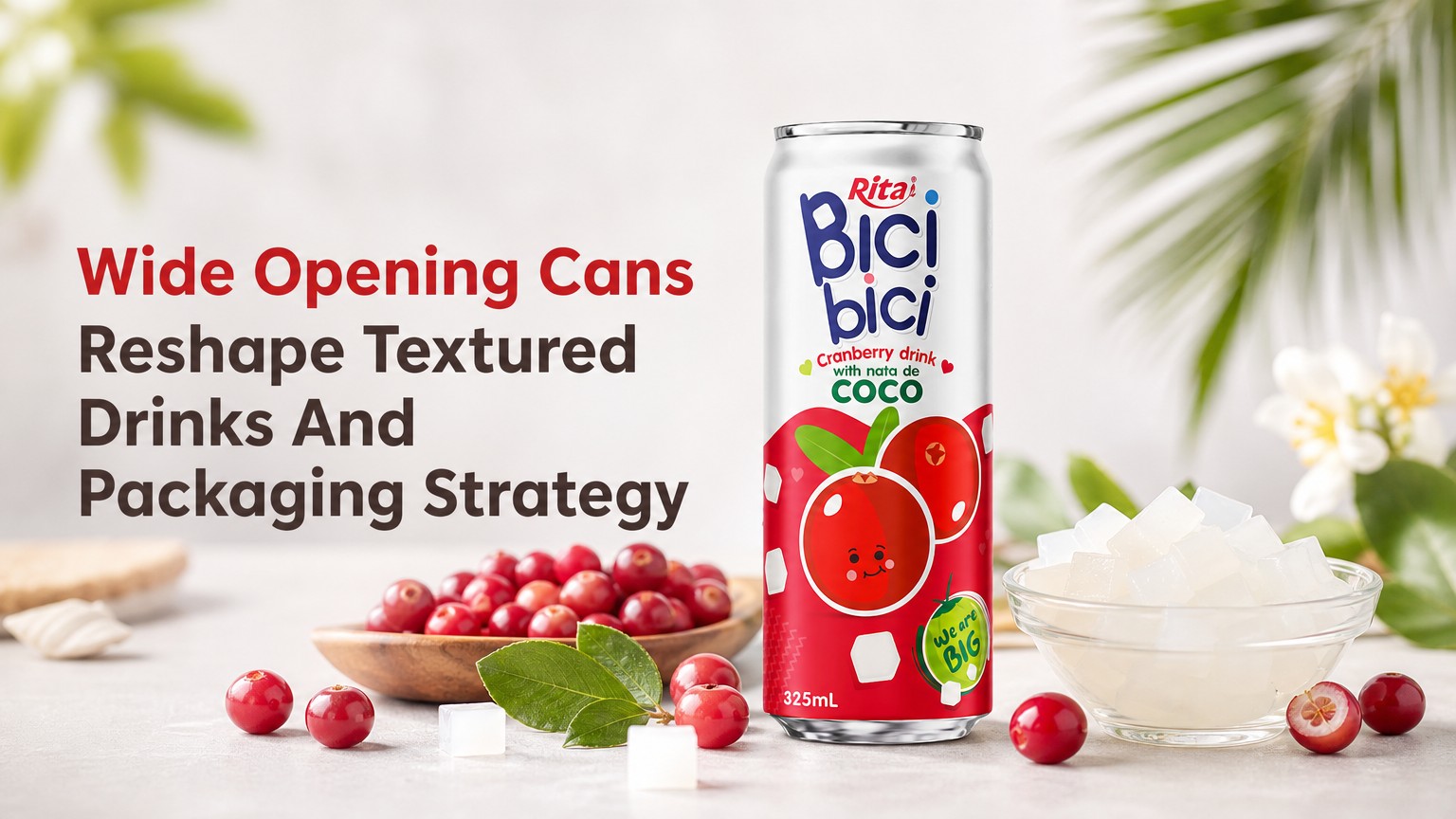
As the global beverage industry searches for ways to cut packaging waste and create more engaging consumer experiences, one small but meaningful shift has begun to draw attention on export order books. A cranberry drink with nata de coco produced by Vietnamese manufacturer RITA, packaged in a 325ml wide opening can, is emerging as a case study in how packaging design can serve commercial and sustainability goals at the same time, while addressing the texture-driven preferences that define the modern drinks market.
Key Takeaways
- The wide opening can turns a standard beverage container into a reusable drinking cup, reducing packaging complexity while improving the consumption experience.
- Textured fruit drinks featuring nata de coco are moving from novelty to mainstream shelf listings across high-growth import markets.
- Aluminium remains one of the most widely recycled beverage packaging formats, supporting category-wide sustainability positioning.
- RITA’s OEM and private label capability allows buyers to adjust sweetness, flavour intensity, nata de coco cube size and artwork for specific markets.
- Regulatory pressure on packaging and claims, seen across the broader drinks industry, is accelerating interest in simpler, verifiable formulations.
Textured Drinks Are Winning Space Across Fast-Growing Asian Markets
The textured beverage segment has become one of the most watched categories in the drinks trade, and the pull is clearest across Asia, where importers and distributors in Southeast Asia, East Asia and South Asia report consistent demand for drinks that offer more than liquid alone. Consumers are increasingly selecting beverages based on mouthfeel and in-can experience, and distributors are responding by expanding shelf space for formats that deliver both.
Cranberry-based formulations sit comfortably within this trend. The tartness of cranberry juice pairs with the soft, chewy texture of nata de coco to create a balanced drinking experience that appeals across age groups, without requiring heavy sweetening or artificial flavouring. That combination is proving attractive to buyers who want a drink that stands out on shelf while still reading as straightforward and transparent on the label.
RITA Food and Drink Co., Ltd. has been supplying this kind of export-ready formulation for two decades. Established in 2004, the company operates more than 50 automated production lines and exports to over 200 countries and territories, with monthly shipping volumes measured in hundreds of containers. Its fruit juice product catalogue covers tropical juices, mixed-fruit blends and texture-forward drinks, giving buyers a wide surface for assortment planning.
What matters for importers, however, is not only the flavour but the format in which it travels. Aluminium cans with easy-open lids, PET bottles and aseptic cartons all compete for the same shelf position, and the packaging decision increasingly determines whether a drink gets tried, repurchased or left behind.
Inside The Wide Opening Can Design
The defining feature of this pack is its wide opening can, which changes the relationship between the consumer and the drink in a way that narrow-opening cans simply cannot.
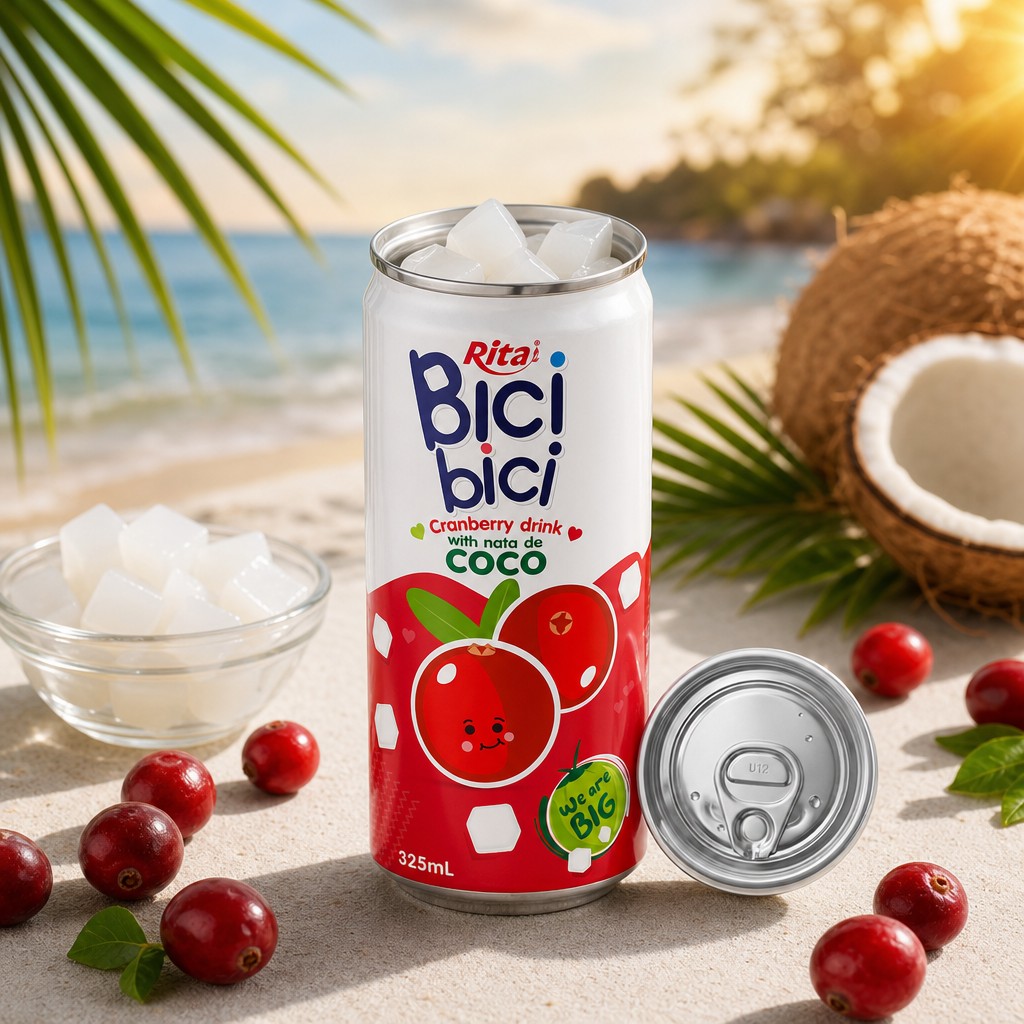
The fully removable lid transforms the container into a convenient drinking cup, giving direct access to the large nata de coco cubes inside rather than filtering them through a small aperture. The packaging carries the slogan “We are BIG”, highlighting the generous size of the coconut pieces, and the label artwork features smiling cartoon cranberries against white and red tones with green accents — a design built to catch attention at a glance on crowded retail shelves.
What Changes When The Lid Comes Off
From a product experience standpoint, the fully openable lid solves a practical complaint that has followed nata de coco drinks for years. Conventional narrow-opening cans restrict flow, leave pieces trapped at the bottom and force consumers to tilt, shake or crush the can to reach them. The wide opening removes that friction entirely and allows the drink to be consumed more evenly from start to finish, which in turn supports better taste consistency in every sip.
For retailers, the format also supports secondary usage occasions. The openable can can function as a cup after drinking, which is useful in food courts, convenience stores and on-the-go consumption settings where consumers are not carrying reusable drinkware. That small detail extends the product’s usefulness beyond the moment of purchase.
Why Cube Size Is A Commercial Decision
Nata de coco cube dimensions are not merely an aesthetic question. Larger pieces create a more premium impression and are easier to eat with the wide opening format, while smaller pieces distribute more evenly through the drink and suit straw-based consumption. RITA’s private label programme lets buyers specify cube size, sweetness level and flavour intensity to match local preferences in individual markets rather than applying a single global specification everywhere.
That flexibility is a meaningful advantage in markets where texture expectations differ widely between countries and even between regions within the same country. The company’s own range of coconut products demonstrates the breadth of nata de coco formats available for export, from standard cubes to specialty cuts designed for specific drinking occasions.
Ingredient Sourcing And What Transparency Means In Practice
Behind every textured drink is a supply chain that buyers are under growing pressure to understand, and the story of where each ingredient comes from has become part of the value proposition rather than background detail.
The cranberry component of the formulation is sourced as a concentrate from established global suppliers, reflecting the fact that cranberry cultivation is concentrated in a small number of producing regions far from Vietnam’s tropical agriculture base. Buyers working with RITA can trace the documentation behind this sourcing and confirm it against the specifications declared in their own market.
The Coconut Link
The nata de coco ingredient follows a different path. It is derived from coconut water and coconut milk, and Vietnam’s coconut belt remains one of the most dependable raw material regions in the country. RITA’s relationship with the Ben Tre coconut growing region has been a recurring part of the company’s sourcing narrative, with Ben Tre’s long-standing coconut production tradition providing consistent raw material quality season after season.
Visits to the region make the sourcing chain visible to partner brands and buyers, who can see the distance between plantation and finished product being measured in months rather than years. That proximity is one reason Vietnamese coconut-based beverages have been able to scale export volumes without a corresponding drop in ingredient consistency.
For a closer look at the origin of the coconut raw material used across RITA’s coconut line, this footage from the Ben Tre coconut farm shows the plantation environment and handling process directly:
Market Data And Export Outlook For Textured Fruit Drinks
Export demand for texture-forward fruit beverages has strengthened as importers across the region look to diversify beyond single-serve carbonated drinks, and the data points in this market are shaping purchasing decisions on both the formulation and packaging side.
For buyers, the relevant comparison is not only between flavours but between formats and their logistics profiles. The table below summarises how the main beverage packaging options used in the export of textured drinks compare on the attributes that typically drive the sourcing decision.
| Packaging Format | Texture Handling | Shelf Life Profile | Export Consideration |
|---|---|---|---|
| Wide opening aluminium can | Direct access to large nata de coco cubes | Extended, typically up to 24 months | Lightweight, stackable, widely recyclable |
| Standard aluminium can | Restricted by narrow aperture | Extended | Lower cost, lower differentiation |
| Transparent PET bottle | Visible texture, requires wider mouth | Typically shorter without aseptic filling | Higher volume per shipment cost |
| Aseptic carton | Limited cube presentation | Extended when filled aseptically | Preferred for ambient distribution |
Source: product specifications supplied by RITA Food and Drink Co., Ltd. and standard industry packaging classifications.
Aluminium remains the dominant format for textured canned drinks precisely because it pairs a long ambient shelf life with the mechanical properties needed for a fully removable lid — a combination that alternative materials have been slower to replicate at commercial scale.
Private Label And OEM Demand Is Accelerating
One of the clearest signals in this category is the rate at which importers are moving from sourcing finished goods to developing their own brands.
RITA Food and Drink Co., Ltd. supports that shift through a mature OEM and ODM programme built on two decades of export experience. The company produces beverages in aluminium cans, glass bottles, PET and PP bottles, and offers private label artwork development for buyers who want to enter the textured drink category without building manufacturing capability from scratch.
From a commercial standpoint, the OEM route offers several advantages that are directly relevant to sustainability positioning. Formulation adjustment happens at the point of production rather than through reformulation rounds in the buyer’s own market, which shortens development cycles and reduces trial-and-error waste. Packaging specifications can be aligned to the target market’s recycling infrastructure and retail requirements at the point of manufacture rather than retrofitted later.
For buyers who want to understand the full scope of private label possibilities, the OEM service programme covers flavour development, packaging selection and label design, while the ODM side adds formulation support for brands entering the category for the first time.
The practical advantage for a buyer entering the textured fruit drinks space is the ability to control three variables at once: flavour intensity, texture specification and pack format. The product page for the Bici Bici 325ml cranberry drink with nata de coco sets out the available specification ranges, including the 24-month shelf life and the international certification framework under which the drink is produced.
Sustainability Pressures Are Rewriting Packaging Decisions
The drinks industry’s relationship with packaging has become more consequential over the past two years, and the developments now playing out across major beverage groups are being watched closely by regional buyers and distributors.
Royal Swinkels, the Dutch beer major, is exploring non-alcoholic wine opportunities as it seeks growth beyond its core categories, a signal that portfolio diversification now happens with sustainability and consumer expectation in mind rather than as an afterthought. Danone’s investment in its Volvic benchmark site, together with its appeal against Harrogate Spring Water’s expansion plans, shows that major producers are treating water stewardship and site strategy as competitive decisions rather than compliance exercises. Molson Coors’ finalisation of production plans for the Sharp brewery reflects a similar pattern of consolidating manufacturing into sites that can meet both volume and responsibility targets. Meanwhile, the UK advertising regulator’s reprimand to Huel over health claims is a reminder that formulation and marketing are now scrutinised together.
For the textured fruit drinks segment, the most direct implication is packaging. Aluminium is one of the most consistently recycled packaging materials in global beverage markets, and its recyclability makes it a straightforward foundation for sustainability messaging that does not require additional claims or certifications to substantiate. That is a significant advantage in markets where regulatory scrutiny of environmental language is tightening.
Simpler Formulations Are Easier To Defend
The regulatory picture is pushing in a second direction as well. Drinks that are produced without artificial flavours, colours or preservatives carry a lower compliance burden in export markets, because their ingredient declarations stay short and verifiable. A cranberry juice base with nata de coco is an example of a formulation that reads clearly on a label and does not depend on functional claims to justify its existence on shelf.
That clarity matters more than it once did. As regulators in several markets tighten the rules around nutrition and wellness language, buyers are showing a stronger preference for drinks whose value is delivered through taste, texture and format rather than through extended claims. The category trend is toward products that can be described precisely, sourced transparently and recycled readily — a combination that the wide opening can and a simple two-ingredient base both support.
What Importers And Distributors Should Evaluate Before Ordering
Buyers evaluating a textured drink programme for the coming year would do well to weigh a small number of practical questions rather than a long specification sheet.
Packaging Behaviour In Real Retail Conditions
A wide opening can performs differently depending on how it is merchandised, transported and consumed. Test the pack in the target environment before committing to volume: check how the removable lid behaves in transit, whether the label remains legible after handling, and how the can sits in the shelf and in cooler conditions typical of convenience retail.
Specification Control From Supplier
Confirm that the manufacturer can vary cube size, sweetness and flavour intensity without a new production setup, and ask for the documentation trail behind raw material sourcing. RITA’s export footprint, spanning more than 200 countries and territories with certifications including BRC, FSSC 22000, Halal, Kosher, ISO, GMP, HACCP and SMETA, provides the kind of verification that importers need when a product moves from one regulatory regime to another.
Shelf Life Against Distribution Reality
A 24-month shelf life is meaningful only if the product’s shelf presence supports it. In markets where textured canned drinks move quickly, the long life is an insurance policy against slow-moving retail inventory. In markets where trial rates are still developing, buyers should model turnover before selecting between extended-life cans and shorter-life PET alternatives.
Brand Positioning And Localisation
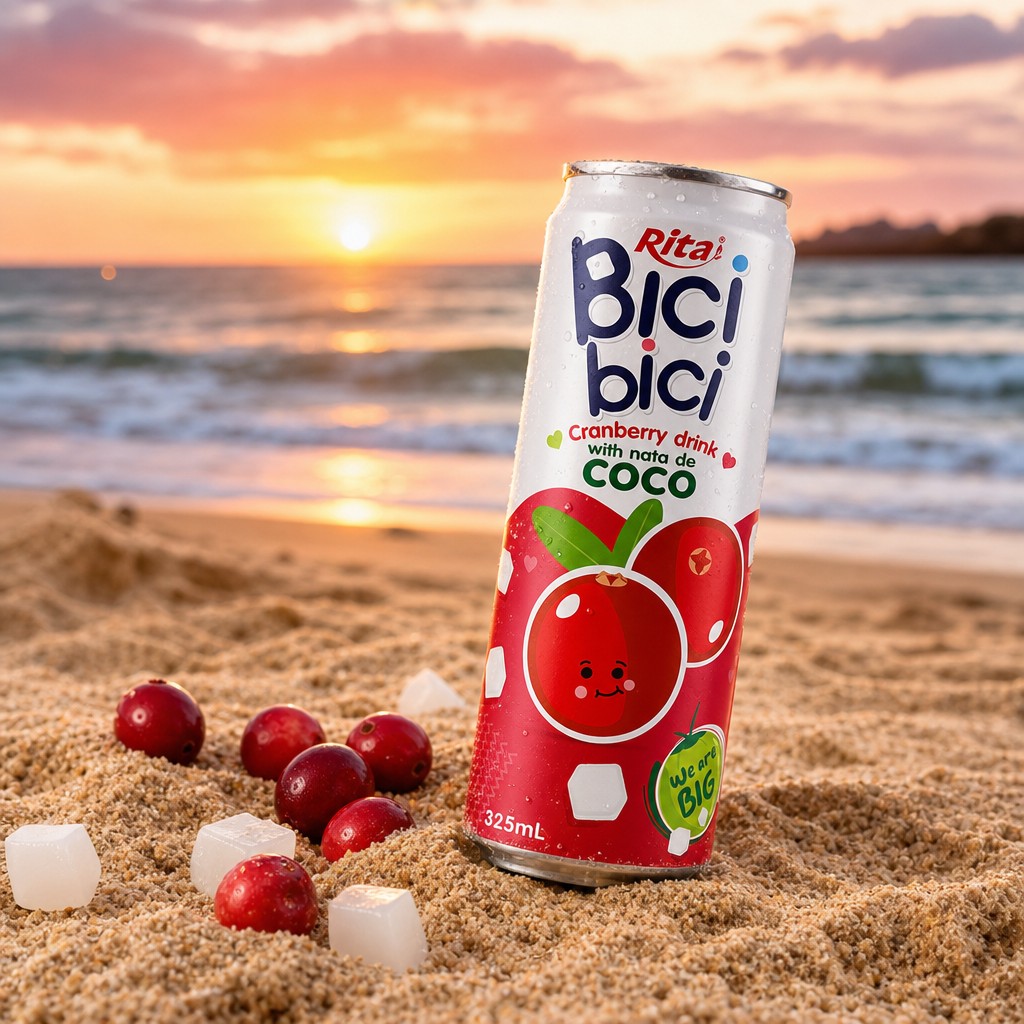
The label design — cartoon cranberries, white hexagonal motifs, the “We are BIG” badge and a predominantly white and red colour scheme with green accents — is built for immediate shelf recognition. Buyers entering a new market should ask how much of this artwork can be localised, and whether the pack format and label system can accommodate a co-branded or fully private label presentation without redesigning the core packaging.
Looking Ahead To The Next Packaging Cycle
The next phase of growth in textured fruit drinks will be defined less by new flavours than by how brands handle the packaging question. Textured drinks have already proven their appeal in Asian markets; the open issue is whether suppliers can deliver that appeal in formats that satisfy both consumer expectations and tightening environmental standards.
The wide opening can represents one of the more practical answers available today. It addresses a genuine usability problem, removes a component of packaging complexity, and relies on aluminium, a material with established recycling infrastructure. For manufacturers, it offers a differentiator that does not require new ingredients or new claims to defend. For importers and distributors, it provides a format that can be positioned around texture, convenience and material responsibility simultaneously.
RITA Food and Drink Co., Ltd.’s ability to produce this format at scale, adjust it to individual market requirements and support it with an established export and certification framework makes the Bici Bici 325ml cranberry drink with nata de coco in a wide opening can a useful reference point for buyers planning their next packaging and assortment decisions in the region.